
Radio silence, the whey shortage and more...
Hey folks!
Back in the day, before audio streaming and podcasts became our constant travel companions, there was one thing most Indians listened to on their way to work, college or just about anywhere.
The radio or FM.
But somewhere along the way, many of us stopped tuning in. And a few days ago, the consequences of that became impossible to avoid.
For context, HT Media decided to surrender licenses for operating several FM radio stations through its subsidiary Next Radio. That means Radio Nasha, Radio One and Fever FM are no more, even though their licenses still had another 5–6 years of life left.
So how did some of our favourite radio stations end up shutting down before their own licenses expired, you ask?
Well, the answer isn’t Spotify.
It’s actually three different forces that came together at the same time and slowly pushed radio into a corner.
To begin with, it all started with how FM licenses were sold in India. Back in the late 1990s and early 2000s when the government opened up the FM sector to private competition, it didn’t hand out licenses. Instead, it auctioned them off. Broadcasters bid against each other for frequencies in different cities, and the highest bidder won the right to operate a station for 10 years.
And about a decade ago, everyone wanted in. Thanks to analysts who expected the radio industry to grow at over 15% every year, driven by advertising revenue. At the time, forecasts suggested that radio’s share of the Indian media and entertainment advertising market would double to 10% of a ₹1 lakh crore industry from just 4–5%.
So naturally, broadcasters got excited, with some willing to pay license fees that translated to roughly 4% of their own revenue.
Economists have a name for what happened next: the winner’s curse. In competitive auctions, the winner is often the one who overestimates what something is worth. You win precisely because you were the most optimistic. Or, in hindsight, the most wrong.
Because then, two things happened.
First, mobile data exploded. The phones we bought either stopped coming with FM receivers altogether or came with FM chips that were never switched on.
And there’s long been a suspicion that phone manufacturers did this deliberately. Because you see, radio doesn’t need data or Wi-Fi and if FM remained easily accessible, people would have one less reason to stream music, podcasts and audio content using mobile data. And fewer streams mean less data consumption.
Sure, manufacturers decide whether to enable or disable the FM chip. But carriers often influence those decisions because many phones are sold through carrier partnerships, bundled plans or exclusive distribution arrangements. And carriers benefit when consumers use more data.
The second problem was even more painful. Advertising rates collapsed. When the pandemic hit, radio ad rates fell by 30–50%. And unlike many other parts of the media industry, they never really recovered.
For HT Media, radio eventually contributed just 1.6% of total revenue. Compare that with the roughly 4% (or more) of revenue it had effectively committed toward license fees years earlier while betting on a radio advertising boom, and the economics simply stopped making sense.
That explains why HT Media chose to walk away early instead of waiting for the licenses to expire, leaving radio stations shut and frequencies silent.
Sure, we have playlists today. But they’ll never quite match the joy of waiting for your favourite song to come on, stumbling upon a forgotten classic after years or listening to someone dedicate a song to their partner while the rest of us quietly rooted for them.
We still think making playlists for your partner is cute, though.
But as static takes over, one line feels more fitting than ever: “Radio, someone still loves you!”
Here’s a soundtrack to put you in the mood…
One by Thaikkudam Bridge recommended by our reader Tanay Dharamshi.
Thank you for the rec, Tanay!
What caught our eye this week
Whey too much demand
If you’ve bought whey protein recently, you may have noticed something odd.
Prices have quietly climbed. Some flavours are harder to find. And if you’re loyal to a particular brand, it might even be out of stock.
And no, the gym bros didn’t suddenly buy all of it.
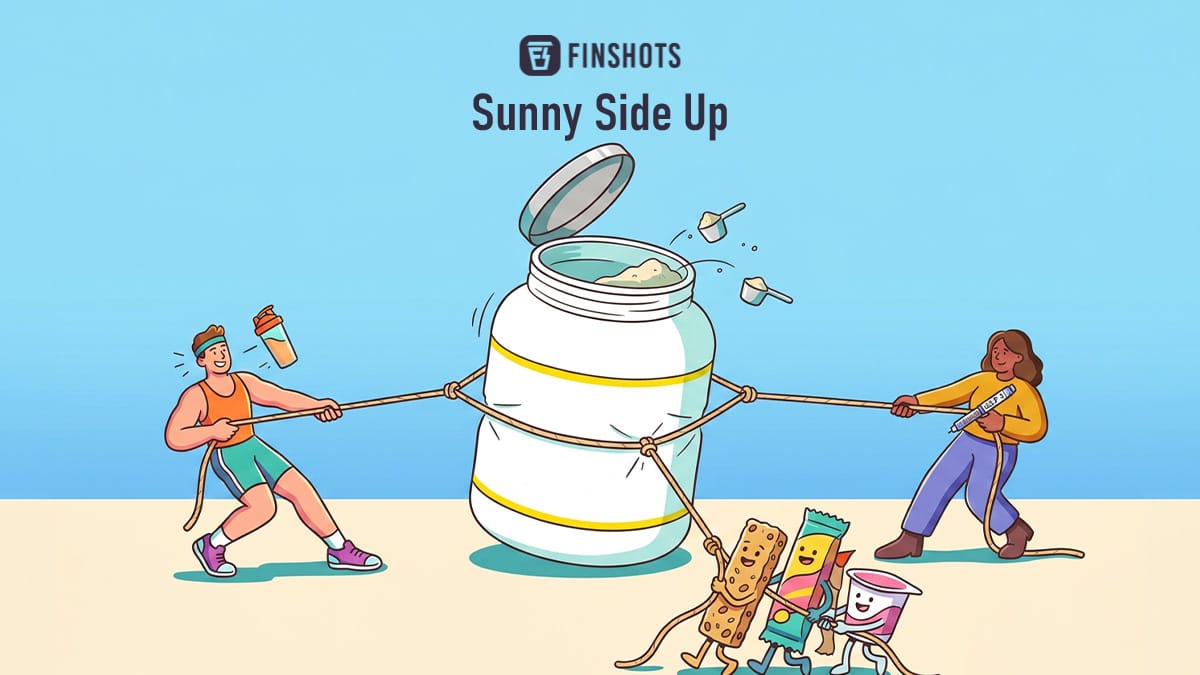
Instead, your protein tub is now at the centre of a three-way tug of war driven by soaring demand.
The first group is easy to guess: fitness enthusiasts. Over the last few years, protein has escaped bodybuilding circles and gone mainstream. Whether it’s runners, office workers or older adults trying to preserve muscle, everyone suddenly seems to be chasing their daily protein target.
The second group is newer and definitely one of a kind. Millions of people taking GLP-1 weight-loss drugs such as Ozempic and Wegovy are now being advised to increase their protein intake. These drugs reduce appetite, so the food people eat needs to pack more nutrition into every bite. Protein also helps preserve muscle while they’re losing weight, making whey one of the easiest ways to hit those goals. Industry executives say the GLP-1 boom has become one of the biggest new demand drivers for whey.
And then comes the third competitor that almost nobody sees coming.
Food companies.
Walk into an Indian supermarket today and the protein boom is impossible to miss. There’s protein yogurt, milkshakes, chips, bars, coffee and even protein-enriched atta. For context, India’s high-protein dairy market alone touched about $1.5 billion in 2024 and is expected to grow another 12% this year, showing just how quickly protein has moved beyond the gym aisle.
Which makes you wonder, if there’s a shortage, why don’t dairy companies simply make more whey?
For starters, it’s because whey isn’t made in a factory. It’s a by-product of cheese-making. In fact, for centuries, whey was simply the leftover liquid after milk was curdled and turned into cheese. It was treated as a low-value by-product and, in many places, simply discarded.
That changed when advances in food processing unlocked the protein hidden inside whey. But its origins never changed.
Every pound of cheese creates roughly nine pounds of liquid whey. Only then is it processed into whey protein concentrate or isolate.
In other words, you can’t just decide to produce more whey next month. You need more milk, more cheese production and, crucially, more processing capacity to convert liquid whey into the high-protein powders that consumers want. Building those specialised filtration plants takes years. And that’s much slower than demand can grow.
And the squeeze is now showing up in prices.
The price of 80% whey protein concentrate has jumped nearly 90% over the past year to around €20,000 per tonne. Some manufacturers have already sold much of their output for the rest of the year, while dairy companies are rushing to invest millions of euros in new whey-processing facilities. But those projects will take time to come online.
So the next time you scoop protein into your shaker bottle, remember that you’re not just competing with the person doing deadlifts next to you. You’re also competing with someone trying to lose weight and a food company launching its next high-protein snack — all for an ingredient that, not too long ago, many cheesemakers were happy to throw away.
Infographic
Readers Recommend
This week our reader Saiprasad Chavan recommends reading The English Teacher by R.K. Narayan
The English Teacher is a semi-autobiographical novel by R. K. Narayan that follows Krishna, an English lecturer whose life is transformed by love, loss, and a search for deeper meaning. After a personal tragedy, he embarks on a spiritual journey that reshapes his understanding of life and happiness.
Thank you for the rec, Saiprasad!
That’s it from us this week. We’ll see you next Sunday!
Until then, send us your book, music, business movies, documentaries, or podcast recommendations. We’ll feature them in the newsletter! Also, don’t forget to tell us what you thought of today's edition. Just hit reply to this email (or if you’re reading this on the web, drop us a message at morning@finshots.in).
Don’t forget to share this edition on WhatsApp, LinkedIn and X.