
Why are investors suddenly obsessed with schools?

In today’s Finshots, we try to reason why PE firms Vitruvian Partners and KKR are interested in buying up Indian schools.
But here’s a quick sidenote before we begin.
We’re hosting a free 2-day Insurance Masterclass that helps you build real financial security by understanding health and life insurance the right way.
📅 Tuesday, 14th July at 6:30 PM: Life Insurance
How to protect your family, choose the right cover amount, and understand what truly matters during a claim.
📅 Wednesday, 15th July at 6:30 PM: Health Insurance
How hospitals process claims, common deductions, the mistakes buyers usually make, and how to choose a policy that won’t disappoint you when you need it most.
👉🏽 Click here to register while seats last.
Now, onto today's story.
The Story
When you think of high-profile private equity deals, your mind probably goes straight to flashy artificial intelligence startups, advanced manufacturing plants, or cutting-edge financial services. But this past week, two of the biggest deals in the Indian business landscape happened in a completely different sector. They happened right inside traditional, physical classrooms.
For context, a few days ago, Vitruvian Partners acquired Peak XV’s stake in K12 Techno, the company behind Orchids International Schools and SparkleBox, valuing the entire business at around ₹7,200 crore. If that was not enough to turn heads, KKR-backed Lighthouse quickly followed suit, acquiring Pathways Gurgaon in a deal valued at ₹1,500 crore.
At first glance, it looks like global investors are suddenly feeling deeply passionate about the future of Indian education. But if you look past the textbooks and report cards, you quickly realise this is something else entirely.
At the end of the day, private equity firms are not charity houses. They are in the business of finding companies that can generate reliable, growing, and highly predictable cash flows. And as it turns out, premium schools do exactly that. They have quietly transitioned into one of the most attractive consumer businesses in India, all thanks to a powerful concept known as inelastic demand (meaning that even if the cost of education rises, it doesn't significantly affect parents' willingness to send their children to what they perceive as "good" schools).
Now, the obvious explanation here is that India’s education market is simply booming. As median household incomes rise, aspirations of parents skyrocket. This means more families are willing to pay more to send their children to ‘premium’ and ‘international’ schools. While that is absolutely true, it only tells part of the story. It does not fully explain why massive global funds are suddenly deploying multi-thousand-crore cheques into brick-and-mortar campuses.
To understand why, let’s take a look at what happened after the COVID-19 pandemic.
The economy split into two paths. One group, comprising higher-income households, saw their wealth surge. Stock markets touched record highs, real estate rebounded, salaries in sectors like technology and finance grew, and discretionary spending came roaring back.
The other group had a much slower recovery, grappling with inflation, weaker wage growth, and tighter household budgets. In other words, while one India recovered rapidly, another took much longer to get back on its feet.
Economists call this the “K-shaped” recovery because, well, the graph looks like a “K”.
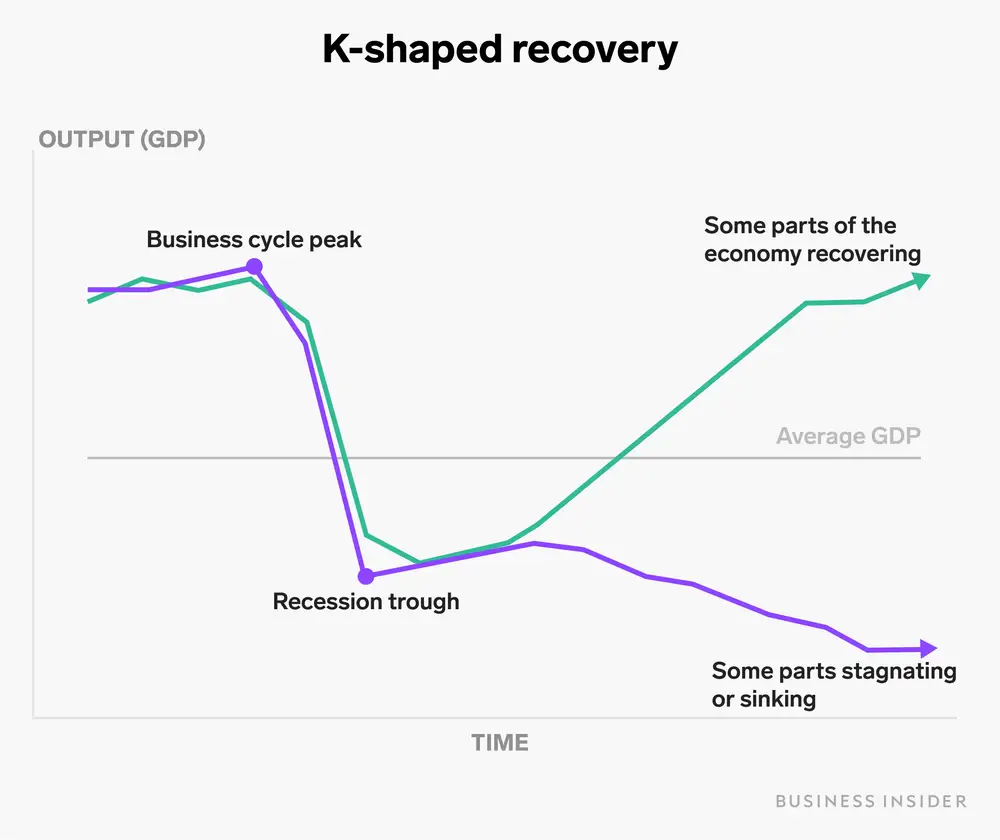
Premium schools have been among the biggest beneficiaries of this divergence. They're not competing for every household in the country, but for the segment whose incomes and aspirations have continued to rise despite broader economic uncertainty.
There's another trend playing out alongside this boom. Over the past two years, government schools have lost nearly 86 lakh students while private schools have attracted 88 lakh more enrolments.
Now, this doesn't necessarily mean government schools are getting worse. In fact, there are encouraging signs that they're improving. National dropout rates have declined, teacher strength has crossed the one-crore mark, and the ASER 2024 survey found that foundational learning levels in government schools have recovered sharply since the pandemic.
Yet, despite these improvements, many families are still choosing private schools as soon as they can afford them.
For investors, that's an important signal because parents are voluntarily willing to spend more on education.
Think about it this way. Once a parent enrols their child in a school, they are highly unlikely to switch schools. Unless something goes spectacularly wrong or the family relocates to an entirely different city, the child stays put. So, unlike an e-commerce platform or a food delivery app, a school does not have to spend anything to win back its customers every single month. A single successful admission can effortlessly translate into 10 to 15 years of highly recurring revenue from loyal customers.
To make things even sweeter for investors, that revenue is remarkably diversified. A premium school does not make money just from basic tuition fees. The cash flows come from multiple streams, including one-time admission fees, transportation services, daily meals, uniforms, textbooks, after-school programs, summer camps, and various extracurricular activities.
Better still, most schools enjoy the luxury of annual fee revisions. While parents might haggle over the price of a new smartphone or decide to postpone an expensive family holiday, education is historically the absolute last expense families cut, even during severe economic downturns. For a private equity fund, that is the ultimate dream business.
When economic uncertainty hits, families will compromise on almost every aspect of their lifestyle before they ever compromise on their child's education.
Beyond the sticky customer base, premium schools enjoy another massive structural advantage, and that is absolute scarcity. Building a reputable, trusted school brand is incredibly difficult. It requires decades of building community trust, attracting high-quality teachers, navigating complex regulatory approvals, and securing prime real estate in crowded urban areas. These factors create massive natural barriers to entry, effectively protecting established school operators from aggressive new competition.
This represents a monumental shift from the time when private equity was pouring money in just a few years ago. During the bygone era of low interest rates, global investors aggressively chased high-growth digital startups. Millions of dollars were thrown at food delivery, fintech, and online edtech companies, with the hope that profits would somehow follow the scale.
Today, the global investment playbook has flipped upside down. The focus has decisively shifted toward businesses that produce tangible, predictable earnings right now. Much like hospitals and diagnostic chains became institutional darlings over the last decade, premium schools are now fitting perfectly into this new low-risk, high-predictability thesis. As household incomes climb, parents think less about the rising cost and focus entirely on securing the best possible future for their children.
Of course, running a school is not without its fair share of operational headaches. Fee regulations remain a highly sensitive political issue in India, and building a brand-new campus requires substantial upfront capital. Unlike a software company that can scale to millions of users with a few clicks, a physical school cannot grow infinitely without constantly buying land and building physical infrastructure. But so far, none of these structural drawbacks has stopped global investors from viewing premium schools as one of the most dependable cash-flow generators in the country today.
So in many ways, schools are beginning to look a lot like private hospitals. Both operate in highly emotional sectors where consumers willingly prioritise quality over price, both enjoy long-term structural demand, and both are gradually being institutionalised through professional corporate management and deep private capital.
And perhaps that is the bigger story here. On the one hand, governments offer public schools to make education accessible to everyone. On the other hand, PE firms are pouring in thousands of crores into premium schools that promise the very best money can buy.
But somewhere in the middle sits a category that many of us grew up with: good neighbourhood schools that weren't luxurious, but offered a good education at a price middle-class families could comfortably afford.
As premium schools become bigger businesses and government schools continue to evolve, one can't help but wonder: In the race to build world-class schools, will there still be room for simply good schools that you and I probably studied in?
Until then…
If you liked this story on why PE firms are buying up Indian schools, share it with your friends, family or even strangers on WhatsApp, LinkedIn, and X.
And subscribe to Finshots, if you haven’t already. Plis!