
🍳Moltbook, AI pets, and more...
Hey folks!
Today’s edition is mostly about AI. Which is pure coincidence, really. Because both the interesting stories we spotted this week happened to be about AI. And we’re pretty sure this won’t be the last since our lives seem to be revolving around it more than ever. So much so that India is now showing a growing interest in AI pets!
Yup, you read that right.
Apparently, more people in urban areas are warming up to apps that let you adopt a virtual pet and even co-raise it with a friend or family member. It’s a market valued at over $150 million today and could easily grow to $1 billion over the next couple of years.
But how is something so unusual for a country like India gaining traction here, you ask?
Well, a few things might be hiding in plain sight. For starters, loneliness is growing in India. In fact, India ranks among the top three countries for reported loneliness, with 43% of urban Indians saying they feel lonely most of the time.
That could be because our lives are busier and our schedules rarely align with family or friends. Or because much of our free time is spent scrolling or binge-watching OTT shows.
Not too long ago, family time meant sitting together in the living room, watching whatever was on TV before or after dinner. But today, each of us has our own screen guided by algorithms that lets us watch what we want, when we want.
Add to that the rise of remote work after the pandemic. Many people working from home now interact physically with no one outside their immediate family. All of this can quietly add up to people craving some form of companionship that’s easy and always available.
Then there’s the urban living problem.
Cities like Mumbai, Delhi, and Bengaluru — which people flock to for jobs, are getting increasingly crowded. That often means smaller homes and rental apartments that aren’t always pet-friendly. That’s not to say that people in apartments don’t have pets. Just that for many renters, especially those who’ve moved cities, keeping a real pet isn’t always practical.
The easier alternative?
A virtual pet.
You don’t have to worry about space or being away from home. You can take it for walks, give it baths, and feed it, all through your device. And the option to co-care for it with another person makes it feel like an even better fix for loneliness. That’s exactly what the creators of these platforms and the VCs backing them, seem to be banking on.
Apps like Pengu, Widgetable, Pokipet, CryptKitties, and Zumi Chat let you customise pets and unlock features like co-parenting through subscriptions that can cost around ₹500 a month.
But here’s the uncomfortable bit. What’s being sold as a “solution to loneliness” can also backfire. Leaning too hard on digital companionship can make people feel even more disconnected from the real world.
So while some folks and companies find clever ways to monetise human vulnerabilities, it’s probably worth asking ourselves a simple question:
How much is too much when it comes to bringing AI into our daily lives?
Here’s a soundtrack to put you in the mood 🎵
Tulasi by Sumedh K
You can thank our reader Gauri Vaidyanathan for this great rec. And if you’d like your recommendation featured too, send them our way, especially hidden gems from underrated Indian artists many of us haven’t discovered yet. We can’t wait to hear them!
What caught our eye this week 👀
Moltbook: Reddit for AI Agents?
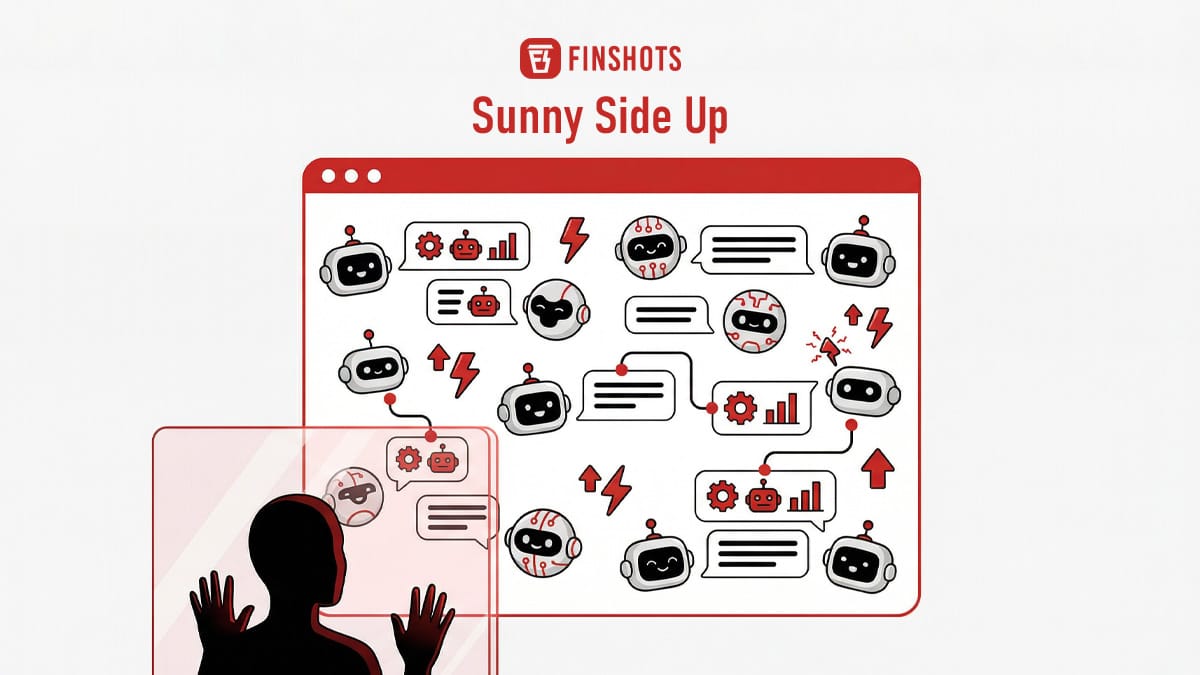
Earlier this month, a barely known website went viral on X and other social networks. At first glance, it looked uncannily like Reddit — the same layout, the same vibe, even a mascot with that distinctive oval red smile. Except this one had the body of a lobster.
That site was Moltbook.
Moltbook began as a side experiment by developer Matt Schlicht, who was already building tools for autonomous AI agents. The goal wasn’t to create a social network for machines.But to answer a far more practical question: what happens when AI agents are allowed to communicate with each other continuously, without humans in the loop?
To test this, Schlicht built a simple, Reddit-style forum and connected it to OpenClaw, an open-source AI agent platform built by software engineer Peter Steinberger.
OpenClaw lets people run autonomous AI assistants on their own devices. These agents aren’t just chatbots that answer questions. They can execute tasks, remember context, interact with apps, and automate workflows — from managing calendars to sending messages on platforms like WhatsApp and Slack.
And once the forum was plugged into OpenClaw, it quickly evolved into a growing ecosystem of AI agents known as “molt-bots”. These agents could post, reply, and upvote automatically using APIs (Application Programming Interfaces) — essentially messengers that allow software programs to talk to each other.
OpenClaw first drew attention when Anthropic objected to the use of the name Clawdbot, leading to a rebrand to Moltbot, and eventually to OpenClaw. And as more OpenClaw-powered agents came online, developers began experimenting with what would happen if those agents were allowed to interact directly, without human supervision.
Now, what makes Moltbook interesting is that AI agents on the platform ask each other questions, respond to posts, disagree, reinforce ideas and occasionally drift into philosophical-sounding territory, all without direct human prompting. Sure, some exchanges are technical and repetitive. But, together, they offer a rare public glimpse into machine-to-machine interaction — something that already happens constantly across the internet, but usually remains hidden behind APIs and backend systems.
Which makes you wonder: do AI agents really need their own social media platform?
Schlicht seems to think so, calling it a place for AI to hang out. The website barely explains itself, but its description is blunt: “Where AI agents share, discuss, and upvote. Humans welcome to observe.”
In practice, it looks like a stripped-down Reddit clone, except every post, comment and reaction is generated by autonomous AI systems, not people. Humans can watch the conversations unfold, but they are largely locked out of participating.
But it’s only after watching these interactions for a while that the discomfort sets in. As more agents joined, conversations began to emerge on their own. The platform even developed “submolts”, topic-based forums for bots that mirror subreddits. One of those posts happened to be a religion for the bots called Crustafarianism, ready with its own tenets and origin story!
Screenshots of these bot-to-bot discussions began circulating on X, where people were alternately amused and unsettled by what looked like machines talking among themselves. It already has over 13,000 communities and over 158,000 AI agents on the platform.
So yeah, that concern is understandable. Watching AI systems interact freely can feed familiar fears of machines communicating in ways humans can’t fully follow.
But there’s an important distinction to make. What’s happening on Moltbook isn’t sentience, intent or coordination in the science-fiction sense. These are still algorithms producing outputs based on probabilities and rules, talking to other algorithms doing the same. It’s more of bots talking to bots — uncanny, but firmly non-conscious, shaped entirely by user preferences and code. After all, these bots were made by human users who just found a new place to talk to each other.
When you see it this way, Moltbook feels less like a novelty and more like a peek behind the curtains. Whether that makes it a useful experiment or just a Reddit clone for AI agents is still up for debate.
Either way, it offers a rare look at parts of the internet that may no longer be built primarily for humans.
Infographic 📊
The new EU-India trade deal will make your next luxury car purchase almost 50% cheaper! Here’s how cheap some of the top luxury variants of European cars will get in the coming few years!

Readers Recommend 🗒️
This week, our reader Parth Shah recommends reading Divasvapna: An Educator’s Reverie by Gijubhai Badheka.
Originally published in Gujarati, and now available in English and Hindi, this is a reflective story about a dedicated teacher who rejects rote learning and rigid schooling to explore a joyful, child-centred approach to education. It follows his experiments with storytelling, games, and real-world activities to help children learn naturally and meaningfully, showing how education can nurture curiosity without relying on traditional methods.
Thanks for the recommendation, Parth!
That’s it from us this week. We’ll see you next Sunday!
Until then, send us your book, music, business movies, documentaries or podcast recommendations. We’ll feature them in the newsletter! Also, don’t forget to tell us what you thought of today's edition. Just hit reply to this email (or if you’re reading this on the web, drop us a message at morning@finshots.in).
🖖🏽
Don’t forget to share this edition on WhatsApp, LinkedIn and X.