
Is Instamart eating Swiggy alive?
In today's Finshots, we look at Swiggy's latest financial results and discuss whether Instamart can achieve profitability.
But before we begin, if you’re someone who loves to keep tabs on what’s happening in the world of business and finance, then hit subscribe if you haven’t already. We strip stories off the jargon and deliver crisp financial insights straight to your inbox. Just one mail every morning. Promise!
If you’re already a subscriber or you’re reading this on the app, you can just go ahead and read the story.
The Story
Since Swiggy listed on the bourses in November 2024, its stock has fallen by more than half, hitting a record low recently. Now, at first glance, this might suggest that the company is struggling to grow its business or that losses are mounting at an extraordinary pace. But that’s not exactly the case.
In the second quarter of FY27, Swiggy's consolidated adjusted revenue grew 34% to ₹7,909 crore, up from ₹5,911 crore during the same period last year. Its food delivery business also reported an adjusted EBITDA of ₹341 crore, compared to ₹240 crore last year. So, this begs the question, if the business is growing and its core operations are becoming more profitable (or less loss-making, rather), why are investors losing confidence?
Well, the answer to that may lie in Swiggy's attempt at building its second growth engine. You see, food delivery is already an established business, and there’s only so much more it can grow, but quick commerce offers Swiggy a chance to tap into a much larger share of consumers’ everyday spending, from groceries and household essentials to electronics and personal care.
But getting a foothold in this market means investing heavily in dark stores, attracting repeat customers and competing with players like Blinkit and Zepto, all before the business can turn consistently profitable.
And Swiggy is still trying to do this through Instamart, while Blinkit and Zepto have already built a sizeable lead. But can Swiggy use the profits from food delivery to build its quick-commerce business without putting pressure on its overall finances?
The first thing to understand is that food delivery is growing. Its quarterly Gross Order Value (GOV) crossed ₹10,000 crore for the first time in September this year, and monthly transacting users reached 19.8 million.
This is partly because Swiggy has launched Toing, a standalone budget food app, in more than 50 cities, and in many of them it quickly scaled to contribute 20% to 30% of core Food Delivery order volumes, as per the company’s latest Shareholder letter.
Swiggy is also trying to make its app work across multiple services, such as Instamart, Dineout, and Scenes. In fact, more than 35% of its users engage with more than one service, which gives the company opportunities to bring existing customers to other services as well.
These initiatives give the company more ways to attract customers, increase order density and reduce delivery costs.
However, the pressure comes from the scale of investment needed to make Instamart competitive. In the September quarter, Instamart's adjusted loss widened to ₹895 crore, up from ₹849 crore during the same period last year.
But treating this increase as proof that the business is simply burning cash without a plan would be misleading. Swiggy has deliberately stepped up spending after two relatively flat quarters to attract users and expand its capacity. It added 69 net dark stores in the quarter, bringing its network to just over 1,200 stores. That single-quarter addition, in fact, matched the number of stores it added over the previous three quarters combined. And new stores take time to attract enough orders to cover their operating costs, so expansion can weigh on margins before it can produce returns.
Swiggy also spent about 1% of Instamart's GOV on pricing initiatives designed to encourage customers to order more often. One example is the ₹9 Store, which offers products at low prices to help build shopping habits. These initiatives helped Instamart add 1.3 million monthly transacting users in the quarter, its highest addition in the last year, with more than 60% of new users returning in the following month. Net order value also grew 13.4% from the previous quarter to ₹6,594 crore, after barely growing for two quarters.
These figures suggest that the additional spending is helping revive demand. But the question is whether the extra orders and customers will generate enough contribution to justify the cost of acquiring and serving them.
To understand that, maybe we could use Blinkit as a benchmark. While Instamart has managed to revive growth, it still has a long way to go before it can match Blinkit's scale and profitability. So comparing the two businesses could help explain why Instamart's growth alone may not be enough.
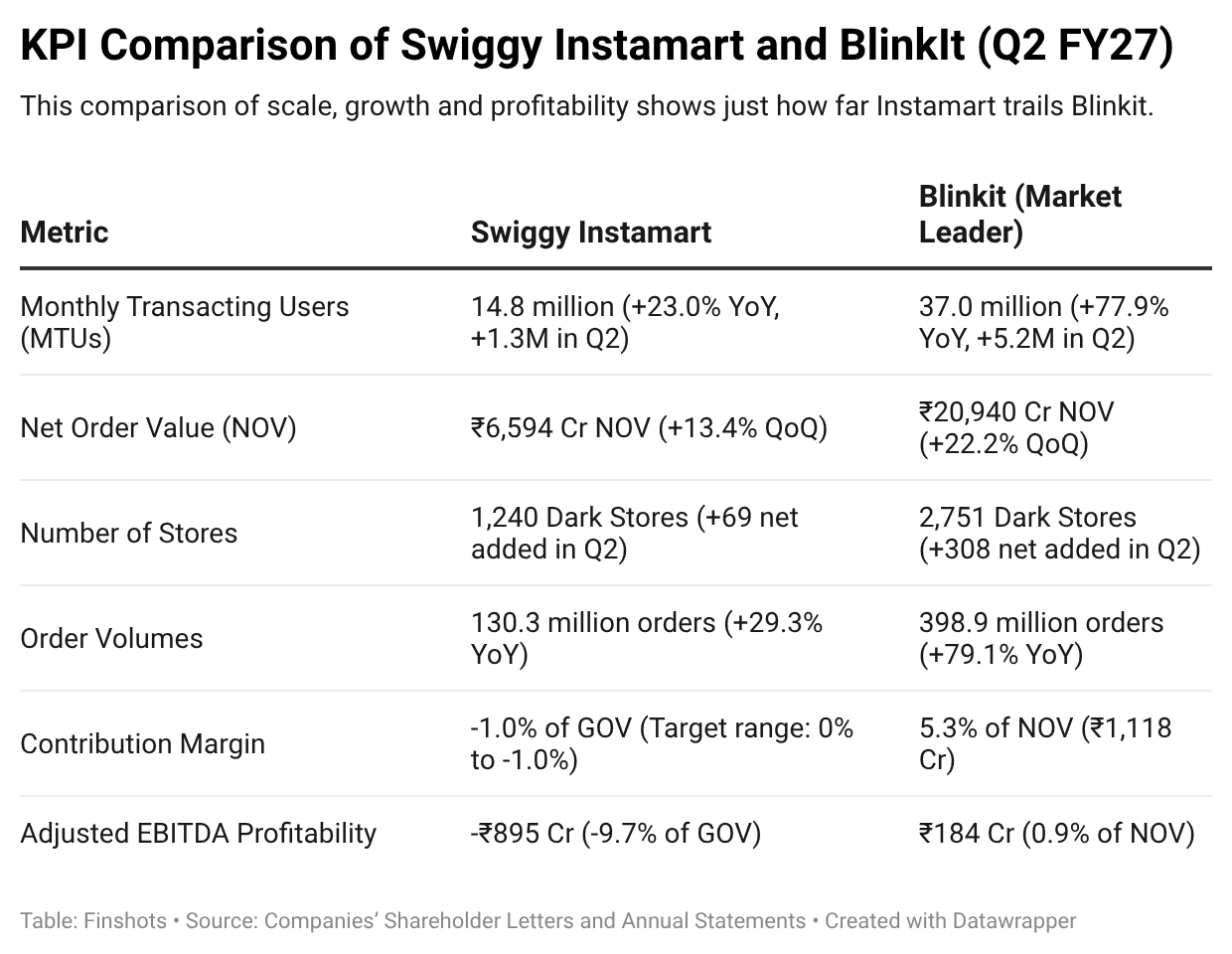
Blinkit's larger network gives it an advantage in reaching customers and spreading operating costs across a higher volume of orders. Its results also show that quick commerce can become profitable at sufficient scale. But they do not guarantee that Instamart will follow the same path, especially if it must keep spending to close the gap.
Which is also why Swiggy is trying to differentiate Instamart rather than compete on scale alone. It's focusing on product selection, private labels and partnerships with established brands. Its private brand Noice now appears in roughly one out of every eight Instamart baskets, and the company says customers who buy these products show about 15 percentage points higher retention.
So a larger basket can help spread delivery and fulfilment costs over more spending, while private brands may offer better margins and give customers reasons to return.
The strategy is sensible, but Swiggy still needs to show that these advantages can translate into better unit economics at scale.
The other question is how long Swiggy can afford to pursue this strategy. Its balance sheet provides some room to manoeuvre because the company reported a consolidated closing cash balance of ₹13,662 crore. This gives Swiggy the ability to invest through a period of intense competition. Still, having the money to compete is different from proving that the investment will pay off.
If Swiggy keeps spending to attract users but cannot convert those users into frequent, profitable customers, a larger network could mean larger losses rather than better economics.
At the end of the day, Instamart's recent losses reflect a deliberate pick-up in pace in expanding its dark stores, improving its product mix, and winning customers. Yet more customers and more orders matter only if they eventually generate enough contribution to cover the costs of serving them.
Which finally brings us to the title. Sure, Instamart is not necessarily eating Swiggy's food delivery business alive. Instead, it is testing how much the company should spend to secure a place in quick commerce. And whether Swiggy can narrow its gap with Blinkit before the cost of doing so outweighs the returns is the real test. That’s something we’ll have to wait and see.
Until then…
If you liked this story about Swiggy and Instamart, feel free to share it with your friends, family, or even strangers on WhatsApp, LinkedIn, or X.
Trust Finshots for Finance? You'll love Ditto for insurance.
Built by the same four friends behind Finshots, Ditto is here to make insurance simple. No spam, only honest advice to help people make smart insurance decisions.
✅Backed by Zerodha
✅Rated 4.9 on Google (34,000+ reviews)
✅Over 7 lakh customers advised
Click here to talk to an IRDAI-Certified advisor for FREE.