
Coffee with capsicum?, obsolete sunscreen, and more...
Hey folks!
Would you have capsicum with your coffee?
Sounds weird, right?
Well, we came across something really interesting this week about computational gastronomy, which suggests that this bizarre-sounding combination may not be as crazy as it seems.
In simple terms, computational gastronomy is about adding data and AI to the science of food.
Traditionally, chefs figure out what works together through experience and a lot of trial and error. But what if you could use data to give that process a little nudge?
See, every ingredient contains hundreds of chemical compounds that contribute to its taste and aroma. But when two seemingly unrelated ingredients share some of these flavour molecules, that could be a clue that they might work well together. Take coffee and capsicum. Coffee has 269 flavour molecules, while capsicum has 218. And they share 78 molecules.
How do we know this?
Thanks to FlavorDB, a searchable database of food ingredients and their flavour molecules. It was developed by a research team led by Dr. Ganesh Bagler at IIIT-Delhi (Indraprastha Institute of Information Technology Delhi) and contains 936 food ingredients and nearly 26,000 flavour molecules.
So you can look it up by starting with something like coffee and see what other ingredients share flavour molecules with it. Coffee, for instance, shares flavour molecules not just with capsicum but even with crab. Yes, crab!
And the reason we found this particularly interesting is that Indian FMCG and alcoholic beverage companies typically spend up to 1.5% of their annual revenue on R&D and product innovation. Of course, this covers everything from manufacturing and packaging to testing and the flavour itself. But the thing is, when a company comes up with a new flavour, there’s still a fair amount of guesswork involved. It can test the product, but ultimately, it has to find out the hard way whether consumers will actually like it.
One good example? Vanilla Coke.
The beverage reportedly failed in India because of its flavour and unattractive marketing, while Indian consumers preferred the stronger, more familiar flavours of Coke, Thums Up and Pepsi. So it was discontinued within a year or two of its launch.
And that’s where computational gastronomy walks in with new possibilities.
Of course, this doesn’t mean you should immediately throw coffee and crab or capsicum into a pan. Because a database like FlavorDB doesn’t tell you that two ingredients will definitely taste delicious together. It simply identifies a molecular connection worth exploring. The chef still has to figure out how to turn that connection into something people actually want to eat or drink.
You could take the example of Shantanu Patil, a food entrepreneur from Maharashtra. He wanted to make a ragi biscuit that reminded people of the raisin-like flavour of the Parle-G Kismi biscuits he grew up eating.
Now, he could have simply added raisins. But that would have increased his costs. Instead, FlavorDB helped him discover that baked ragi paired with cardamom oil could create the flavour profile he was looking for. Not just did he find an alternative ingredient, he also avoided going through multiple rounds of costly trials.
So imagine the possibilities computational gastronomy could unlock in the future for FMCG companies, breweries, restaurants and dessert bars. It’s definitely going to be an interesting space to watch.
And who knows? Maybe one day, coffee and capsicum won’t sound weird at all.
P.S. : Before you move on, no, this post or edition isn’t sponsored by FlavorDB.
Here’s a soundtrack to put you in the mood… 🎵
Khud Ko Miloon by Taba Chake
You can thank our reader, Vinay Singh for this lovely recommendation.
Also folks, keep your music recommendations coming. We’d love to feature them in our Sunday editions, especially gems from underrated Indian artists many of us haven’t discovered yet. Can’t wait to hear them!
Let’s get cracking.
What caught our eye this week
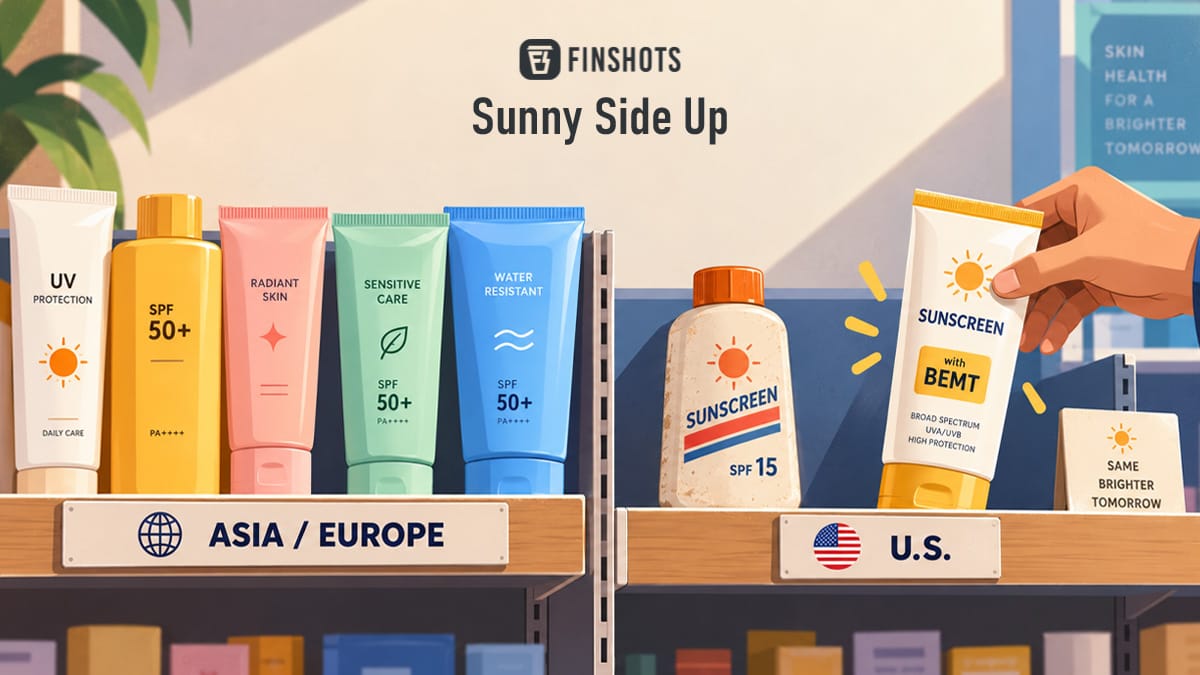
Why America is behind the world on sunscreen
America has one of the biggest skincare markets in the world. But when it comes to sunscreen, its industry has been stuck in the past.
And that’s a little surprising because skin cancer is the most common kind of cancer in the US. The disease also costs their healthcare system about $8.9 billion every year.
Now, one simple way to lower this risk is sunscreen. According to New York’s Skin Cancer Foundation, everyone older than six months should use sunscreen every day to reduce their risk of skin cancer.
But here’s the catch. While Americans can use sunscreen and protect their skin, the sunscreens available to them have historically had weaker sun protection than those available in Europe and Asia. To put that in perspective, US sunscreens, on average, deliver just 24% of the UVA protection that their sun protection factor (SPF) labels suggest.
And that’s because the last time the US approved a new UV filter was way back in 1999.
Yup, 1999.
Think of UV filters as the ingredients that actually block or absorb the sun’s harmful rays. Some mainly tackle UVA — the rays responsible for skin ageing and DNA damage, while others help block UVB, which can cause sunburn.
The problem is that in the US, these ingredients have to go through the Food and Drug Administration (FDA) approval process before they can be used in sunscreens. That’s because America treats sunscreen as an over-the-counter drug rather than as a cosmetic product. Europe and many Asian markets, on the other hand, regulate sunscreens as cosmetics.
So the end result is that American sunscreen manufacturers have historically had far fewer UV filters to work with. For context, the US has just 16 approved UV filters, compared with 29 in Europe and upwards of 30 in Asian countries such as Japan and South Korea.
And more approved filters mean that manufacturers have more ways to make better sunscreens.
Now you might think that Americans could simply import the better sunscreens from Europe or Asia.
But that isn’t the case either because the FDA doesn’t allow sunscreens containing unapproved UV filters to be marketed or sold in the US. So many of the newer formulations that are common abroad aren’t readily available to American consumers. Of course, unless they go on an international vacation and bring a few back home packed in their suitcases (even that isn’t legal by the way, and can get confiscated).
But now, after decades of waiting, there’s finally some relief. In June, the US FDA approved a new sunscreen filter called bemotrizinol (BEMT). And products containing it could start appearing on American store shelves this month.
And mind you, this isn’t exactly cutting-edge science. BEMT has been used in sunscreens around the world for over 25 years.
Still, it could make a difference as BEMT is a broad-spectrum UV filter that can also make it easier for manufacturers to create lighter sunscreens with better UV protection or more cosmetically elegant ones without the dreaded white cast or heavy residue.
And that could be particularly useful in a market like the US, which is the world’s largest skincare and cosmetics market.
But does that mean American sunscreen manufacturers will suddenly start racing to catch up with their European and Asian counterparts?
Probably not.
Because remember? The US’ approved UV filter list is still nearly half the size of those available elsewhere. And adding BEMT doesn’t magically give American manufacturers the same formulation strength as their global competitors.
Which means that foreign sunscreens will probably continue to offer better SPF and formulations.
But nevertheless, it’s still a win for the American sunscreen industry, and manufacturers aren’t hesitating to celebrate. Happy SPF to them, I guess!
Readers Recommend
This week, our reader Arnav Patil is back with a movie recommendation. He suggests watching The Founder, a film that revolves around how McDonald’s started and went on to become a huge fast-food restaurant chain.
Now, we don’t have a link to this film because it doesn’t seem to be available on popular streaming platforms in India. So you may have to find another way to watch it.
Nevertheless, thank you for the rec, Arnav!
That’s it from us this week. We’ll see you next Sunday.
Until then, send us your book, music (preferably from underrated Indian artists), business movies, documentaries, or podcast recommendations. We’ll feature them in this newsletter! Also, don’t forget to tell us what you thought of today’s edition. Just hit reply to this email (or if you’re reading this on the web, drop us a message at morning@finshots.in).
Don’t forget to share this edition on WhatsApp, LinkedIn and X.