
Clothes made of diamonds, humans mutating into crabs, & more...

Hey folks!
Writing for Finshots, I come across some of the most interesting, mind-boggling topics and themes almost every day. It’s like going down a rabbit hole of information that just keeps getting deeper. One such topic that caught my attention this week was carcinization.
What's that, you ask?
Well, evolution can be funny sometimes. As per Carcinization, non-crab crustaceans (may include us humans too!) independently evolve into crab-like forms.
So, this begs a question – was our purpose in this world as humans to become crabs all along? Gags aside, this is a process that has occurred at least five separate times. This phenomenon came into greater light in 2017 when an obscure biology journal published an article in 2017 about “the evolutionary processes which led to crab-like habitus.” In this review of crustacean taxonomy, three scientists from a German university analysed studies dating back to the 1820s and noted how crabs were not one kind of animal. Instead, they had arisen from five different evolutionary lineages.
It’s quite simple to understand. Hermit crabs, squat lobsters, and other crab-like creatures didn’t all evolve from the same ancestor. Instead, they independently developed their crab-like features.
This could also mean that in the Bikini Bottom universe (SpongeBob SquarePants’ world), Mr. Krabs may have been a completely different species millions of years ago before becoming the Mr. Krabs we know today.
This might seem news to us now. But the concept of carcinization has been floating for more than a century. The transformation of these animals in question, all members of the ‘false crabs’ group Anomura (sisters of ‘true crabs’ Brachyura), happened tens of millions of years ago.
But then again, are humans also meant to be crabs in the long run?
Now, sure, humans may not have pincers, segmented bodies, chitinous exoskeletons, compound eyes, or a dorsal heart that pumps haemolymph (crab equivalent of blood) through an open circulatory system. However, as a collective, things may look very different.
Think about how humans have independently kept reinventing the same solutions across history. The arch. The wheel. Writing systems. None of these civilisations were in contact with each other. Yet they arrived at the same answers. Since 2019, people have even coined the term "intellectual carcinization" to describe how ideas emerge independently across cultures. So, in a way, we are already doing our own version of carcinization, just not with pincers.
If evolution keeps building crabs, does that make crabs the ultimate life form? Not quite.
The crab-like body plan has actually been lost at least seven times in a process called decarcinization. So, evolution is not just about making crabs. It's also about unmaking them.
Evolutionary palaeobiologist Matthew Wills puts it simply. Creatures that become crab-like are all decapods (ten-legged animals), and the forces driving this change exist mainly in marine environments. Humans don’t face those conditions.
But what carcinization does tell us is that evolution is not a straight line marching toward some ideal creature. It is nature running the same experiment over and over, with no final answer in mind.
So, the final answer is no, we are not becoming crabs. It is just a shape the universe keeps stumbling upon for certain creatures, maybe for now.
Here's a soundtrack to put you in the mood...
Corona song by the late SP Balasubramanian
You can thank our reader, Namdev Shenoy, for this recommendation. And if you’d like your music recommendation featured too, send them our way, especially hidden gems from underrated Indian artists many of us haven’t discovered yet. We can’t wait to hear them!
What caught our eye this week
Scientists have recently whipped up something that sounds like sci‑fi.
Your clothes could one day keep you cool with tiny diamonds. Yup, you read that right. Okay, maybe we went too far. Not diamonds completely, but diamond nanoparticles. Researchers from RMIT University in Australia explained how they coat cotton fabric with nanodiamonds. These particles are smaller than a thousandth of a human hair and possess properties that can pull heat away from your body and release it into the air. Diamond nanoparticles are already used to keep computer chips cool, so scientists thought, why not replicate the same in clothing? And voila, their experiment succeeded.
And no, these aren’t the diamonds you see in jewellery. They’re made in bulk using methods like detonation or from carbon-rich material such as plastic waste. So they’re surprisingly cheap to produce.
So how does it work, you ask?
Well, you could think of them as super‑charged heat highways. The carbon structure of these tiny diamonds lets them conduct heat way faster than regular cotton. So researchers coat one side of the fabric with a thin polymer layer loaded with nanodiamonds, and that’s the side that touches your skin. The nanodiamonds absorb body heat and then push it outwards, while the uncoated side stops the garment from sucking in hot air from outside. And this can cool the fabric surface by about 2–3°C compared to normal cotton. Now, that may not sound like a lot. But it makes a noticeable difference in comfort and can even cut air conditioning use by around 20–30% in warm environments.
Which makes you wonder if this can be practically used in Indian summer clothing too.
Conceptually, maybe yes. The idea can plug into existing cotton‑based manufacturing, and even a small drop in body temperature is a big deal in our heat‑stressed cities and rural areas.
But the real hurdle is setting up the coating process and maintaining quality at scale. Things like electrospinning and keeping the particles evenly spread.
If some Indian producers partner with nanomaterial suppliers (or even start making them locally), costs could first settle at a premium level for sportswear, uniforms (especially for firefighters and people in healthcare), or workwear, and only slowly come down to mass-market T-shirts as production scales up.
So sure, your first “diamond‑cool” kurta might feel a bit fancy to buy, but the dream is to make sweating‑less clothing as normal someday as a well‑washed cotton shirt. Pretty cool (pun intended), isn't it?
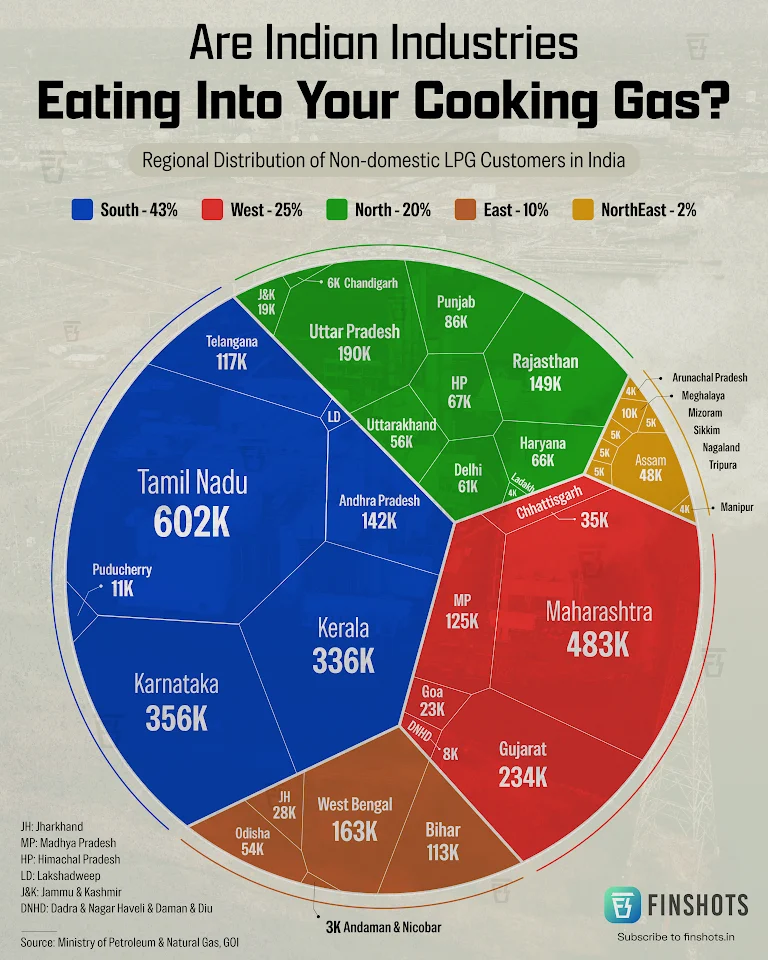
Infographic
India has 332 million active domestic LPG connections. But here is the number that rarely comes up. Nearly 40% of India's LPG consumption is non-domestic. Industries, commercial establishments, agriculture and transport all depend on the same supply chain as your household cylinder.
Readers Recommend
Dune by Frank Herbert recommended by our reader Rahul Roy Karuturi.
Dune is a a sci-fi novel set in a desert planet that produces 'spice', the most precious resource in the galaxy. Thanks for the recommendation, Rahul!
That’s it from us this week. We’ll see you next Sunday!
Until then, send us your book, music, business movies, documentaries, or podcast recommendations. We’ll feature them in the newsletter! Also, don’t forget to tell us what you thought of today's edition. Just hit reply to this email (or if you’re reading this on the web, drop us a message at morning@finshots.in).
Don’t forget to share this edition on WhatsApp, LinkedIn and X.