
🍳Classic Legends win back Yezdi, and more...
Hey folks!
As a kid, I hated taking baths. And I’d be lying if I said adulthood changed that. Somewhere in my head, I always imagined a washing machine for humans — hop in, get scrubbed clean, hop out like toast popping out of a toaster. Sounds like a comic strip, I know. But guess what? Someone in Japan has turned a version of that fantasy into reality.
Science Co., an Osaka-based shower tech company, has built a machine that works like an ultra-fancy spa pod, cleaning and drying you in just 15 minutes. You step into a transparent capsule, settle into a built-in recliner, and let warm water rise halfway up around you. Then comes the real magic — ultrafine microbubbles invisible to the eye. These aren’t your ordinary bubbles. They reach deep into pores, clearing out dead skin cells, sebum, and gunk that regular showers never touch.
The pod also has sensors strapped to your back, constantly tracking heart rate, blood pressure, and other vitals. Using AI, it adjusts the entire experience in real time — changing water temperature, spray intensity, and even ambience based on your physical and emotional state. While this is happening, calming visuals and soothing music wrap around you like a mindfulness blanket.
So yeah, my childhood fantasy has partly come true. And I say ‘partly’ because each unit costs about ¥60 million. That’s roughly $385,000. Definitely not something you can squeeze into your bathroom anytime soon. So for now, only the wealthy or commercial spaces can afford it. But the company claims that if production scales, cheaper home-use versions could show up someday.
But that brings us to the bigger question — why did Science Co. build this in the first place? And who really needs a human washing machine?
Some media outlets have already labelled it a bizarre contraption, and honestly, it does sound like one until you look at the context.
Japan is ageing faster than almost any other country, and a large chunk of its elderly population now needs help with something as basic as bathing. The trouble is, the country doesn’t have enough nurses or caregivers to go around. It’s already short by nearly 3 lakh workers, and that gap could widen to 5.4 lakh by 2040. So Japan is turning to other Asian nations, especially India, to help fill the shortage.
In a scenario like this, there has to be something that eases the burden, because traditional bathing isn’t always easy. That’s where this new device begins to make sense. It removes the need for hands-on assistance, lowers the risk of injury, and, thanks to its built-in sensors, keeps an eye on vital signs to flag potential medical issues early. So, what sounds like a luxury gadget suddenly feels more like a timely solution to a growing problem.
Of course, right now it still doubles as a luxury wellness product for high-end spas and resorts. But once it becomes affordable, it might change caregiving. And if ageing and lower birth rate trends continue, even India could find itself needing something like this sooner than we think.
What do you think?
Here’s a soundtrack to put you in the mood 🎵
Aaftaab by The Local Train
You can thank our reader, Rishabh Jain, for this great recommendation!
Ready to roll?
What caught our eye this week 👀
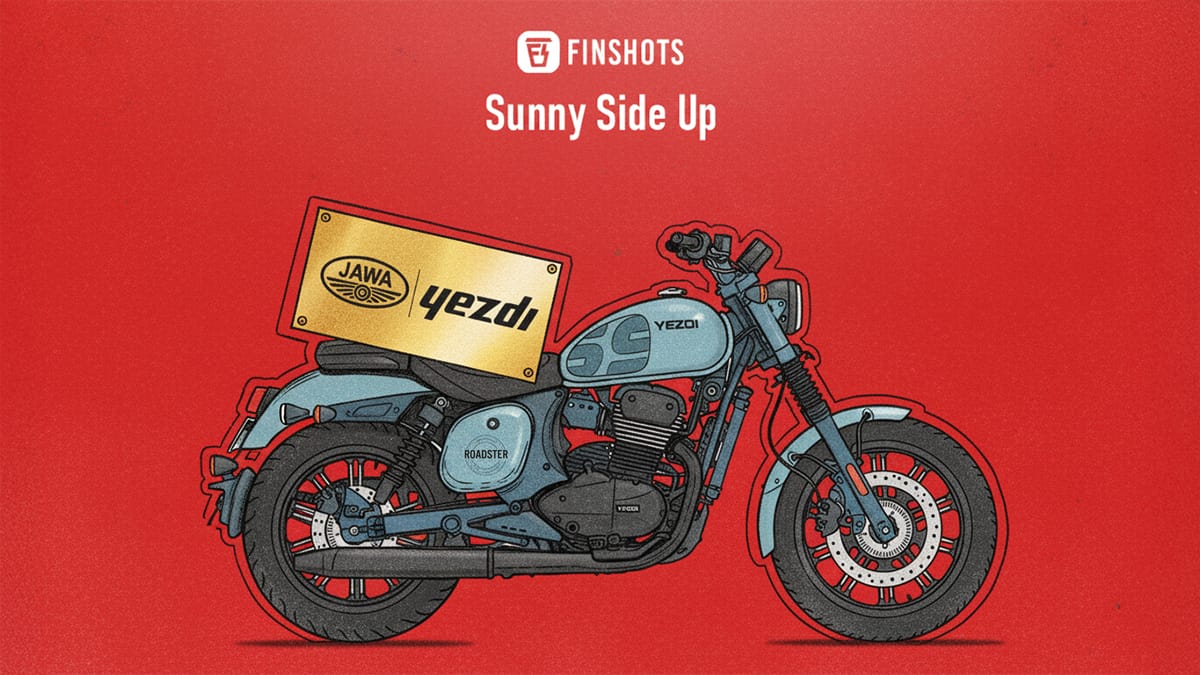
‘Classic’ Yezdi returns
Almost two years ago, Yezdi, the legendary motorcycle brand once sold alongside the cult-classic Jawa, found itself in a courtroom battle over its own name.
Ask your grandparents and they’ll probably recall Yezdi with a mix of nostalgia and old-school charisma. Its two-stroke bikes were iconic for many reasons. They struggled to keep up with the Japanese machines of the time, sure, but they earned a place in India’s cultural memory strong enough that when the brand was revived in the last decade, fans welcomed it right back.
But somewhere between going defunct in the 1990s and being resurrected in the 2020s, a legal storm had been brewing: one that questioned who actually owned the name Yezdi in the first place.
That lawsuit ended with the Karnataka High Court stating that Classic Legends and Real estate developer Boman Irani, the names behind Yezdi’s revival, didn’t own the trademark to the name and as such, they were outright banned from using it! We covered it in our Sunny Side Up edition back then.
And oddly enough, this was despite the fact that Ideal Jawa, the original maker of the bikes, was long gone and there hadn’t been any renewal, use, or even a valid listing of the trademark for decades.
Now the verdict of this case clearly flipped after almost three years, so what changed between then and now?
To understand that, we need to revisit the technicalities of the first case. In the 2022 ruling, the court said that because Ideal Jawa was still under liquidation, its assets, including the trademark, remained in the custody of the Official Liquidator. That was true even though the name had been unused, unregistered and unrenewed for years. Under that interpretation, Classic Legends and Boman Irani had no claim.
Naturally, they appealed. Their argument rested on three foundational points.
- Ideal Jawa had stopped using the trademark long before liquidation began. If the company itself had abandoned the name, how could it suddenly become the liquidator’s property?
- A trademark only has value if its goodwill survives. After decades of non-use, any goodwill associated with “Yezdi” had disappeared, which meant the old company did not have a meaningful claim to it.
- Boman Irani had already obtained fresh Yezdi trademark registrations in 2013 and 2014. These were granted long before the modern revival and through proper legal process.
These three points formed the basis on which the Division Bench reconsidered the case in 2025.
By taking all of this into account, the Karnataka High Court eventually ruled that Ideal Jawa had effectively abandoned the Yezdi trademark. The company stopped production in 1996, went into liquidation in 2001, and the original trademark lapsed in 2007 and 2008. Between that lapse and the registrations obtained by Irani, roughly six years passed, and nobody from Ideal Jawa, the liquidator, or any creditor made a claim.
That is what finally restored the Yezdi name to the people actively reviving it, rather than to a company that had long left it behind. So with that, every modern day ‘Yezdi’ owner can breathe easy and smile knowing that their trusty steel steed’s brand name is legally secure.
Infographic 📊

Readers Recommend 🗒️
This week, our reader, Aayush Gupta, recommends reading Never Split the Difference by Chris Voss.
Aayush says, “It’s one of those books that can change your life. The author is a former head of the FBI’s hostage negotiation division who later founded a corporate coaching and consultancy firm. The book offers deep insights into the art of negotiation, with simple, easy to remember pointers. As a bonus, it’s packed with gripping anecdotes from high-stakes hostage situations during the author’s FBI days and shows how the lessons and outcomes from those moments shaped his teachings.”
Thanks for the recommendation, Aayush!
That’s it from us this week. We’ll see you next Sunday!
Until then, send us your book, music, business movies, documentaries or podcast recommendations. We’ll feature them in the newsletter! Also, don’t forget to tell us what you thought of today's edition. Just hit reply to this email (or if you’re reading this on the web, drop us a message at morning@finshots.in).
🖖🏽
Don’t forget to share this edition on WhatsApp, LinkedIn and X.