
An exit at HDFC Bank without answers
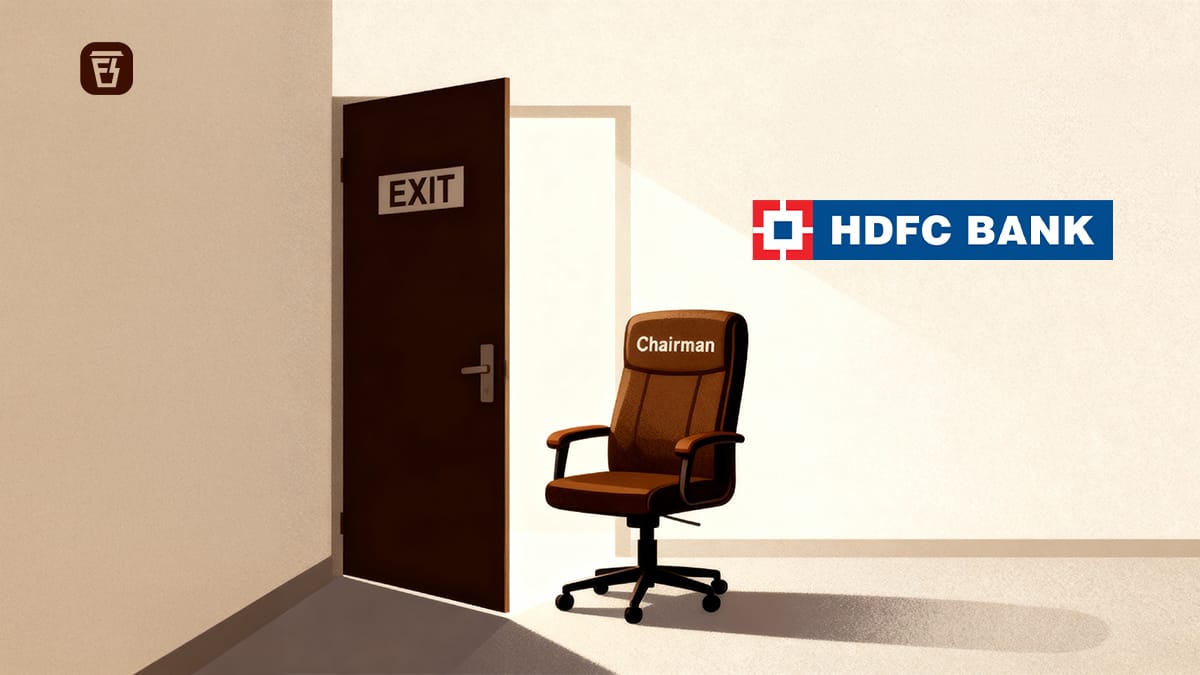
In today’s Finshots, we talk about the recent exit of HDFC Bank’s chairman and why it’s raising more questions than answers.
The Story
Last week, HDFC Bank’s chairman Atanu Chakraborty stepped down in what could have been just another high-profile exit. But it wasn’t the resignation that stood out. It was what he said on his way out.
In his resignation, Chakraborty pointed to “certain happenings and practices” within the bank that, over the last two years, were not in line with his personal values and ethics.
It was a carefully worded statement, but one that raised more questions than it answered. And what made it unusual was that there was no single revelation or headline scandal. And yet, the former chairman’s brief letter was enough to rattle investor confidence and send the bank’s stock sharply lower.
So what may have erupted at one of India’s strongest private banks, you ask?
Well, a chairman stepping down over “values and ethics” isn’t the kind of headline you see every day. Especially not from a bank that has spent decades positioning itself as the gold standard of Indian private banking: disciplined, stable, almost boringly reliable. But when someone at that level exits like this, it tends to leave a question hanging in the air, even if no one can quite name it yet.
So, based on what’s emerged over the last few days since the chairman’s exit, here are a few things that could plausibly have stirred up HDFC Bank’s management.
For starters, there’s a regulatory action from the Dubai Financial Services Authority that had largely stayed under the radar. For context, within days of the resignation, three senior executives at the bank’s UAE operations were dismissed following an internal investigation. Apparently, they were involved in mis-selling Additional Tier-1 (AT-1) bonds at HDFC Bank’s UAE branches.
Sidebar: AT-1 bonds are a type of debt instrument issued by banks to strengthen their core capital. They are riskier than traditional bonds, so banks have to offer higher interest to reward investors who buy them.
Allegedly, this happened between 2019 and 2022, when they convinced non-resident Indian customers to shift their foreign currency deposits from India to Bahrain by presenting these AT-1 bonds as fixed-maturity products and safe alternatives to deposits, when in fact they are high-risk perpetual bonds. This essentially means that investors don’t get their principal back but only receive annual interest payments. The risk, however, is that if the issuer’s financial health deteriorates, it can permanently write down the bond’s face value to zero, causing investors to lose their entire investment. And that’s exactly what happened.
The bonds, issued by Credit Suisse, were wiped out in 2023 when the bank collapsed and was absorbed by UBS, leaving investors with nothing.
And the fallout was significant. The Dubai Financial Services Authority had earlier barred HDFC Bank from onboarding new customers at its DIFC branch in Dubai, something that hadn’t been publicly disclosed since the bank says that it was conducting internal investigations and probing whistleblower complaints over the past two years.
MD and CEO Sashidhar Jagdishan acknowledged that there were areas where the leadership “agreed to disagree”. It was a rare admission for a bank known for projecting unified confidence.
But that’s only a recent case. Another possible trigger could be the alleged fraud at Mumbai’s Lilavati Hospital.
Last year, the Mehta family, which controls the Lilavati Kirtilal Mehta Medical Trust, filed an FIR against Jagdishan, along with a few current and former bank employees. The allegation was that they helped a former trustee, Chetan Mehta’s group, misappropriate the Trust’s funds and gain control over it.
The Trust says it found evidence — including a seized handwritten “cash diary”, suggesting that around ₹14 crore was misused by former trustees. Out of this, ₹2 crore was allegedly paid directly to Jagdishan. And this wasn’t just any payment. They claim it was a bribe from the Chetan Mehta group to Jagdishan to provide “financial advice” that helped the group tighten its grip over the Trust and continue siphoning funds. There’s also an accusation that he helped harass the father of a current trustee, who was locked in a loan dispute with HDFC Bank.
But the claims don’t stop there. The Trust also alleges that Jagdishan facilitated deposits of about ₹25 crore of Trust money into an HDFC Bank account without proper approvals or board resolutions. On top of that, around ₹1.5 crore was allegedly routed as CSR funds to hospital staff to destroy or forge evidence. And, as per their claims, Jagdishan and his family even received free medical treatment at Lilavati Hospital.
HDFC Bank, however, has firmly denied all these allegations. It says this is an attempt by the Trust to target its senior officials and distract from a separate issue — a long-pending unpaid debt of over ₹65 crore from Splendour Gems Limited, which is linked to the Trust.
But there’s not much to read into here, as the case is still ongoing.
Yet, in the middle of all this, a report by Moneycontrol adds another layer. It suggests that Chakraborty had issues with two board-level decisions. One was the reappointment of Jagdishan without a thorough review of his performance in his second term as MD & CEO. While the other was the proposed appointment of Jimmy Tata as executive director, after Bhavesh Zaveri’s term ends in April. Tata, currently the bank’s chief credit officer, is one of the longest-serving senior executives. But Chakraborty reportedly felt that tenure alone shouldn’t guarantee a board seat.
So yeah, it seems these disagreements within the top management may have slowly built up, eventually pushing things to a tipping point — and possibly leading to Chakraborty’s abrupt resignation.
Of course, none of this has been officially linked to the chairman’s exit. We’re only connecting the dots here. But taken together, it’s hard to ignore the sense of friction beneath the surface — whether around growth decisions, how products are sold, or how strictly the bank holds itself accountable when things go wrong.
And yet, if you look at the official response, the tone has been largely reassuring. Interim chairman Keki Mistry said that Chakraborty had not provided the board with specific details of his concerns. Even the RBI described HDFC Bank as a “Domestically Systemically Important Bank with sound financials, a professionally run board and a competent management team.” The Finance Ministry echoed this, calling it a “strong institution with strong fundamentals.”
But that reassurance hasn’t fully settled nerves. Investors weren’t entirely convinced. Some argued that instead of dismissing the concerns, the bank should have constituted a committee of independent directors to engage with Chakraborty directly and issue a more detailed public explanation.
Which leaves things in a bit of a grey zone. For now, the picture remains incomplete, and the outcome will depend on what scrutiny and investigations reveal in the coming days.
Until then…
Liked this story? Share it with a friend, family member or even strangers on WhatsApp, LinkedIn and X.
🚨Three insurers are revising their term premiums!
Three prominent insurers are set to revise their term insurance premiums. Policies issued after the revision will reflect the updated pricing. If you have already generated a quote, the premiums may change once the revision comes in.
Here’s why this matters: When you purchase a term life insurance policy, you pay a premium or a small fee each year to protect against financial risks. In the unfortunate event of your passing, the insurance company pays out a substantial sum to your family or loved ones.
If you've been considering a term plan, now is the perfect time to act. To assist you in the process, our advisory team at Ditto is here to help. Click on the link here to book a FREE call with our IRDAI-certified advisors.