
Why the Supreme Court sided with SEBI against Kotak AMC
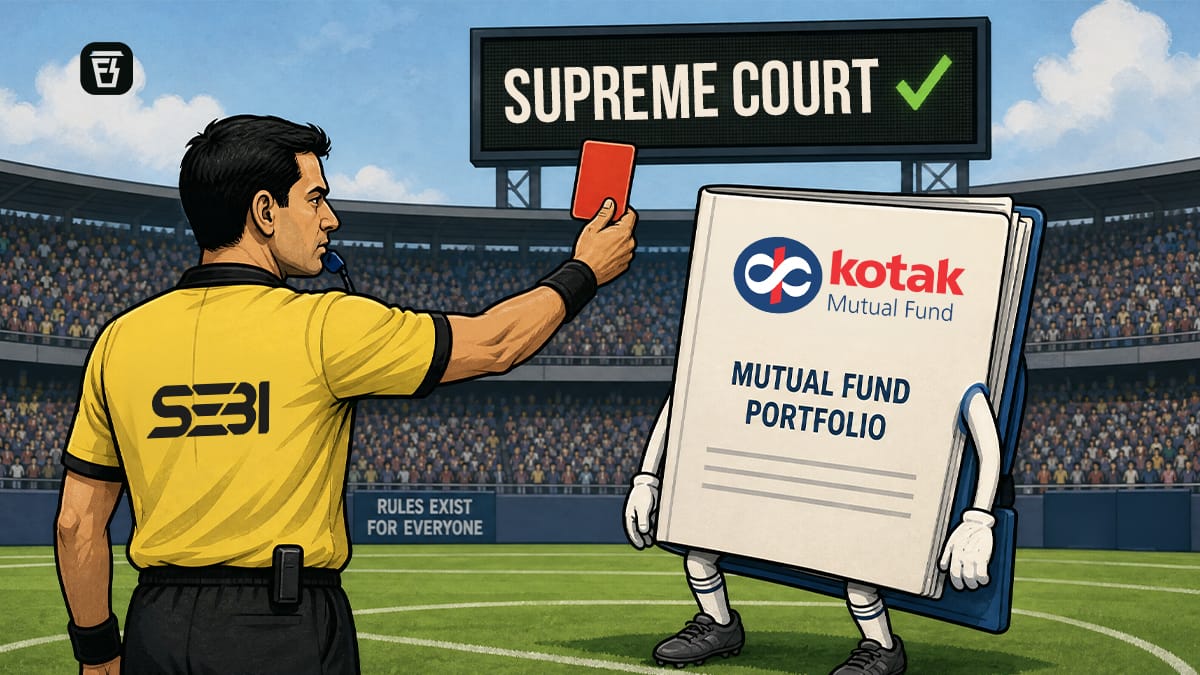
In today’s Finshots, we explain why the Supreme Court upheld a SEBI order against Kotak AMC.
But here’s a quick sidenote before we begin. We’re hosting a free 2-day Insurance Masterclass that helps you build real financial security by understanding health and life insurance the right way.
📅 Tomorrow (Saturday), 18th July at 11:00 AM: Life Insurance
How to protect your family, choose the right cover amount, and understand what truly matters during a claim.
📅 Sunday, 19th July at 11:00 AM: Health Insurance
How hospitals process claims, common deductions, the mistakes buyers usually make, and how to choose a policy that won’t disappoint you when you need it most.
👉🏽 Click here to register while seats last.
Now onto today’s story.
The Story
This week, the Supreme Court upheld a ₹2.1 crore penalty imposed on Kotak Mahindra Asset Management Company (AMC) and its trustee company, Kotak Mahindra Trustee Company (which oversees whether the AMC complies with SEBI regulations and acts in the best interests of investors). The penalty itself isn’t huge, but the judgment settles an important question.
Can an asset manager break mutual fund rules if doing so ultimately protects investors?
Well, the apex court’s answer was a clear no. And to understand why, we’ll have to go back to between 2013 and 2016, when Kotak AMC launched six close-ended Fixed Maturity Plans (FMPs).
For the uninitiated, FMP is similar to a bank fixed deposit, except that it’s structured as a debt mutual fund. You can invest only during the fund’s initial offer period. After that, the fund closes for fresh investments, which is why it’s labelled “close-ended”.
The AMC then takes this money and invests it in debt securities issued by governments or companies, making sure that these securities mature on or before the FMP itself. And at the end of the scheme’s tenure, investors receive their money back along with whatever returns those debt investments have generated. Unlike a bank FD though, these returns aren’t guaranteed.
Now, coming back to these FMPs, Kotak AMC invested about ₹266 crore in debentures issued by two Essel Group companies — Konti Infrapower & Multiventures and Edison Utility Works.
If Essel Group sounds familiar, that’s because it’s Zee Entertainment’s parent company. And these debentures were secured by pledged shares of Zee itself.
Think of it as collateral for a loan. Since debentures are essentially loans, the borrower often offers something valuable as security. If the borrower (in this case Essel) repays on time, the collateral is returned. But if it defaults, the lender (Kotak) can sell that collateral to recover the money. In this case, the collateral happened to be Zee’s shares.
Then came 2019. Essel Group was battling a severe debt crisis, and Zee’s stock price crashed, which in effect created a new problem. The pledged Zee shares were suddenly worth much less than before and no longer provided sufficient security for the debentures.
Normally, Essel would have had to pledge additional shares to restore the required level of collateral. But it couldn’t.
And that left Kotak AMC with two choices. It could either immediately sell the pledged Zee shares and recover whatever money it could, or restructure the debentures, giving Essel more time to repay.
Kotak chose the second option for one simple reason. Dumping such a large quantity of Zee shares into the market would have pushed the stock price down even further, hurting not just Kotak’s investors but also every other lender and investor exposed to Zee. So instead of forcing a sale, Kotak extended the repayment timeline. And when the FMPs finally matured, Kotak AMC repaid most of the investors’ money on time, withholding a small portion (the amount still locked up in the Essel debentures) and paying it out roughly five months later, along with interest.
SEBI, however, viewed this as a serious violation and penalised Kotak AMC, its trustee company, and a bunch of senior executives, including Kotak AMC’s Managing Director, Nilesh Shah.
But hey, didn’t Kotak actually do the more prudent thing here? After all, it wasn’t just thinking about its own investors but also about everyone else who could have been hurt by a fire sale of Zee shares. So why did SEBI still fine them?
See, FMPs come with a fixed maturity date. That means investors must be paid in full when the scheme matures unless they’re first asked whether they’d like to roll over or extend the scheme. Kotak AMC didn’t do that.
Which is why despite the fact that investors eventually got all their money back with interest, and nobody actually lost money or even complained, SEBI still viewed this as a serious violation. And passed two separate penalty orders in 2021 and 2022: one against Kotak AMC and another against the trustee company and its senior executives.
Now you can imagine that Kotak wasn’t happy about this. Its argument was probably the same one that’s been running through your mind while reading this story: “Sure, we technically broke a rule. But investors didn’t lose anything. In fact, they were probably better off because if we’d sold the Zee shares immediately, everyone would’ve suffered bigger losses. So why penalise good-faith, investor-friendly behaviour?”
And that’s exactly what Kotak said when it challenged SEBI’s order before the Securities Appellate Tribunal (SAT), the body that hears appeals against SEBI’s decisions.
SAT, however, wasn’t convinced. So the case eventually landed before the Supreme Court, which wasn’t convinced either.
So why did every authority, including the apex court, think SEBI was right, you ask?
Well, the answer is very very simple.
The Court said mutual fund regulations aren’t about how things eventually turn out. They’re about whether you follow the rules in the first place, regardless of whether doing so ultimately leads to a gain or a loss. As the Court put it, the law makes no distinction between a breach that results in profit and one that results in loss. Because if fund managers could justify breaking the rules by simply saying, “It all worked out in the end…”, it would create dangerous incentives for others to ignore regulations whenever they believed their own judgment was better.
There was another reason too. Kotak actually had a perfectly legal way to extend the FMPs. It could have sought investors’ consent in advance through a rollover and given anyone who didn’t want to continue the option to redeem their money.
But it didn’t. Instead, it made the decision all by itself, informed investors only a day before signing the extension agreement, and offered a detailed explanation only after SEBI came asking questions. Which meant investors never really had the opportunity to say no. That’s why the Court called it a denial of unitholders’ choice rather than an act of investor protection. On top of that, inadequate disclosures also meant both investors and SEBI were kept in the dark about a major decision affecting their money.
Then came another issue. SEBI also found that Kotak AMC’s investment committee had invested in Konti and Edison even though both companies had been consistently reporting losses. But instead of properly evaluating the borrowers’ financial health, it relied largely on the Zee shares pledged as collateral.
And even that wasn’t ideal because SEBI’s rules require at least a 4x collateral cover for such share-backed debt instruments. But Kotak’s cover was only about 1.5x, something SEBI saw as evidence of inadequate due diligence.
Kotak, however, had one final argument. It told the Court, “We’re not the only ones who invested in Essel Group’s securities. There were 22 other entities, including 8 mutual funds. So why single us out for allegedly not doing enough due diligence?”
And the Court had an interesting response.
It said this argument relied on a legal concept called “negative equality” or in simple words, just because others got away with something doesn’t make your own violation legal. Think of it this way. Imagine you’re riding a bike without a helmet. A traffic police officer stops you and issues a fine. In your defence, you say, “But I was riding safely. I didn’t hurt anyone. Besides, there are plenty of other people riding without helmets too.”
You see how that argument doesn’t really work? Not wearing a helmet is still an offence, regardless of whether others escaped punishment. The Court said the same principle applied here. And Kotak couldn’t defend its own actions simply because other institutions may have done something similar.
And that’s the long and short of why the Supreme Court agreed that SEBI was justified in penalising Kotak AMC.
And while this penalty is far too small for investors to worry about Kotak Mahindra Bank’s stock, because the group generates over ₹1 lakh crore in revenue and net profits on a consolidated basis, and commands a market capitalisation of around ₹3.75 lakh crore, the case still leaves investors with an important takeaway.
No investment is completely risk-free. Even debt instruments, which many people consider relatively safer than equities because they’re generally less volatile, can carry structural risks that go well beyond the borrower’s financial health.
So before you invest, always make sure you understand exactly what you’re putting your money into.
Until next time...
If you liked this story, feel free to share it with a friend, family member or even strangers on WhatsApp, LinkedIn, and X.
And if you’re someone who loves keeping tabs on the world of business and finance, hit subscribe if you haven’t already. And if you’re already a subscriber, thank you! Maybe forward this to someone who’d enjoy our stories but hasn’t discovered us yet.