
Why Axis Bank may finally say yes to microfinance
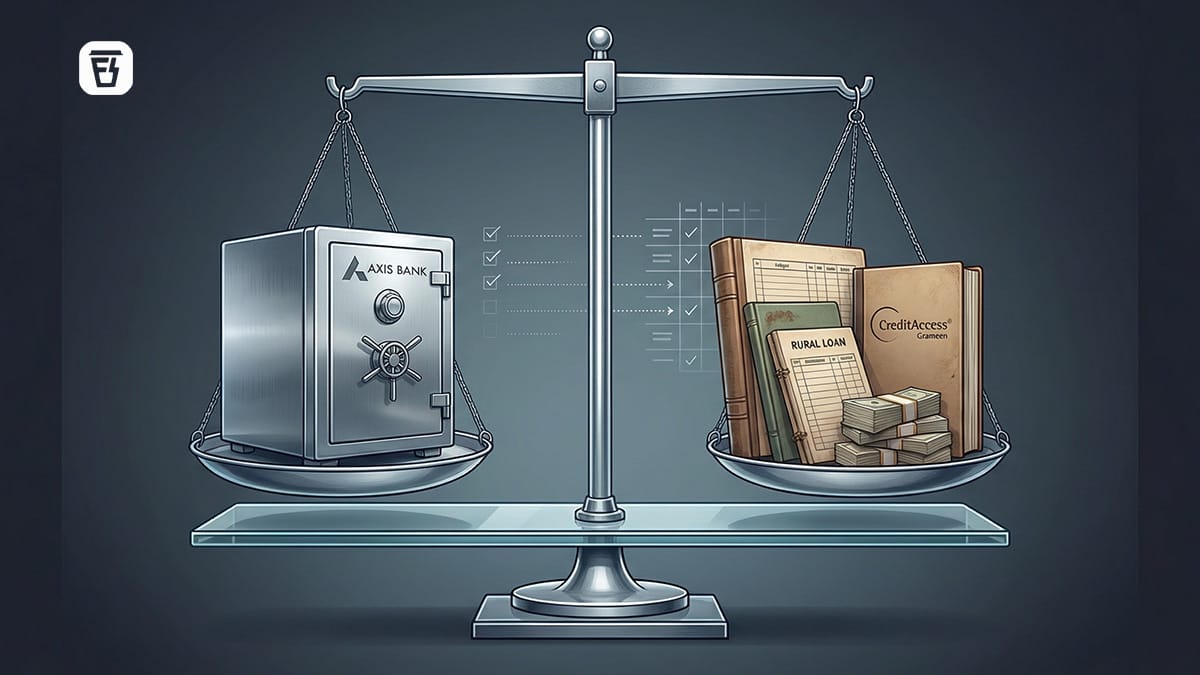
In today’s Finshots, we tell you what’s driving Axis Bank’s interest in CreditAccess Grameen, India’s largest microfinance institution.
The Story
Savitha is a widow from a small village in Karnataka. She wants to set up a small grocery shop to support her two children. But with no credit history and no collateral to offer, every bank in her district turns her away. When she shares her situation with a helpful neighbour who runs a small business himself, he tells her about CreditAccess Grameen — a non-banking financial company–microfinance institution (NBFC-MFI) that focuses on providing small loans to low-income women in rural areas.
The next day, a CreditAccess Grameen representative visits Savitha at her modest home and explains a simple group-lending model. Five women form a group and act as informal guarantors for one another’s loans. There’s no need for collateral. The group repays the loans from their business earnings, and mutual support — along with a bit of peer pressure — helps ensure repayments stay on track. Savitha likes the idea, and within a few weeks, she receives ₹50,000 to start her shop.
This isn’t just a single story. It’s a composite scene that has played out millions of times since CreditAccess Grameen was founded in 2007. Today, it is India’s largest microfinance institution, with a 6.9% share of the microfinance market and a loan portfolio of ₹26,500 crore as of December 2025.
Now, just a few days ago, CNBC-TV18 reported that Axis Bank was evaluating the acquisition of 66% of CreditAccess Grameen’s promoter stake, which is currently held by its Netherlands-based promoter entity, CreditAccess India BV.
But here’s the interesting bit. Go back to around December 2024, and Axis Bank didn’t seem particularly keen on acquiring microfinance institutions. It wasn’t ruling them out altogether, but MFI acquisitions clearly weren’t a priority at the time.
Now, barely a year later, the bank is reportedly evaluating exactly that kind of deal. So what changed, you ask?
Let’s begin with Axis Bank’s past baggage or its brush with Spandana Sphoorty, another major microfinance lender in India.
See, back in 2021, there was talk that Axis Bank was keen on acquiring Spandana Sphoorty, then India’s second-largest MFI. But the deal never went through. The main reason was a disagreement between Spandana’s founder and then MD, Padmaja Gangireddy, and its private equity promoter, Kedaara Capital, over valuation.
Kedaara wanted to sell its stake to Axis Bank at about 1.6 times Spandana’s book value (essentially the company’s net worth or its assets net of liabilities). Gangireddy, however, pointed out that around the same time, other MFIs were being acquired at valuations as high as 4.75 times book value. So from her perspective, a company she had built and scaled was being sold at an unfair, almost throwaway price.
These valuation disagreements, combined with internal concerns around the accuracy of Spandana’s collection efficiency data, eventually led Axis Bank to walk away from the deal.
Now hold on to that thought as we move to the next part of the story. It might feel unrelated at first, but it’ll make sense soon.
In FY25, India’s microfinance sector went through what can only be described as a mini-meltdown. Delinquency rates or the share of loans overdue by 30, 60, or 90 days, which were comfortably sitting at around 2% just a year earlier, suddenly tripled to nearly 6%.
And the reasons weren’t hard to spot.
In 2024, lending surged across the sector. This easy credit pushed many low-income households into a debt trap, with borrowers taking multiple loans, sometimes from more than one MFI. As repayments piled up, many simply couldn’t keep up on repayments. And when MFIs tried to recover dues, they ran into another wall. States like Karnataka and Tamil Nadu tightened rules to curb harsh recovery practices, making collections even harder.
The damage was brutal. MFI stocks tanked, with some losing up to 68% of their market value. CreditAccess Grameen wasn’t spared either and saw its stock fall by over 20%. The sector as a whole shrank by 7% as lenders pulled back and cut loan books to stem losses.
But here’s the interesting bit. CreditAccess Grameen has bounced back faster and more meaningfully than most of its peers. By Q3 FY26, the worst seemed to be behind it. Its gross NPAs, which had climbed to nearly 4% in 9MFY25, stayed stable even in 9MFY26. Its net interest margin (NIM or the difference between the interest a bank or lender earns on its loans and the interest it pays on the money it borrows, expressed as a percentage of its average earning assets) improved by about 2% over the same period. Profits did fall 9.5% YoY to ₹438 crore, but that still looked far healthier than peers like Spandana Sphoorty, which saw NIMs shrink by 4% and losses widen 17% to ₹704 crore, despite lowering NPAs.
Put simply, CreditAccess Grameen appears to have navigated one of the toughest cycles the microfinance industry has seen in decades.
And this is where you should recall that thought we asked you to hold earlier. If Axis Bank is looking for a quality asset at the right price, CreditAccess Grameen starts to make sense. It was panic-sold when the sector was under extreme stress and is now showing clear signs of recovery. That combination of proven scale, survival through a brutal downturn, and a depressed valuation, could make it an attractive acquisition target at a price that would have been unthinkable during the pre-crisis boom.
Acquiring CreditAccess Grameen also fits neatly into Axis Bank’s bigger strategy. For years, Axis leaned heavily on wholesale lending — large loans to businesses and corporates. Now, it wants to shift decisively towards retail lending, which means loans to everyday customers like you and me. These loans are smaller, spread across millions of borrowers, and tend to be far more stable over time. That intent became clear when Axis recently said that it wants 58–60% of its loan book to be retail, while keeping 23–25% in wholesale lending to retain scale and diversify income.
And the springboard for this shift?
A microfinance institution like CreditAccess Grameen.
It’s arguably the loudest megaphone for retail penetration in India today. An acquisition would instantly give Axis Bank access to 4.4 million borrowers, largely in rural areas, with 99% of them being women. For context, Axis Bank currently lends to about 2.2 million women borrowers. So you can see how this one move could nearly triple that base overnight.
Another thing to note here is that about 39% of CreditAccess Grameen’s new borrowers are “new-to-credit” — people who’ve never borrowed from the formal banking system before.
From Axis Bank’s point of view, that’s a cross-selling goldmine. A woman who takes a ₹50,000 microfinance loan today could become a gold loan customer, an insurance buyer, or a deposit customer a few years down the line.
That said, a deal like this isn’t without its complications.
Integrating a microfinance business is far from straightforward. The loan sizes and collection models are different. Risk management works differently. Even the way customers are engaged is not the same. A good example is Axis Bank’s acquisition of Citibank’s consumer banking business in 2024, which itself took months to stabilise. Now imagine something far more operationally intensive than that, and you begin to see the challenge with a microfinance integration.
There’s also the bigger drawback to consider. The microfinance sector itself is still under stress, even if CreditAccess Grameen has held up better than most. The Economic Survey acknowledges this clearly, saying, “While the microfinance sector has evolved significantly over the past decade, its continued growth would hinge on strengthening enabling infrastructure (such as the tools to assess creditworthiness), ensuring responsible lending practices, and continuously strengthening institutional resilience to manage cyclical volatility.”
In simple terms, MFI growth won’t come easily and will depend on better ways to judge whether borrowers can actually repay through improved credit data, stronger credit histories, and technology that tracks incomes and repayment behaviour. Without these, lenders risk pushing already stretched households further into debt.
And that matters because for someone like Savitha in that little village in Karnataka, and millions like her, what counts most is responsible lending. Whether the lender is an independent MFI like CreditAccess Grameen or a division within Axis Bank, the core mission remains the same: financial inclusion for the underbanked.
So yeah, the Axis Bank–CreditAccess Grameen story isn’t really just about microfinance. It’s about how market crises create opportunities for strategically minded acquirers.
And the only thing left to wait and see is whether this deal actually goes through and how it plays out if it does.
Until next time…
If this story helped you understand why Axis Bank may be eyeing a stake in CreditAccess Grameen, why not share it with friends, family, or even curious strangers on WhatsApp, LinkedIn, and X? After all, sharing is caring.
The #1 Financial Mistake Most Indians Make
Delaying buying a term insurance plan.
There could be many reasons for this, but for a lot of people, it's simply because they're unsure or just haven't had the right guidance.
The truth is, term insurance is one of the simplest and most affordable ways to protect your family financially if something were to happen to you. If you’re unsure where to begin, Ditto can help. Book a FREE consultation with an advisor who’ll walk you through it.
PS: Ditto is rated 4.9 on Google (13,000+ reviews)!