
What does buying the dip really mean?
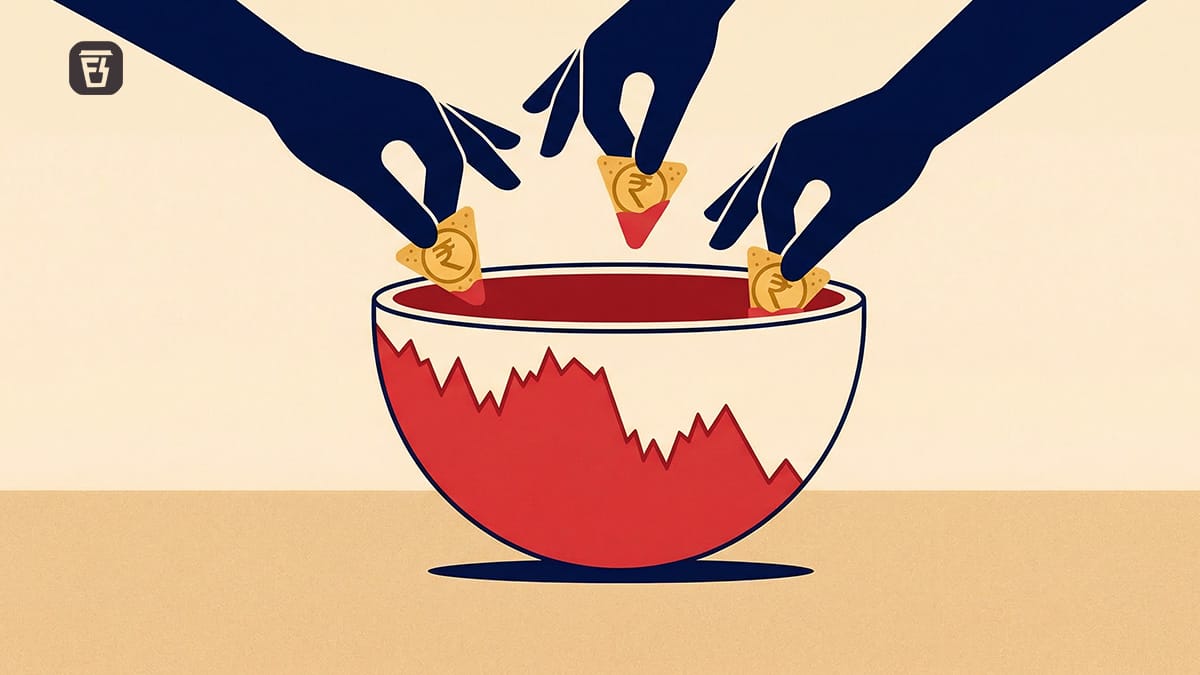
In today’s Finshots, we talk about the falling markets and what ‘buying the dip’ really means.
But here’s a quick disclaimer before we begin. Companies or stocks mentioned in this edition are only examples and not investment advice. Please do your own research or consult a registered financial advisor before investing.
Now onto today’s story.
The Story
On February 27th, 2026, a day before the US-Israel-Iran war began, the NIFTY closed at 25,180 points. Since then, it has slipped about 8%.
And as the market fell, one web search term suddenly started popping up everywhere — “buy the dip”. According to Google Trends, search interest for that phrase has surged. For context, in India alone, it has jumped nearly 5,000% since the war broke out.
You’ve probably seen this play out around you too. The news is talking about it. Social media chats are buzzing with it. And people who discovered stocks during the 2021 pandemic boom may be telling you that this could be “the chance of a lifetime.” Not to forget the finfluencers who may be reminding you that Warren Buffett loves it when markets bleed.
Now, none of that is entirely wrong. But it isn’t entirely right either.
And the gap between those two things is exactly where real money gets made… or even lost. Because the truth is, most people casually throwing around the phrase “buy the dip” don’t really understand what they’re saying.
So let’s slow down and talk about what buying the dip actually means.
To begin with ‘buying the dip’ sounds like a single idea. But in reality, it usually falls into three very different situations.
The first is a valuation dip. This happens when a fundamentally strong company or index falls simply because the entire market panicked.
Think about early 2020 when COVID first appeared. Nobody knew how serious the virus would be, so markets crashed. Between January and March 2020, for instance, the NIFTY and SENSEX both fell about 38%. But many companies inside those indices were still strong businesses. Their long-term earnings potential hadn’t really changed. So you could say that markets were reacting to uncertainty. And looking back, buying during that fall turned out to be a genuine gift.
The second type is a structural dip. This happens when something fundamental changes such as a sector getting disrupted, a company losing its edge, or a policy reshaping an industry.
Take telecom stocks in 2016 and 2017. Prices fell sharply when Jio entered the market with free voice calls, cheap data and free roaming. That wasn’t just panic, but the industry itself changing. This meant that buying telecom stocks blindly back then would have been like buying a burning building at a discount, with a few exceptions like Airtel.
And then there’s the third kind or what veteran investors call a geopolitical dip.
This is the trickiest and most misunderstood category. And it’s exactly the situation markets are facing right now.
Just to give you a quick flashback, on February 28th, the US and Israel launched joint airstrikes on Iran. The strikes killed Iran’s Supreme Leader Ayatollah Ali Khamenei and triggered Iranian retaliation across the Gulf. Iran responded by striking US and Israeli military facilities in the region, including bases in Qatar, Kuwait and Bahrain.
But the bigger shock came from the Strait of Hormuz. Iran effectively halted traffic through this narrow waterway — the route through which nearly 20% of the world’s oil flows. Suddenly global oil supply looked uncertain. And Brent crude (a widely used international benchmark for oil) briefly ended up touching $120 a barrel.
For India, which depends heavily on imported oil, that’s a serious problem. The scramble for alternative supplies and the broader geopolitical uncertainty rattled investors. So in just days, Indian markets wiped out over ₹25 lakh crore in investor wealth.
But markets rarely move in a straight line. Around March 9th, indices briefly recovered a few hundred points. And if you were watching social media, you probably saw some people declaring things like “dip bought, profit incoming.”
But… you know what happened next.
After that brief bounce, markets fell again.
Which raises an obvious question: how do you know when the dip has actually arrived?
Well, the honest answer is simple.
No one really knows.
But during times like these there’s an interesting idea that doesn’t get much attention. It’s something researchers call the War Puzzle. The concept comes from a 2015 study by researchers at the University of Zurich. They examined how stock markets reacted to major conflicts since World War II — including the Vietnam War, the Gulf War, the Iraq War and the Afghanistan War. Their goal was to see how markets behaved as tensions escalated and when wars actually began.
And what they found was surprising. Unlike an old saying often attributed to London financier Nathan Rothschild, which goes, ‘Buy on the sound of the cannon, sell on the sound of the trumpet’, the research found almost the opposite.
As the probability of war rises, markets usually fall because investors fear economic disruption and geopolitical risk. But once the war actually begins, markets often stop falling and sometimes even rise.
That’s the War Puzzle. Uncertainty peaks when a war seems likely. Once the conflict begins, that uncertainty disappears, even if the news itself is bad.
There is one twist though. When wars erupt suddenly without warning like the Korean War in 1950 or Iraq’s invasion of Kuwait in 1990, markets often drop sharply when the conflict begins.
Which tells you something important. In markets, the real enemy is often uncertainty.
And that explains something slightly counterintuitive you may have noticed recently.
Even after the strikes began on February 28th, markets didn’t collapse outright. They wobbled and fell. But they also partially recovered at times. Indices like the S&P 500, FTSE, Nikkei, Hang Seng and the NIFTY all slipped, then gained back some ground before falling again as investors tried to price in different scenarios.
But the War Puzzle carries an important warning. The most dangerous time to buy is often when a war might happen. The better moment usually comes once the war has begun — but only after investors get some clarity on how it might end.
So how do you know if this dip is actually buyable?
To answer that, you need to ask yourself two questions.
- Is the damage to earnings temporary or permanent?
Take Indian IT companies as an example. If we’re talking purely about the war, the damage may be temporary. Their clients are largely American and European firms not directly tied to Middle Eastern oil routes. So if these companies can manage the separate AI risk, they may show the resilience that they’ve demonstrated in past slowdowns. Of course this is just an example and not investment advice.
Aviation, on the other hand, could be different. Airline stocks like IndiGo have reacted sharply as oil prices jumped. That’s because higher crude pushes up aviation turbine fuel costs and hits airlines directly. In that case you may not be buying a temporarily mispriced stock but stepping into a genuinely tougher operating environment or what investors often describe as catching a falling knife.
- What is the most likely resolution pathway, and how long could it take?
This is where many retail investors stumble and ask, “Will the market recover?”
See, it almost always does, eventually. So the better question is: how long will the pain last, and can I afford to sit through it?
Now, no one can be certain. But some research and analyst views suggest that the conflict could settle within roughly two months. That means if you invest during this period, you shouldn’t assume that the market bottom has already arrived.
Instead, you could focus on fundamentally strong stocks that are down mainly because of war panic — while being prepared for more volatility if the conflict drags on.
In fact, there’s also another bonus point to think about: where the market was before the dip. This matters just as much as the size of the dip.
Because before this war began, Indian markets were already considered significantly overvalued. So even a 10% fall from an all-time high during a war and oil shock doesn’t automatically make stocks cheap. It may simply bring valuations closer to fair value.
So buying the dip may not be wrong. But calling it a generational opportunity may be stretching things too far.
There’s also some historical context. An analysis of six major geopolitical events between 1990 and 2026 shows that on average the SENSEX delivered 3-month forward returns of around 28% and 6-month returns of about 38% from crisis lows. But those returns started from genuine panic bottoms, not mild corrections.
So what should you actually do?
If you’re a long-term investor who owns companies with strong earnings and fundamentals, the simplest answer may be to do nothing.
But if you have surplus cash, one sensible approach is to invest gradually by staggering purchases of more of these stocks or other fundamentally strong companies that once felt too expensive. That way, even if prices fall further because of panic, you’ve entered at fairer levels.
And if you’re panicking and thinking of selling, pause for a moment. Ask whether your original investment thesis has changed. If you bought a company for its export revenues and management quality and the stock has fallen 10% simply because Brent crude is at $100, that might be the dip worth buying — not the one to panic sell.
In the end, the market isn’t a machine that rewards courage. It rewards clear thinking when under pressure.
Right now, across Dalal Street, thousands are rushing in or rushing out, believing that timing the market is wisdom. But the real edge lies in understanding why something fell, what needs to happen for it to recover, and whether you have the patience to wait.
Because the dip is real.
But the real question is: which dip, in what, and for how long?
And that question is worth far more than any finfluencer advice or WhatsApp forward you’ll see today.
Until then…
If this story helped you make sense of how to navigate markets during uncertain times, consider sharing it with your friends, family, or even strangers on WhatsApp, LinkedIn, or X.
Message to All the Breadwinners
You work hard, you provide, and make sacrifices so your family can live comfortably. But imagine when you're not around. Would your family be okay financially? That’s the peace of mind term insurance brings. If you want to learn more, book a FREE consultation with a Ditto advisor today.