
SBI's best quarter ever?

In today’s Finshots, we break down SBI’s latest quarterly results.
The Story
State Bank of India (SBI) just reported what many are calling its best quarter ever. And to be fair, the numbers give that claim some weight.
The bank’s overall business, i.e., its total deposits plus advances grew 11% quarter-on-quarter (QoQ), crossing ₹103 lakh crore. A big part of this came from advances, which in turn pushed up its net interest income, which rose 5% QoQ to ₹45,000 crore.
Higher income meant stronger profits. So naturally, net profit grew 4% over the previous quarter and a sharp 24% year-on-year (YoY), clocking its highest-ever quarterly profit of ₹21,000 crore in Q3FY26. And if you zoom out a bit, for the nine months ended FY26, SBI reported a net profit of ₹60,300 crore compared to ₹52,200 crore in the same period last year.
And then there’s asset quality — something banks are constantly judged on. SBI’s numbers here look particularly solid. Its Gross NPA (non-performing assets or total value of loans and advances that have stopped generating income due to defaults) ratio improved to 1.57% (from 1.73% last quarter), while the Net NPA ratio dropped to 0.39% (from 0.42% last quarter). In fact, these are the lowest levels the bank has seen in over two decades.
Naturally, the market liked what it saw. The stock jumped 12% in the week after the results. And as a result SBI also crossed the ₹11 lakh crore market cap mark, becoming the fourth-largest listed company in India.
But here’s the thing. Big headline numbers can tell one story. But the deeper details sometimes tell another.
So the real question is — was this truly SBI’s best quarter?
On the surface, yes. But scratch that surface just a little, and a few interesting nuances begin to show up.
Let’s start with what actually powered those profits.
Interest income did rise, no doubt. But a meaningful chunk of the boost came from non-interest income, not all of which was recurring. To put things in perspective, SBI received a one-time special dividend of ₹2,200 crore from its subsidiary, SBI Mutual Fund. It also booked ₹770 crore as interest on income-tax refunds. Add to that a massive 174% YoY jump in treasury operations — essentially gains from revaluing its own investments.
Now, treasury gains are still part of the bank’s earnings. But they’re not the core, steady, bread-and-butter banking income.
And when you adjust for these one-offs, the Net Interest Margin (NIM) or the difference between the interest the bank earns on loans and what it pays on deposits and borrowings, relative to its earning assets, starts to look slightly different.
What that means is, on a QoQ basis, NIM inched up 2 basis points to 2.95%. That sounds fine. But if you look at the graph since Q3FY25, you’ll see that SBI’s NIM has fallen by 17 basis points. And when you adjust for those one-off incomes we spoke of earlier, NIM actually looks 1 basis point weaker than what was reported this quarter.
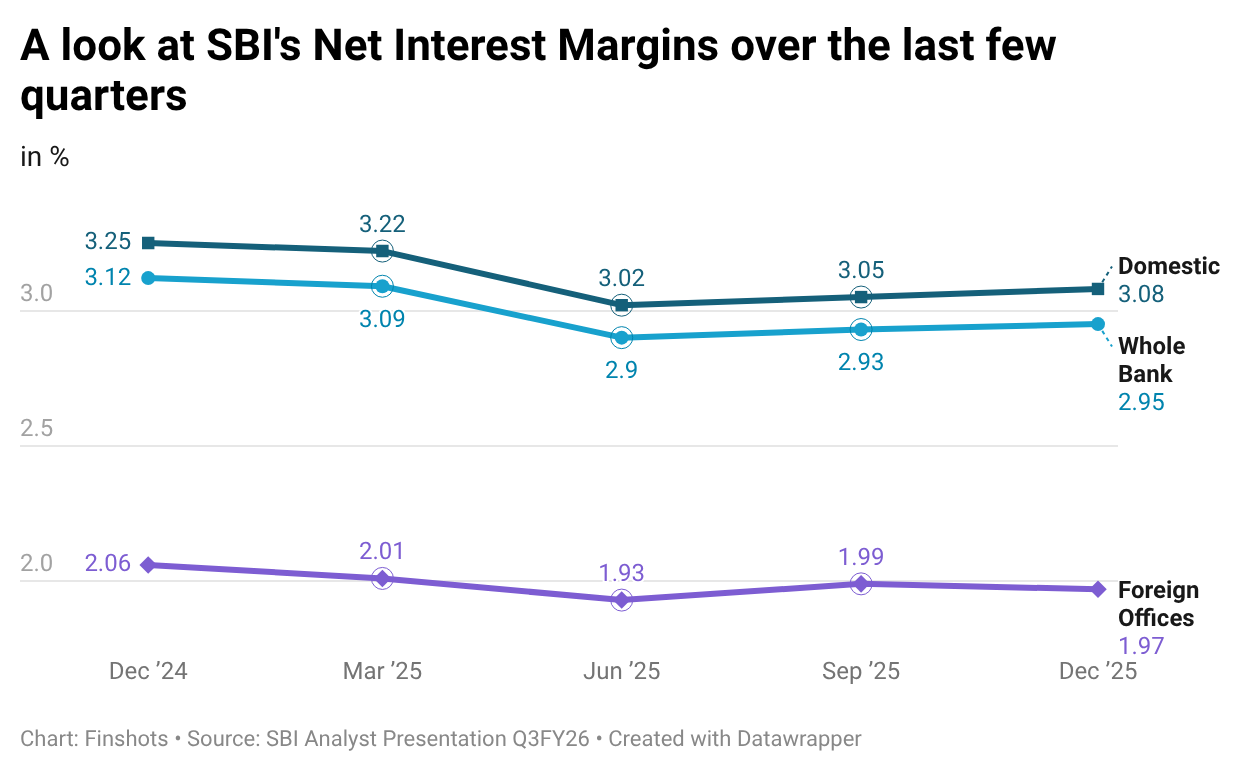
Now, 1 basis point might not sound dramatic. But when you notice a gradual downtrend over multiple quarters, it starts to matter.
And that’s important because we’re in an environment where deposits aren’t easy to gather. Banks are competing hard for them. When funding costs rise and deposit growth becomes tougher, maintaining margins becomes a delicate balancing act.
Which brings us to the one metric everyone keeps circling back to when they talk about NIM — the CASA ratio. CASA simply stands for Current Account Savings Account deposits. And CASA ratio is CASA deposits expressed as a percentage of a bank’s total deposits.
And this ratio has quietly become the biggest headache for banks lately since it’s been slipping across the industry. Many private banks, in particular, haven’t been able to grow their CASA books meaningfully. That’s obviously because depositors are choosing to park their money in the stock market or other higher-yielding instruments as opposed to just leaving them almost idle in their bank accounts.
But the thing is that these CASA deposits are the cheapest source of funds for banks. Savings accounts typically cost them around 2.5–3% in interest, whereas current accounts cost nothing. And losing these cheap CASA deposits creates a problem especially since credit growth across India has been outpacing overall deposit growth.
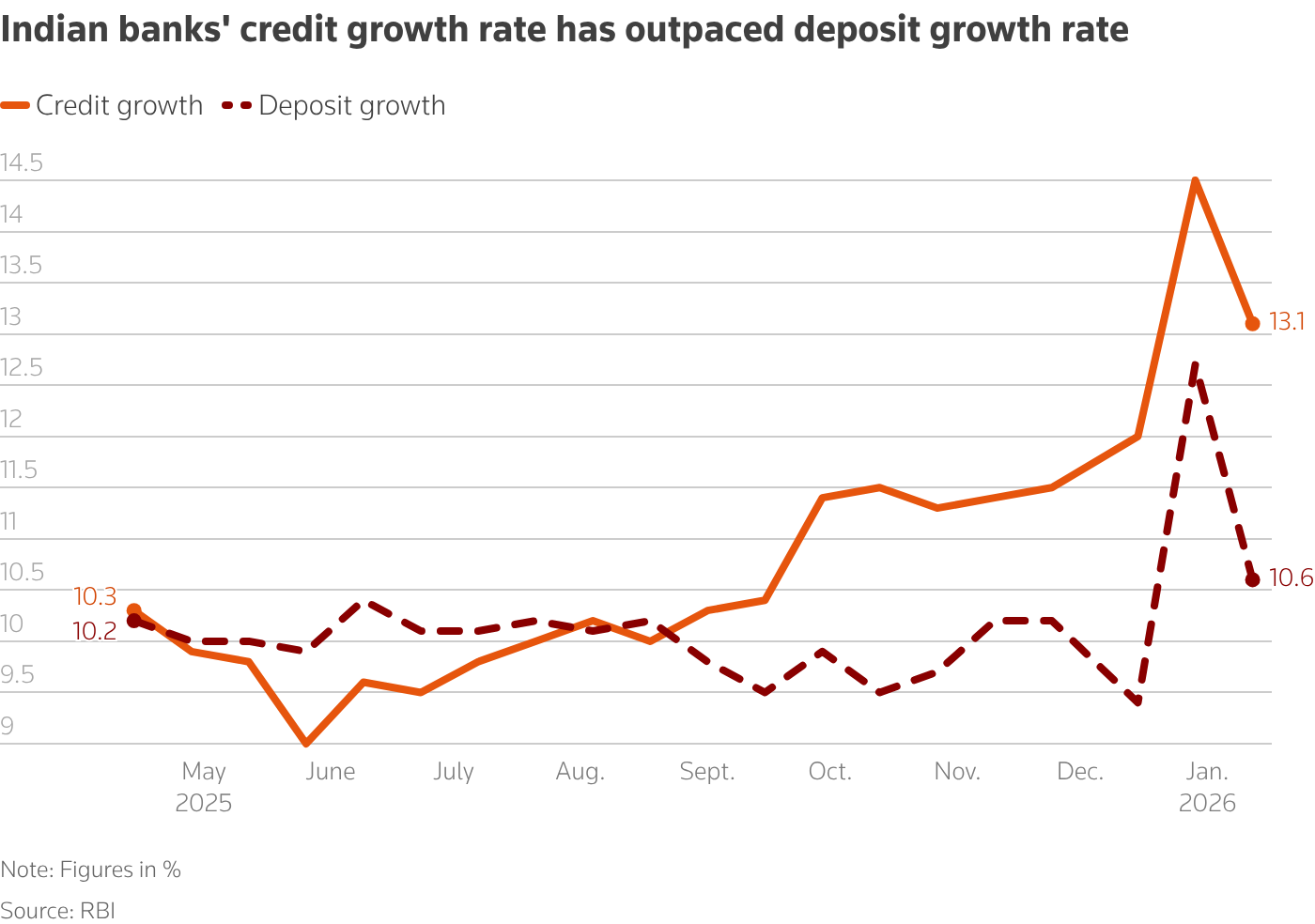
So when credit demand rises and CASA deposits don’t grow fast enough, banks are forced to lean more on term deposits, which come with higher interest rates. That pushes up their cost of funds. And when that happens, their NIM starts to shrink.
We’ve seen this play across many large private banks.
HDFC Bank’s CASA ratio, for instance, slipped from 34% to 33.6% YoY, even though total deposits grew 11%. Kotak Mahindra Bank saw a sharper drop. Its low-cost CASA ratio fell 101 basis points YoY to 41%, despite deposit mobilisation rising 14% and credit disbursals jumping 16%. Axis Bank wasn’t spared either. Its CASA ratio declined 60 basis points to 39%, even as loans grew 14% and deposits increased 15%.
This makes SBI’s CASA performance look relatively stronger. For context, its CASA ratio stood at 39.13% in Q3FY26, only marginally lower than 39.2% a year ago. More importantly, its CASA deposits actually grew 8.88% YoY, touching ₹21.4 lakh crore.
The only other large bank that managed to keep its CASA ratio broadly stable was ICICI Bank at 39%. But when you look at the scale, there’s a huge difference. While ICICI’s CASA deposits stand at about ₹6.5 lakh crore, SBI’s is over five times that.
Which makes you wonder — how exactly is SBI managing to hold on to its CASA in such a tight liquidity environment?
At first glance, the answer seems obvious. SBI is the default banker for central and state governments, PSUs, and millions of salary and pension accounts. Naturally, that gives it a steady stream of low-cost deposits. And yes, that’s a real advantage.
But even government current account mobilisation has been drying up lately.
Which is why, over the last couple of years, SBI has quietly pivoted. It has leaned more into private-sector business accounts. That shift has led to a steady uptick in current account balances. Instead of aggressively chasing affluent retail customers like some of its peers, SBI has focused on granular SMEs and MSME accounts. It has also partnered with institutions like temples, universities and similar organisations to build “sticky” current accounts, which are equivalent to low-cost deposits that don’t flee at the first sign of a higher interest rate elsewhere.
And then, of course, there’s scale.
SBI is simply massive. It accounts for roughly a quarter of all loans in India. For every ₹100 lent in the country, about ₹22–23 comes from SBI. That’s serious heft.
Add to that its physical presence — over 23,000 branches, more than the next five banks combined. That reach allows SBI to mobilise even the smallest household deposits from the smallest towns. Individually, those amounts may seem tiny. But together, they meaningfully strengthen the CASA book. And that, in turn, helps keep its credit-deposit ratio in a relatively comfortable position even as credit demand continues to surge.
So yeah, that’s pretty much the story behind SBI’s so-called best quarter.
And maybe it’s fair to call it that. Because even though SBI clearly has structural advantages on its side, it has still managed to hold steady in the face of some real headwinds.
The numbers look strong. The foundation looks stable. And while not every metric is meaningfully improving, the bank is still holding its ground at a time when many others are facing pressure.
And sometimes, that’s good enough to earn the title.
Until next time…
Liked this story?
Share it with a friend, family member or even strangers on WhatsApp, LinkedIn, or X.
Before you go…
A quick note for our NRI readers!
If you’re living abroad, there’s a good chance you’re overpaying for life insurance.
Indian term insurance can often be way cheaper than policies in the US, UK, or Singapore. But eligibility rules, medical tests abroad, rider restrictions, and claim settlement in INR can get complicated fast.
So we put together a practical, no-fluff guide on Term Insurance for NRIs in India covering premiums, documentation, underwriting, and what really happens during a claim.
If you earn abroad but your family depends on India, this is worth 5 minutes.