
Reading between the lines of Info Edge's shareholder letter
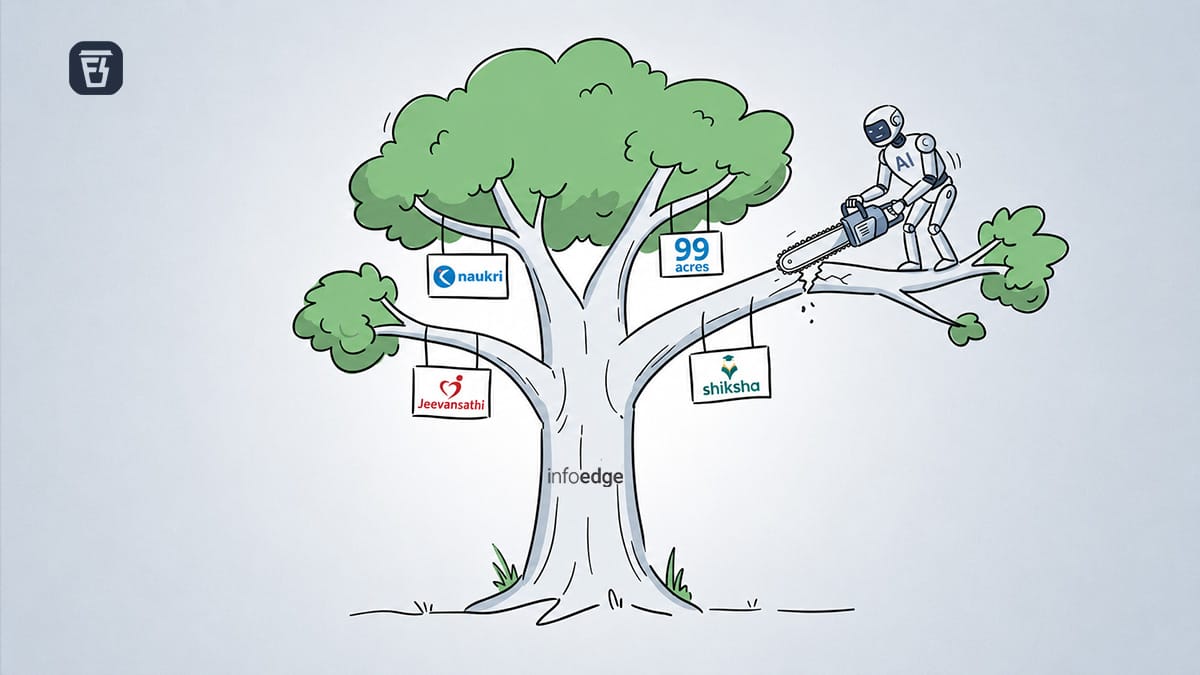
In today’s Finshots, we give you a quick rundown of Info Edge’s latest letter to shareholders and try to understand whether its AI bets are smart or potentially self-sabotaging.
But here’s a quick sidenote before we begin. We’re looking for a business writer to join Finshots’ newsletter team. If you’re someone who can tell compelling stories and explain financial concepts in plain English without drowning readers in jargon, do consider applying through the link here. Or share this with someone who might be a good fit for the role.
Now onto today’s story.
The Story
If you haven’t had the chance to read Info Edge’s shareholder letter released this week, here’s the gist.
But first, you need to know that Info Edge is really two businesses rolled into one. On one side, it runs businesses like Naukri.com (job portal), 99acres (property listing platform), Shiksha (education discovery platform) and Jeevansathi (matrimony platform) that generate steady cash. On the other, it uses that cash to invest in startups like a venture capital fund.
And this year’s shareholder letter is almost entirely about that second business, with three main highlights:
- The company invested ₹614 crore across 28 AI startups. Those investments have already doubled in value to ₹1,268 crore.
- It has invested ₹455 crore in deeptech companies. These bets have returned a modest 1.2x so far because most of these companies are still focused on research and intellectual property. Meaning, they haven’t built real products yet. So generating revenues and returns could take more time.
- And finally, overall, Info Edge has invested ₹4,900 crore across 135 startups. Today, that portfolio is worth a staggering ₹41,300 crore! But there’s a catch. Nearly ₹31,500 crore of that value comes from just two companies — Eternal (formerly Zomato) and PB Fintech (Policybazaar). Strip out these two, and the rest of the portfolio looks far less glamorous.
Put all this together with one line in the letter: “We believe future value creation will be driven by Artificial Intelligence, Deeptech and Consumer Technology”; and it’s easy to see why the stock jumped about 4% the next day.
But here’s what you probably missed from the shareholder letter. Info Edge’s AI strategy could actually be a double-edged sword.
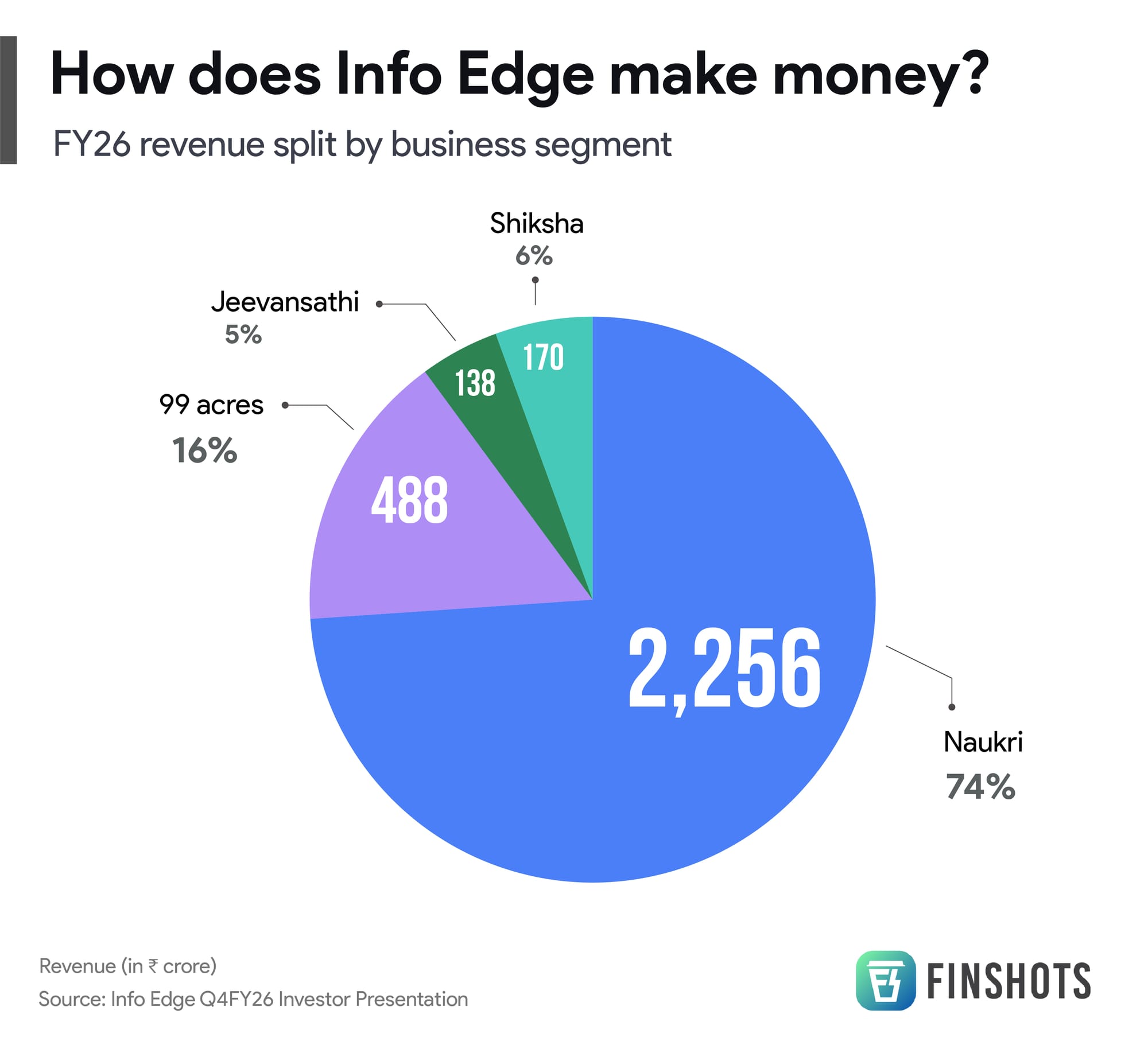
Remember where the money for all these investments comes from? It’s largely generated by its operating businesses. And Naukri is by far the biggest one, contributing about 74% of the company’s revenue.
Now, Naukri’s business model is surprisingly simple. It’s essentially a marketplace that connects recruiters with job seekers. Companies pay Naukri to post jobs and access its resume database. Job seekers use the platform for free. And this model has worked remarkably well for nearly three decades.
But it rests on one key assumption: that companies need a platform like Naukri to find the right candidates, and that they’ll keep paying for it.
And AI could challenge that.
After all, searching through millions of resumes and matching candidates with jobs is exactly the kind of task AI excels at. So, instead of paying Naukri to search its database, recruiters could increasingly rely on AI agents that scan not just job portals but the entire internet to do the job.
If that happens, Naukri’s resume database may no longer be as valuable as it once was, no?
There’s another problem too. Naukri grows when companies hire. But AI is also slowing hiring in the very industries that matter most to it — Indian IT and other white-collar sectors. For context, net hiring in India’s top five IT companies has collectively dropped by around 7,000 employees in FY26. TCS alone laid off 12,000 employees last July and now plans to hire only 25,000 fresh graduates this year, well below its average intake of around 40,000 over the past three years. Even if you look at the gross hiring of IT firms for the last five years, it averaged around 2.3 lakh employees, but in FY26 they added only around 1.7 lakh of them.
And fewer hires mean fewer job postings, fewer recruiter searches and, ultimately, slower revenue growth for Naukri.
That’s exactly where the irony lies because if you think about it, Info Edge is using the profits from Naukri’s toll booth to fund AI startups, some of which could one day make that very toll booth obsolete.
Now, you could argue that this isn’t necessarily a bad strategy and that Info Edge is probably hedging its bets. If its operating businesses slow down, the gains from its startup investments could help offset the weakness.
But there’s a catch. Those investments are funded by the cash generated from the operating businesses in the first place. So for the investment engine to keep running, the operating engine has to stay healthy. It’s a bit of a vicious cycle.
And since Naukri generates most of Info Edge’s revenue, cash and profits, with the other businesses still too small to pick up the slack, any threat to Naukri becomes a threat to the entire engine.
To put things in perspective, Naukri’s recruitment billings grew 9.5% year-on-year in Q4 FY26, down from 11% in the previous quarter and below its historical average of 14–15%. Revenue, meanwhile, grew 14%.
But billings are the number to watch. That’s because Naukri works like a subscription business. Companies pay upfront for a certain period of job postings or access to its resume database. That’s recorded as billings. Revenue, however, is recognised gradually over the life of the contract. In other words, today’s billings become tomorrow’s revenue.
And slower billings are something Naukri can’t really afford.
But it could happen if you think about how most people find jobs today. They probably Google something like “software jobs in Bengaluru” or “marketing jobs for freshers”. Right now, Google still needs to send job seekers to Naukri because AI Overviews can’t replace a job portal just yet. But what if Google or even someone like OpenAI builds an AI powered jobs platform that answers those searches directly?
That’s what’s increasingly being called the “Google Zero” effect, a scenario where Google stops sending traffic to websites because users get the answers they need directly from AI Overviews.
In fact, Info Edge has already seen this happen with Shiksha. As Google’s AI began answering education-related queries directly, fewer students visited Shiksha’s website and its billings fell 13%.
Put all of this together, and it’s clear that Naukri needs to become more than just a classifieds platform. It needs to evolve into a jobs intelligence platform that tells recruiters not just who applied, but who is most likely to join, perform and stay.
And maybe Naukri already knows this. That’s why it’s begun reinventing itself.
Take AI REX, for instance. It’s an AI tool that automates much of the hiring process — from collecting job requirements to shortlisting candidates, helping companies hire faster. Products like these move Naukri beyond simply selling access to a resume database. Instead, they’re selling AI-powered services that are harder to replace and can command higher prices.
At the same time, Naukri is becoming less dependent on India’s IT sector. Businesses like Global Capability Centres (GCCs), which grew 17% last year, along with platforms like IIM Jobs and Naukri Gulf, are helping drive that shift. GCCs are the India-based offices of global companies, and unlike many IT services firms, they’re still hiring aggressively. Focusing more on these customers could help Naukri reduce its reliance on the ups and downs of the Indian IT industry.
But perhaps the bigger challenge lies in the fact that AI-powered hiring platforms are shifting the focus from resumes to verified skills. Instead of simply listing qualifications, candidates can prove what they know through tests and certifications, allowing AI to match them with the right employers. If Naukri doesn’t build similar capabilities, it risks becoming little more than a resume database in an AI-first world.
So yeah, the bottom line is that, for now, Naukri’s revenue still looks healthy because it’s recognising revenue from contracts signed months ago. But the early warning signs such as slowing billings and weak IT hiring, are becoming harder to ignore. At the same time, AI-powered hiring platforms and changing internet search habits are making the industry far more competitive.
To its credit, Info Edge isn’t standing still. It’s investing in AI tools, diversifying its customer base and trying to move Naukri beyond being just a resume database. The real question, though, is whether these bets can scale fast enough before the slowdown in billings starts showing up in revenue.
Because if they don’t, that bold line from the shareholder letter, that “future value creation will be driven by AI and deeptech”, could end up being tested much sooner than investors expect.
Until then…
Liked this story? Share it with someone who keeps talking about credit scores on WhatsApp, LinkedIn and X.
🚨 ATTENTION: FINSHOTS FAMILY
This weekend, we’re hosting a free 2-day Insurance Masterclass that helps you build real financial security by understanding health and life insurance the right way.
📅 Tomorrow (Saturday), 27th June at 11:00 AM: Life Insurance
How to protect your family, choose the right cover amount, and understand what truly matters during a claim.
📅 Sunday, 28th June at 11:00 AM: Health Insurance
How hospitals process claims, common deductions, the mistakes buyers usually make, and how to choose a policy that won’t disappoint you when you need it most.