
Why US tariffs just got slower
In today’s Finshots, we tell you why US tariffs just got a whole lot slower and what it means for the next phase.
But before we begin, if you’re someone who loves to keep tabs on what’s happening in the world of business and finance, then hit subscribe if you haven’t already. If you’re already a subscriber or you’re reading this on the app, you can just go ahead and read the story.
The Story
Last year, tariffs slipped into the world the way higher prices often do. There was no single moment when everything changed. Goods became a little more expensive, negotiations a little harder, and decisions a little more cautious. Before long, everyone behaved as if this was simply how things were going to be. Not just India, but every major economy — from China and the European Union to the UK and Australia.
The tariffs were broad and applied across countries. That scale forced companies and governments to respond as if the rules had genuinely changed forever.
For India in particular, the stakes were high. The US is one of India’s largest trading partners, with annual goods trade crossing $120 billion in 2024, and key export sectors exposed to tariff risk. India was also among the countries facing higher reciprocal duties, making the hit feel both immediate and structural. Up until very recently, we were on the verge of signing our own trade deal with the US. And the alternative to not having one, was being exposed to a ridiculously high 500% tariff.
As a result, countries began accelerating trade negotiations with the US and with each other. All of this was just to hedge against what looked like a prolonged phase of American protectionism. Supply chains were adjusted. Investment plans were reworked. The assumption was simple: tariffs were here to stay.
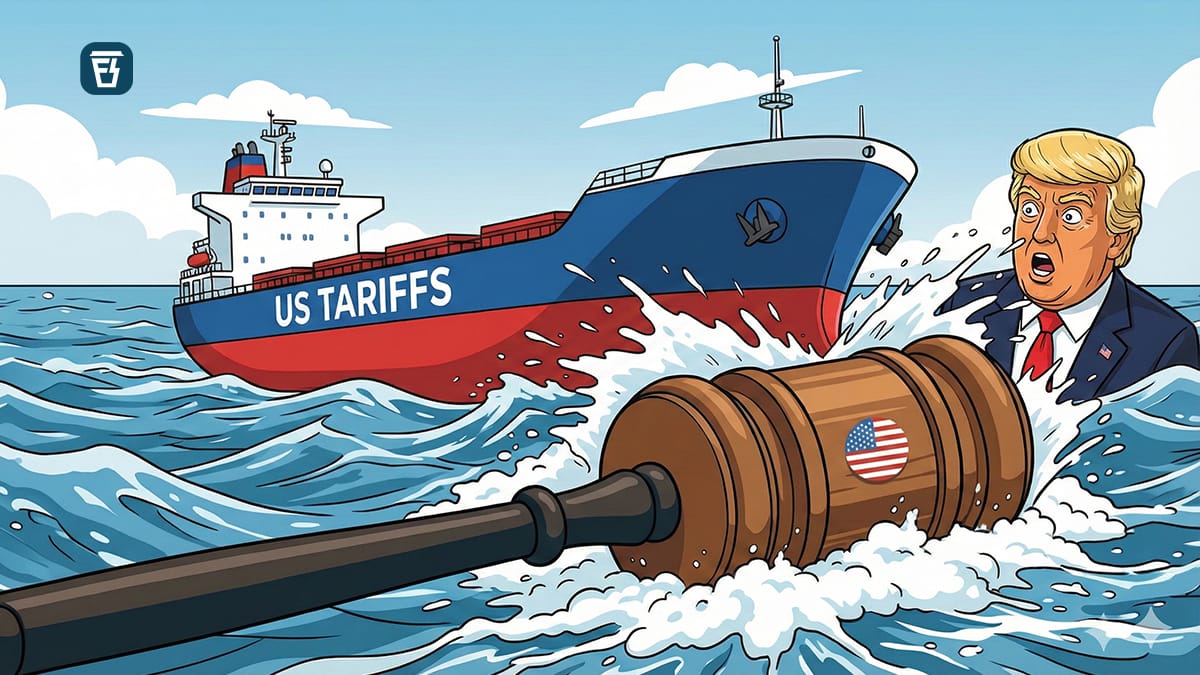
That assumption broke abruptly last week when the US Supreme Court ruled that the tariffs imposed by the President were illegal.
That single judgment didn’t just undo a set of duties. It questioned something far more fundamental — whether tariffs can be imposed quickly and kept indefinitely without Congressional approval.
Here’s why. When the tariffs came into effect last year, governments and companies worked around them without much protest, more focused on what to do next. But almost no one stopped to ask a basic question first - were they legal?
You see, the tariffs were imposed by President Trump by using a law called the International Emergency Economic Powers Act (IEEPA). This is a law meant for genuine national emergencies. Now what constitutes an emergency are things like threats to national security, state sponsored terrorism and foreign government aggression.
But what doesn’t count as an ‘emergency’ per se are trade deficits, general economic imbalances and of course tariffs.
That difference is exactly what the US Supreme court pointed out.
In its 6-3 ruling last week, six justices agreed that the tariffs were unlawful, while three dissented. It stated that emergency powers can’t be used as a shortcut to run long-term trade policy. Tariffs aren’t a short-term fix — they change how businesses plan for years. The court’s view was that emergency powers weren’t meant to be used that way.
But this ruling didn’t say that tariffs can’t be imposed at all. It only said it can’t be imposed this way (through the IEEPA). The ruling also landed at an awkward economic moment. With US growth slowing, doing nothing wasn’t really an option — even if the fastest legal route had just been shut.
That one distinction led to what came next. The White House complied and removed the previous tariffs it imposed but in turn, it took a different route.
They did it by imposing a temporary import surcharge, capped at 150 days, using a narrower trade law designed for short-term balance-of-payments stress. The surcharge was applied across all countries and later raised from 10% to 15%. It may be called a surcharge, but for global trade it looks and feels like a tariff — just one with an expiry date.
So what does this mean now and what does the future look like?
Well for starters, the tariffs haven’t disappeared completely. They’ve just changed form. They are now more temporary, more legally fragile, and harder to sustain without backing from Congress. But the repercussions are what could make this a case study for future generations.
Let’s start with the importers who were actually paying the tariffs in the first place.
They are already preparing to challenge the duties they’ve already paid. And even though it hasn’t been that long, the US Treasury could be looking at an eye-watering $175 billion of refunds from 3 lakh businesses.
This isn’t the first time the US government has had to refund companies. Back in 1998, when a different import-related tax was partly struck down, roughly $730 million was eventually refunded — a process that took nearly two years to complete.
The tax in question was the Harbor Maintenance Tax, introduced by Congress in 1986 and calculated as a levy on the value of cargo moving through US ports. The Supreme Court later ruled that applying the tax to exports was unconstitutional, forcing the government to roll it back and issue refunds.
For the current scale and size, it could be years before businesses actually start seeing refunds. When asked about the refunds, Trump himself said that they’ll end up being in court for five years.
In the meantime, any effort to make tariffs last will have to pass through slower channels — formal investigations, national security reviews, or Congress itself.
More importantly, the ruling shifts the balance of power. Earlier, tariffs were imposed first and questioned later. That sequence has now reversed. Speed no longer guarantees durability. Any tariff announced overnight is far more likely to be temporary, challenged in court, or rolled back unless it survives a longer political and legal process. Because the US Supreme court literally stated that only Congress had the power to levy taxes and duties under the constitution.
Already, the EU, China and other major countries have stepped forward and are reconsidering past agreements. The EU clearly stated that it won’t be accepting any tariff increase from the US, given how they already signed a trade deal last year. Beijing has said it is conducting a “full assessment” of both the Supreme Court ruling and the new temporary tariffs.
But India’s response stands out for what it hasn’t done.
Rather than rushing to finalise or rewrite trade commitments, India has paused, reassessed, and waited. Officials are studying how the Supreme Court ruling and temporary tariffs affect earlier assumptions baked into negotiations.
The Supreme Court ruling doesn’t close the chapter on US tariffs. It opens a more complex one. For countries watching closely, including India, this moment calls for patience rather than urgency. With trade policy still up in the air, decisions made too quickly may age faster than the tariffs themselves.
So nothing about this moment feels settled yet. Tariffs are still in place, numbers are still shifting, and negotiations are still unfinished. But the idea that trade policy can be imposed quickly and treated as permanent has been gently unsettled.
Until then…
If this story helped you understand what changed with US tariffs, share it with a friend, family member or even strangers on WhatsApp, LinkedIn and X.
Message to All the Breadwinners
You work hard, you provide, and make sacrifices so your family can live comfortably. But imagine when you're not around. Would your family be okay financially? That’s the peace of mind term insurance brings. If you want to learn more, book a FREE 30 minute consultation with a Ditto advisor today.