
Why Softbank sold its golden goose
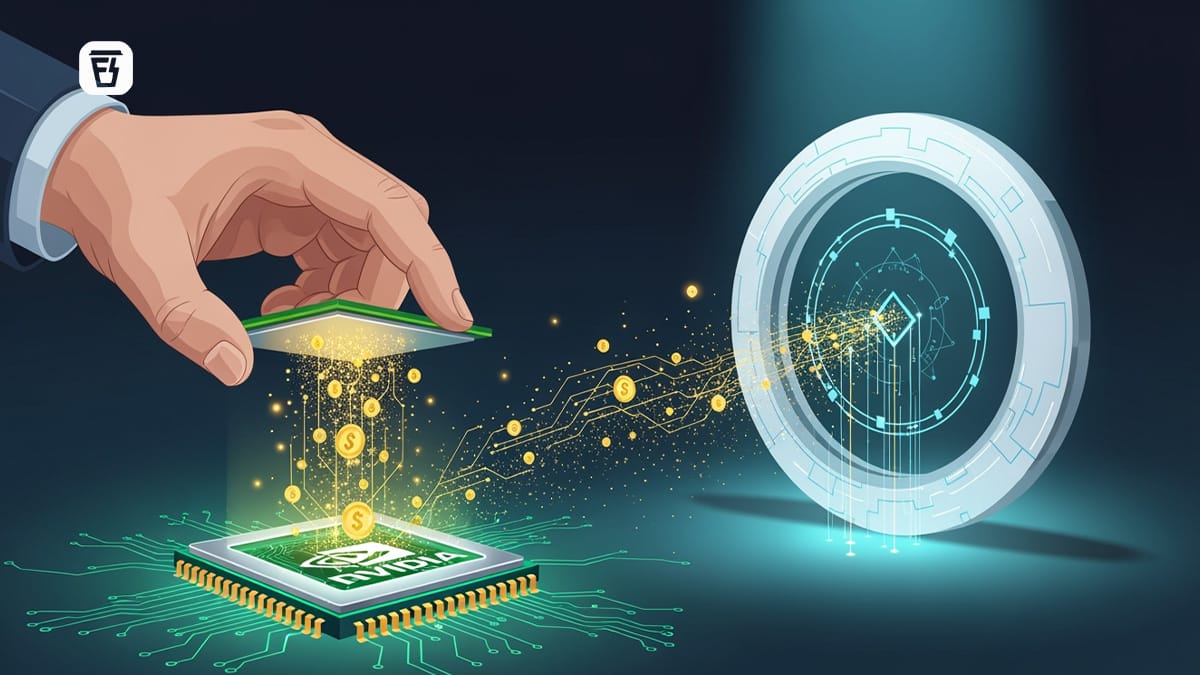
In today’s Finshots, we talk about Softbank’s recent stake sale of Nvidia, and what it plans to do with the proceeds through the Vision Fund.
But here’s a quick side note before we begin. Trust Finshots for Finance? You’ll love Ditto for insurance.
Built by the same four friends behind Finshots, Ditto is here to make insurance simple. No spam, only honest advice to help people make smart insurance decisions.
✅Backed by Zerodha
✅Rated 4.9 on Google (13,000+ reviews)
✅7 lakh+ customers advised
Click here to talk to an IRDAI-Certified advisor for FREE.
Now on to today’s story.
The Story
Meet Masayoshi Son, the CEO of Softbank. For years, he has been preaching a new dawn, one he calls the ‘AI Singularity’, a moment he believes will arrive within the next decade, when artificial intelligence surpasses human intelligence. That belief became the driving force behind Softbank’s ‘Vision Fund’, a $100 billion fund that actively seeks out and invests in AI startups, ride-hailing companies, and food delivery businesses. Son’s bold bets have made him one of the richest people in Asia, and turned Softbank into one of Japan’s most influential and profitable companies.
Now, when you’re running a multi-billion dollar fund, naturally, your eyes turn to the crown jewel of the AI-boom — Nvidia. And for Masayoshi, it wasn’t just a jewel, it was the keys to the empire. You see, he had invested in Nvidia in 2017, way before the stock rallied to the moon! Back then, GPUs (graphics processors) were still a small corner of the semiconductor market, and AI was just beginning to show some promise. But as the world caught on, Nvidia’s value skyrocketed and SoftBank, unfortunately, exited too early. Even Nvidia’s CEO, Jensen Huang, couldn’t resist teasing Son about it at the Tokyo AI Summit in 2024 — joking that they could cry together about it. Because at one point, Softbank was among Nvidia’s largest external shareholders.
To be fair, that regret is justified. In the past two years, Nvidia’s valuation tripled, briefly hitting $5 trillion this year. That made it the most valuable semiconductor company in history. Their GPUs are at the heart of the generative AI-revolution, powering everything from OpenAI’s ChatGPT to Anthropic’s Claude.
So for the Vision Fund, Nvidia was the perfect validation of Son’s long-running bet on the AI Singularity. And which better stock to hold than Nvidia? Its rise was the proof in the pudding.
As Nvidia became the hardware engine behind the AI-software boom, Softbank made billions and in every sense, it became the golden goose of the fund. Which is why what happened next confused the entire world.
In its October quarterly filings, SoftBank revealed that it had sold its entire Nvidia stake — roughly $5.8 billion worth, locking in almost a twofold return on its investment. The announcement caught markets off guard and briefly pushed SoftBank’s own shares into the red. After all, why would one of the loudest champions of artificial intelligence cash out of the very stock driving the AI boom?
For months, analysts and investors had been whispering about a potential AI bubble, and moves like this only fuelled those debates. The numbers themselves seem almost surreal — valuations in the trillions, profit multiples that defy history, and an industry moving faster than it can keep up with demand.
But it feels like they saw the public speculation from the Nvidia sale coming, which is why, in the same filing, Softbank stated its plans on investing the gains back into other AI ventures, with one of them being OpenAI.
But the irony in that, is how OpenAI is one of Nvidia’s biggest customers. That’s what has investors scratching their heads: capital and funding that leaves Nvidia somehow finding its way back.
Which definitely begs the question: Are we actually seeing an AI growth spurt or is it an echo chamber where every dollar invested circulates among the same few companies?
Well, the simple answer is both yes and no.
For SoftBank, though, it has always been about the long game. Eight years ago, when Eric Gunderson — then CEO of a little-known mapping startup called Mapbox, met Masayoshi Son, he expected to pitch his company. Instead, Son ended up pitching him on his plan to own a slice of every company touching the AI ecosystem, be it food, transport, finance, or medicine, because all of them were collecting data. And data, he argued, would become the new gold mine. Whoever owns the data owns the intelligence.
That’s where OpenAI’s “Stargate” project comes in — a massive next-generation AI data centre initiative reported to involve Oracle and projected by industry leaks, to require investments on the scale of hundreds of billions of dollars.
But a moonshot like that needs very deep pockets. And this is where SoftBank re-enters the picture. Flush with a quarterly profit of over $16 billion, it suddenly had the firepower to bankroll what might be the most ambitious infrastructure bet in AI history — and position itself as a primary financial backer. At the centre of this effort sits Masayoshi Son, whose vision of the AI Singularity is expanding beyond algorithms into the physical infrastructure that will power them. What began as a US-centric proposal is already global, with the first European site announced in Norway.
Okay, but why do data centres need such astronomical budgets?
To answer that, we need to rethink what a “data centre” is. You’re probably picturing rows of towers in an air-conditioned server room, with fans whirring in the background. This is how the internet-era servers are built. But companies like OpenAI, that run large language models, need much more than today’s servers can provide.
Think tens of thousands of Nvidia GPUs, all linked together to operate as a single unit. That kind of density demands enormous electricity — measured in gigawatts, equivalent to the power consumption of small cities. For context, with each of the 5 planned data centres, the initial plan of Stargate Project will need 10 gigawatts of power in total, enough to run about 7 million homes.
These GPUs also run hot, which means advanced liquid cooling is non-negotiable. That partly explains why Norway was chosen as the first European Stargate centre. Naturally cooler temperatures and of course, a lower cost of electricity doesn’t hurt, does it?
There’s another strategic layer here. Back in 2024, China announced plans to build eight advanced computing hubs as a part of its “Eastern Data, Western Computing” strategy. By setting up data centers in the US and Europe, they’re trying to train and keep the next AI boom within western borders.
But out of all these reasons, the most interesting is the future of AI itself — AGI or artificial general intelligence. Both Son and Sam Altman are building data centres that can support workloads no one fully understands yet. In short, they’re future-proofing.
And all of this fits neatly into SoftBank’s focus on “Physical AI”. Think robotics, data centres, and the cloud infrastructure that links intelligence with the physical world.
So if you connect the dots you’ll see that selling Nvidia didn’t mean abandoning the golden goose. It was funding the farm. This was Masayoshi’s goal with the Vision Fund: Own pieces of the companies that are crucial to the AI-driven future. So yeah, it’s more than a financial pivot
In its latest quarterly filing, SoftBank described its new strategy as ‘Physical AI: connecting intelligence with embodiment through robots, data centres, and cloud systems.’
Of course, the irony that Stargate’s construction will rely heavily on Nvidia’s chips, remains. The very company SoftBank exited will supply the silicon powering its next great ambition. But in the end, it perfectly captures this moment in AI history where the industry is so closely tied that even letting go of a golden goose can feel like feeding it from another hand.
Until then….
Liked this story? Share it with your friends, family or even strangers on WhatsApp, LinkedIn, and X.