
Why Microsoft and OpenAI are at odds
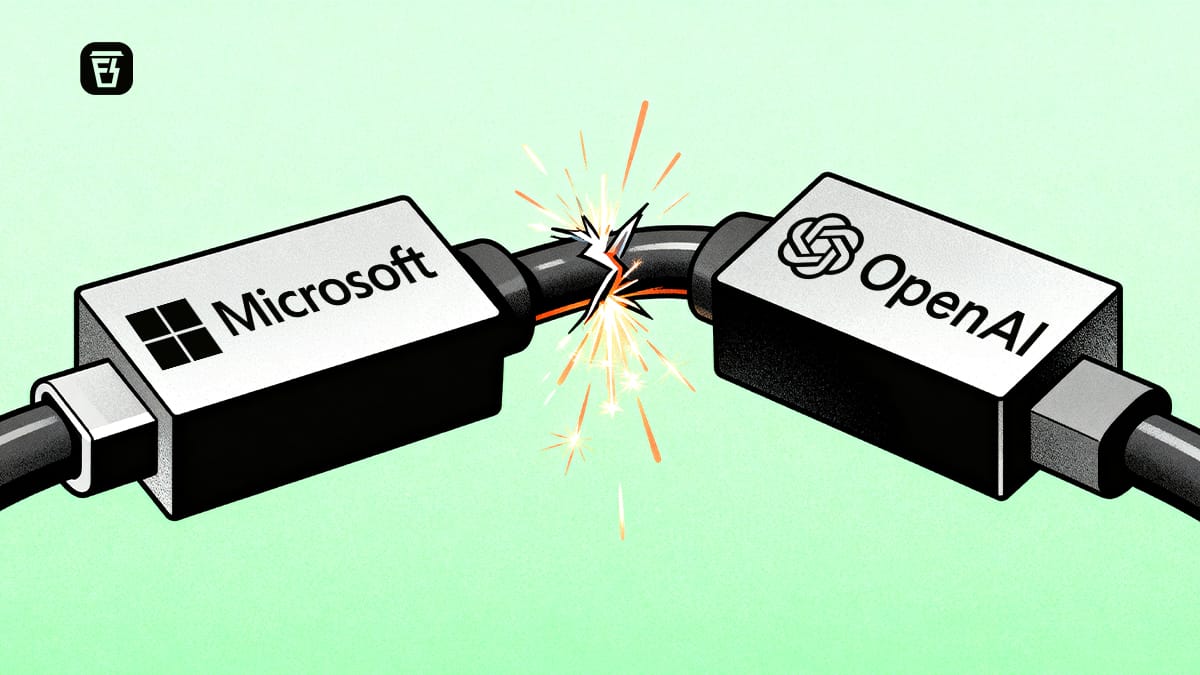
In today’s Finshots, we take a look at why semantics could decide the outcome of a potential multi-billion-dollar lawsuit between Microsoft and OpenAI.
But before we begin, if you love keeping up with the buzz in business and finance, make sure to subscribe and join the Finshots club, loved by over 5 lakh readers.
Already a subscriber or reading this on the app? You’re all set. Go ahead and enjoy the story!
The Story
For most people, generative AI is simple. You ask a question, and it gives you an answer. And if you ask a follow-up, it responds again. It’s like a conversation with any other person.
But behind this interaction lies a small detail: Does the AI model ‘remember’ things you’ve said earlier?
If it does, it’s called a ‘stateful’ model. If it treats every question like a fresh start, it’s called ‘stateless’.
And right now, that tiny distinction sits at the centre of a potential multi-billion-dollar battle between Microsoft, OpenAI, and Amazon.
Let’s take a step back and understand what’s really going on. Because, for years, OpenAI and Microsoft looked like the perfect partnership.
Back in 2019, Microsoft invested $1 billion in OpenAI, forging an agreement that required all access to OpenAI's AI models to be routed solely through Microsoft's Azure platform. This exclusivity positioned Azure at the centre of the generative AI boom, driving Microsoft's cloud revenues to record highs as global demand for ChatGPT and OpenAI's API skyrocketed.
Sidebar: An API, or Application Programming Interface, is essentially a bridge that allows two software systems to talk to each other. Think of it like ordering food at a restaurant. You don’t go into the kitchen and cook the meal yourself. You place an order, and the kitchen sends the food back. Similarly, when a company uses an AI model, it doesn’t build one from scratch. It simply sends a request through an API, and the model returns an answer.
As a result, Microsoft doubled down and invested another $10 billion in 2023. This investment secured Microsoft's rights to 49% of OpenAI's profits and access to both existing and future intellectual property (IP) generated by OpenAI until AGI (Artificial General Intelligence, or AI that can think and reason like humans) is achieved.
However, cracks have eventually started to appear in the partnership.
OpenAI’s rapidly growing computing demands started to outpace Microsoft’s willingness to fund infrastructure. Investors and even Microsoft AI’s CEO, Mustafa Suleyman, grew uneasy about Microsoft’s heavy reliance on OpenAI. And questions surfaced around the cost and scalability of models like GPT-4.
At the same time, ambiguities in their agreement, especially around what qualifies as AGI and how long Microsoft’s access to OpenAI’s IP would last, created further uncertainty. For OpenAI, being deeply dependent on Azure became a strategic risk, while for Microsoft, relying so heavily on a single partner raised concerns about long-term control.
So, in 2025, OpenAI restructured into a for-profit Public Benefit Corporation (PBC), with the non-profit wing (renamed the OpenAI Foundation) retaining control. As part of the restructuring, a new, less rigid agreement was signed with Microsoft to ease tensions in the partnership.
Under the new terms, Microsoft converted its profit-sharing rights into a roughly 27% equity stake in the newly formed OpenAI Group PBC, and relinquished its status as OpenAI’s exclusive cloud provider.
This allowed OpenAI to source computing power from competitors like Amazon and Oracle. However, Microsoft still retained a clause requiring that “all stateless API calls” should be routed through Azure.
Additionally, the agreement also tweaked the contentious AGI clause. Now, any claim that AGI has been achieved must be verified by an independent panel of experts. At the same time, Microsoft also secured access to OpenAI’s research methods until 2030 (or until AGI is confirmed). It also locked in rights to OpenAI’s models and products until 2032, even if AGI is achieved earlier.
But with the exclusivity clause now over, OpenAI signed a $50 billion partnership with AWS (Amazon Web Services). Under this deal, AWS will become the exclusive third-party cloud provider for OpenAI’s new enterprise platform, Frontier. This is OpenAI’s enterprise platform designed to help businesses build and run AI-powered tools at scale.
And that is where things start to get messy.
At the heart of this dispute is a deceptively simple question: Who really controls access to OpenAI’s models?
According to Microsoft, any API access to OpenAI’s stateless models must flow through Azure. And this clause is not a minor technicality. Most businesses don’t use AI the way we do with ChatGPT or Gemini. They connect it directly to their own products using APIs. Companies build these models into their own products, workflows, and services. So, if AWS can offer OpenAI-powered services outside Azure, it risks weakening the core of Microsoft’s AI strategy.
However, OpenAI and AWS argue that because their new model is ‘stateful’ rather than ‘stateless’, it did not breach the contract.
In response, Microsoft says that even though Frontier looks like a stateful system, it still relies on stateless models underneath. This, therefore, violates the new agreement. According to it, if OpenAI’s stateless models can be accessed through another cloud provider, even indirectly, it weakens a key advantage Microsoft secured early. Plus, Azure’s value in AI is closely linked to its exclusive relationship with OpenAI. If that exclusivity weakens, so does Azure’s position in the cloud market.
But OpenAI and Amazon have a different point of view.
Their argument is that the new platform does not violate the original agreement because it does not give model access in the usual API sense. Instead, Frontier is being positioned as a product built on top of OpenAI’s models, rather than a direct way to use them.
In this view, customers are not using the models themselves. They are using a system that is powered by those models.
This turns the dispute into a question of definitions, not just contracts. If a product uses an API in the background, but doesn’t let users interact with it directly, does that still count as “access”? Or if a service builds a model deeply into its system, is that the same as offering the model itself?
The entire disagreement hinges on how these boundaries are defined and interpreted.
But behind this legal and technical debate lies a broader shift in incentives. Because OpenAI is no longer a small research-first organization dependent on a single partner. It is evolving into a full-scale company with global ambitions. As it grows, being tied exclusively to one cloud provider limits its pricing flexibility, reduces backup options, and increases risk if something goes wrong.
Microsoft, on the other hand, is trying to protect a position it secured early and at considerable cost. Its investment in OpenAI was not just financial. It involved building infrastructure, integrating models into its ecosystem, and aligning Azure’s growth with OpenAI's success. That bet has paid off, but it depends heavily on maintaining preferential access.
If OpenAI’s models become available across multiple cloud providers, Azure is reduced to “one option among many” rather than the default gateway.
This is why Microsoft has signalled to pursue legal action. Because for Microsoft, this is not just about enforcing a contract. It is about preserving their moat in an increasingly competitive cloud market.
What makes this situation even more interesting is that neither side is clearly in the wrong. Both are acting in line with their own incentives.
In the early stages, the relationship was asymmetric. OpenAI needed capital and infrastructure, and Microsoft provided both.
But today, the balance is closer. OpenAI controls the most valuable models in the industry, and Microsoft controls how these models actually reach businesses and users.
The outcome of this dispute will likely shape how AI infrastructure evolves over the next few years. If OpenAI succeeds in operating across multiple cloud providers, it could accelerate a more open and competitive ecosystem. But if Microsoft strictly enforces its contractual rights, it could slow that transition and reinforce the importance of vertically integrated partnerships.
Either way, the disagreement highlights a deeper reality. What started as a symbiotic partnership is beginning to look more like a negotiation between equals.
And in the coming days, control over distribution may matter just as much as control over the models themselves.
Until then…
If this story helped you understand the current feud between Microsoft, OpenAI, and Amazon, feel free to share it with your friends, family, or even strangers on WhatsApp, LinkedIn, or X.
How Strong Is Your Financial Plan?
You've likely ticked off mutual funds, savings, and maybe even a side hustle. But if Life Insurance isn't a part of it, your financial pyramid isn't as secure as you think.
Life insurance is the crucial base that holds all your wealth together. It ensures that your family stays financially protected when something unpredictable happens.
If you’re unsure where to begin, Ditto's IRDAI-Certified insurance advisors can help. Book a FREE consultation and get honest, unbiased advice.