
Why have ads lost their charm, boneless wings=chicken nuggets?, & more...
Hey folks!
If you eat meat, here’s a question for you. What exactly are boneless chicken wings?
Most of us would say “chicken wings… just without the bones.”
That’s exactly what Aimen Halim, a Chicago-based customer, assumed when he ordered a plate of boneless wings at Buffalo Wild Wings in 2023. But later, he realised something that didn’t sit well with him. The dish wasn’t made from deboned wing meat. It was made from chicken breast.
And that’s when he felt misled. In his mind, “boneless wings” should mean actual wing meat, just cleaned up and easier to eat. Another thing was that he believed he overpaid. After all, breast meat is typically cheaper than wing meat. So if he had known what he was really getting, he says he would’ve either paid less or skipped the order altogether.
Feeling short-changed, Halim took Buffalo Wild Wings to court in the US, arguing that the menu description was misleading.
Now at first glance, you might think he had a decent case.
But the court didn’t see it that way.
The judge looked at the bigger picture. Buffalo Wild Wings also sells something called “cauliflower wings”, which is a plant-based alternative to traditional chicken wings. And that detail mattered because if a reasonable customer understands that cauliflower wings aren’t literally made from chicken wings, then the term “wings” clearly isn’t being used in a strictly anatomical sense. It’s describing a style of dish, not the exact cut of meat.
So the court concluded that no reasonable consumer would assume boneless wings must come from wing meat.
And in a very punny ending line in the court order, the judge said Halim’s claim had “no meat on its bones.” 😂
That’s it. Case dismissed.
So yeah, this just shows how consumer lawsuits often hinge on context. You might feel wronged and others might agree with you. But courts don’t just look at feelings. They look at context and how an “average reasonable consumer” would interpret things in that specific setting. And sometimes, one small detail like cauliflower wings being on the same menu, can change the entire outcome.
That also reminded us of a story we wrote earlier about how McDonald’s ended up losing its Big Mac trademark in the EU in a battle against a smaller Irish fast food chain called Supermac’s. Thanks to some very clever arguments and legal findings. And although not about misleading ads, it was still a fascinating trademark battle that shows how the fine print can flip the script. If that sounds like something you’d be interested in, you can read it here.
Here’s a soundtrack to put you in the mood…
Bas Tum Nahi by Doorbeen
You can thank our reader Sharang Sharma for this lovely rec. And if you’d like your recommendation featured too, send them our way, especially hidden gems from underrated Indian artists many of us haven’t discovered yet. We can’t wait to hear them!
What caught our eye this week
Why are today’s ads not as memorable as the 90s?
This week, we came across an interesting discussion on CNBC TV18 about why 90s ads are still stuck in our heads while today’s ads aren't. And if you really think about it, it’s true, right?
I’m a millennial myself, and I can still remember so many 90s and early 2000s jingles without even trying. I can sing “Washing powder Nirma”, without missing a beat or “Vicco Turmeric, nahi cosmetic” and even Pepsi’s “Oye Bubbly, Oye Oye Bubbly, be my lover Bubbly”. There are many other memorable ads as well. The Cadbury ad where the girl runs out of the crowd and dances onto the cricket field when her favourite player or maybe her partner, wins the game. The Fevikwik ad where a fisherman casually puts a few drops on an ordinary rod, dips it into the river, and instantly catches fish, while another fisherman who’s been patiently waiting there for hours catches nothing.
These are just a handful of mentions, really. And the list is endless.
Now try naming one ad from today that you can randomly hum while doing your daily chores. Tough, right?
So what changed?
Well, there are probably three things going on.
First, we can look at it through the analogy of Veblen goods. These are goods that defy basic economics, i.e., their demand rises as the price rises because the higher price signals scarcity and status. For example, naturally mined diamonds or a Rolex. Advertisement slots back then were almost like Veblen goods. In the 90s, there was essentially one dominant mode of visual entertainment: television. Fewer TV channels meant very limited ad inventory. Prime-time slots, when families gathered together to watch a popular serial or cricket match, were scarce and expensive.
Brands had to pay a premium for those spots. And when you’re paying that much, you don’t make something average. You make something that connects.
Second, viewers actually gave those ads undivided attention. There was no second screen, no scrolling, no skipping after five seconds. You watched what came on TV. And you watched it repeatedly. That repetition almost built muscle memory recall because the jingle played again and again until it became part of your subconscious.
But today, there are multiple ways to consume content. There are OTT platforms, YouTube, and social media. Everyone watches their own preferred content on their own screen. So, there’s an oversupply of content, and naturally, an oversupply of ads that come along with it. We live in what’s often called the “attention economy”, where human focus is the scarcest resource, almost like currency.
Advertisers now have to capture attention instantly in a sea of content. That’s why ads can go viral today and grab attention for a moment, but they don’t necessarily stay memorable. Viral and memorable aren’t the same thing.
And finally, there’s something even more interesting. Ad makers today have more data than ever. They know locations, age groups, and viewer demographics. But despite all that, truly understanding their target audience has become harder. Because there’s an audience for everything now. And especially when it comes to young people, their preferences are fragmented and constantly shifting.
In the 90s, for instance, you could sell aspiration clearly. A Bajaj scooter, mid-range Maruti car or a home meant progress, stability and status. Families were aspirational about climbing the social ladder. And ads simply told a story about what you could become tomorrow.
But today, many young people are rejecting ownership in favour of experiences. Some care deeply about sustainability. Others question consumption itself. The idea of aspiration isn’t as uniform anymore.
And truly great ads usually sell aspirational narratives, which is what builds emotional recall. But when aspiration itself becomes fragmented and harder to define, building that kind of storytelling becomes much more difficult.
So yeah, maybe that’s why it’s harder to find ads today that feel timeless. Nostalgic ads still feel powerful because they were created in a world where scarcity, shared attention, and clear aspirations came together.
And maybe that combination is what made them unforgettable. What do you think?
Infographic
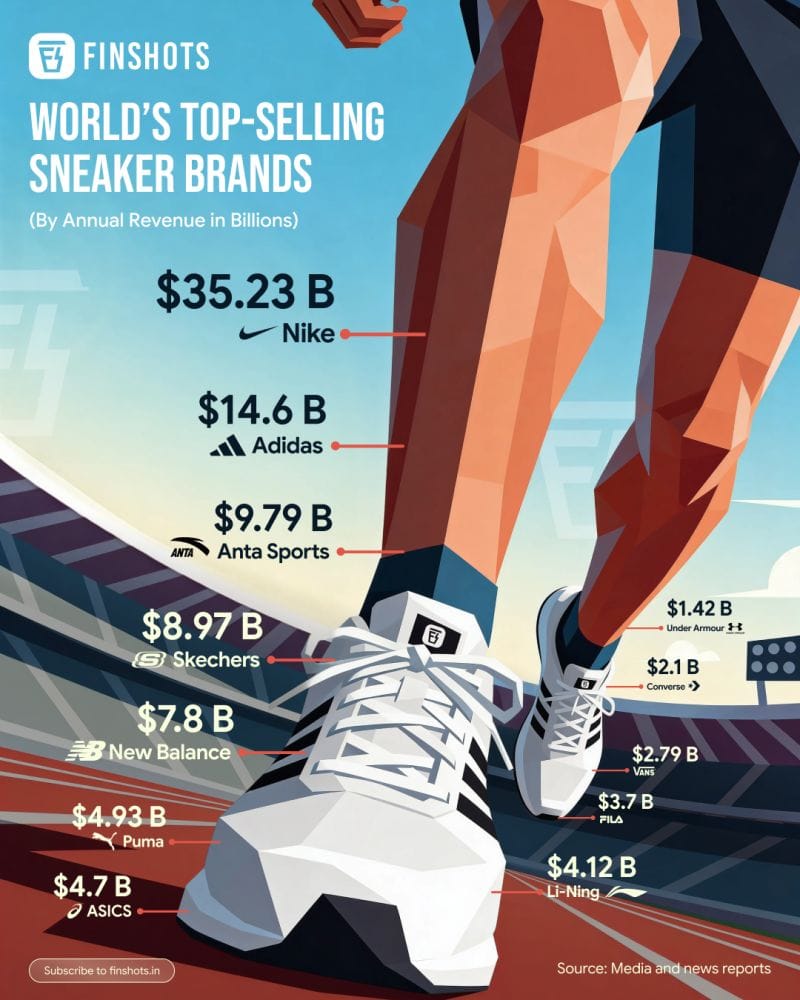
Sneakers have become a fashion statement and have come a long way since their heyday, when Michael Jordan first sported the Air Jordan in 1983!
Here are some of the top-selling sneaker brands by annual revenue, with Nike, Adidas and Anta leading the way.
Readers Recommend
This week, our friend Atul Sharma is back with another book recommendation: Escape from Camp 14 by Blaine Harden.
It tells the true story of Shin Dong-hyuk, who was born and raised inside a brutal North Korean prison camp. The book follows his life under extreme repression and his dramatic escape, offering a rare glimpse into the harsh realities of North Korea’s labour camps.
Thanks again for the recommendation, Atul!
That’s it from us this week. We’ll see you next Sunday!
Until then, send us your book, music, business movies, documentaries or podcast recommendations. We’ll feature them in the newsletter! Also, don’t forget to tell us what you thought of today's edition. Just hit reply to this email (or if you’re reading this on the web, drop us a message at morning@finshots.in).
Don’t forget to share this edition on WhatsApp, LinkedIn and X.