
Why do ships move slowly?
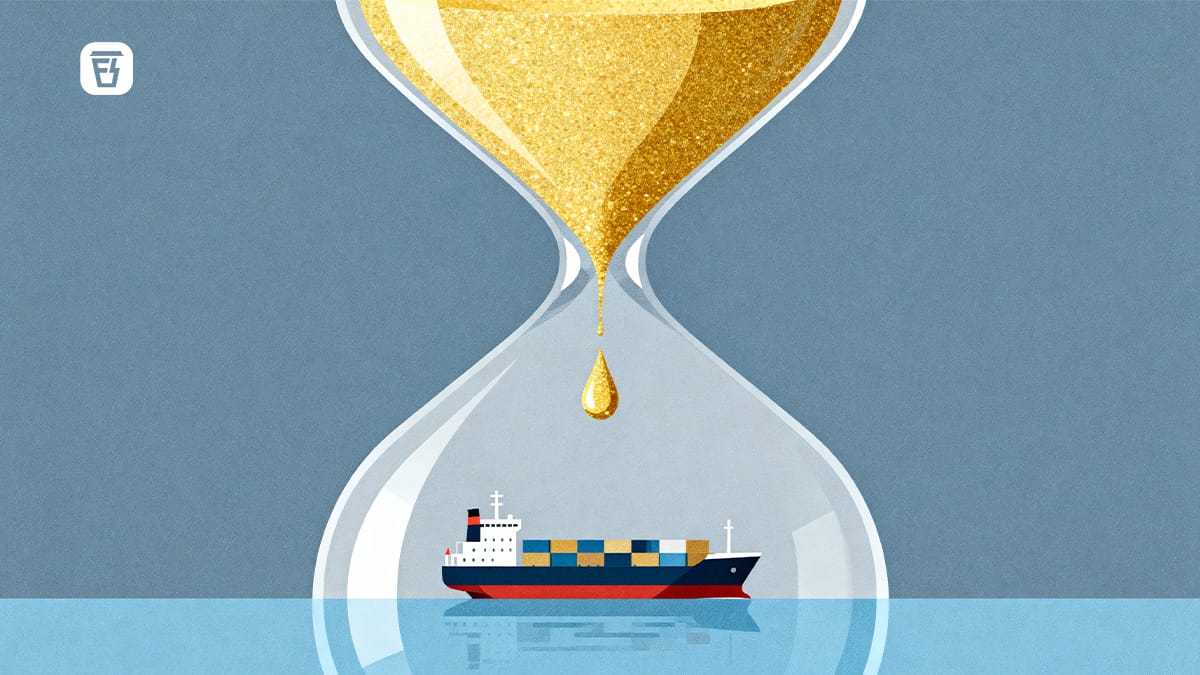
In today’s Finshots, we talk about why ships prefer sailing slow over speed and time.
The Story
If you’ve ever watched a massive cargo ship sailing across the ocean, you might have wondered why it moves so slowly. At first glance it can feel like an illusion created by the vastness of the sea. But the explanation is surprisingly simple. Cargo ships are often slow on purpose.
For an industry that carries international trade today, that might sound counterintuitive. Why would such an integral part of trade turn to slowing cargo movements?
Today, about 80% of the world’s international trade goods are carried by the sea. Anything between a pair of fancy earbuds to imported vehicles are sent over the water across continents.
Naturally, faster ships meant better business. They could take more trips, move more cargo and improve already thin margins. But that assumption began to change in the late 2000s. Particularly, we’re talking about the 2008 oil surge, which set prices to an eye-watering $147 per barrel. And for shipping companies, fuel was already the biggest operational expense.
That price hike meant more to international shipping than any other industry. It alone consumes 5% of all global annual oil use. Suddenly, running ships at a higher speed was more expensive than anyone was ready for.
That’s why the industry had to get creative with what they could do. Instead of pushing ships to their maximum speed, companies started slowing them down. The idea is quite simple. A slower ship burns significantly less fuel. And in an industry where vessels travel thousands of kilometres, even a slight reduction in speed instantly translates to massive cost savings.
That strategy is what became known as slow steaming. And it has worked really well for a lot of reasons. According to the International Energy Agency (IEA), the average shipping speed fell by about 10% and because of that, shipping oil demand fell by one million barrels per day. That’s 159 million litres of oil at 159 litres per barrel.
Now slowing a ship down might sound a bit odd. If a vessel is taking more time per shipment, it means it’s taking fewer voyages per year. But the physics of shipping is another story altogether. Because of their tonnage and size, the energy needed to move a ship rises with speed. That’s why even a modest 10% slowdown can mean 20% reduction in fuel used.
And that’s not just us saying it. The estimate comes from the GreenVoyage2050 initiative on ship speed management run by the International Maritime Organization (IMO), the UN agency that regulates global shipping. We’ll explain more on that later.
But that raises another question: If ships are making fewer voyages, then why not simply build larger vessels to carry more cargo per trip?
That solution isn’t as simple as it sounds. A cargo ship cannot grow indefinitely because there are rules and limits of the ports, canals and maritime infrastructure.
That’s why the industry follows specific ship size categories. For example, ships built to pass through the Panama Canal are called Panamax vessels. Larger ships that can transit the Suez Canal are known as Suezmax. And the largest container ships sailing today belong to a class called Ultra-Large Container Vessels, capable of carrying more than 20,000 shipping containers.
To accommodate them, the ports need deeper harbours, longer berths and of course larger cranes. To expand that infrastructure across the world is expensive and slow.
In other words, simply building bigger ships isn’t always practical. And while larger vessels can carry more cargo, they still burn huge amounts of fuel, especially on long ocean routes.
There’s also the environmental cost of moving goods across the oceans. The IMO has introduced international climate rules that apply to ships above 5,000 gross tonnage. These vessels together account for about 85% of CO₂ emissions from global shipping.
Under the new framework, which is expected to begin around 2028, ships that exceed emissions thresholds could face penalties of $100 to $380 per tonne of CO₂, depending on how far they breach the limits.
Slower speeds also have another environmental benefit. The underwater noise produced by ships increases with speed, meaning slower vessels can significantly quiet the oceans. In fact, a 20% reduction in ship speed could cut underwater noise energy by around 6 decibels, helping reduce disturbances to marine mammals.
Of course, slowing ships down isn’t the only way the industry could reduce fuel consumption and emissions. Engineers have proposed several alternatives over the years, from more efficient hull designs and wind-assisted propulsion to cleaner fuels like ammonia and hydrogen.
But since only a small share of ships in operation are newly built each year (5%), many of these technologies are designed to be retrofitted onto older vessels.
But adopting these solutions across the industry is surprisingly difficult.
That’s because the ship owner and the charterer are two different parties and they often have different incentives.
Think of it like a landlord–tenant relationship. A landlord could invest in better insulation to reduce energy bills of the property. But if the tenant is the one paying the electricity bill, the landlord has little financial incentive to make that upgrade.
A similar dynamic exists in shipping. Many cargo vessels are owned by one company (the ship owner) but operated by another (the charterer). The ship owner invests in building or upgrading the vessel, while the chartering company often pays for the fuel during voyages.
That means if a ship owner spends millions improving fuel efficiency, the savings may go to the charterer instead. This is called a split-incentive problem and it has slowed the adoption of efficiency technologies across the industry.
Which brings the industry back to the simplest lever it can pull: speed.
Unlike retrofits, new fuels or port expansions, slowing a ship down requires no new infrastructure or major investment. And as the industry discovered after the oil shock of 2008, even small reductions in speed can dramatically reduce fuel consumption.
That’s why slow steaming has become one of the most widely adopted efficiency strategies in global shipping. By sailing slightly slower, ships burn less fuel, emit less carbon and still move vast amounts of cargo across the oceans.
With all things considered, slow steaming isn’t without its challenges. Running engines at lower loads can cause technical issues such as incomplete combustion, carbon buildup and turbocharger inefficiencies, which means ships often need additional inspections and maintenance.
Besides, given the current geopolitical tensions and the crisis in the Middle East, many ships are already being forced to take detours and longer routes to move goods across the world. And when that happens, slow steaming isn’t always an option, even if it helps save fuel.
Shipping companies still have schedules to meet. If a vessel loses time because it has to avoid certain routes or sail around conflict zones, the only way to catch up is often to speed up. In some cases, ships may even move faster deliberately to quickly pass through areas that are considered risky. This actually increases both fuel costs and emissions. So in the current context, slow steaming may not be particularly helpful.
Despite these trade-offs, slowing down remains one of the easiest ways for the industry to cut fuel consumption and emissions without any upgrades. But it seems as though wars erupting along key shipping routes have made even this simplest solution to save fuel a tough one.
Until next time…
Liked this story? Share it with a friend, family member or even strangers on WhatsApp, LinkedIn and X.
🚨Three insurers are revising their term premiums!
Three prominent insurers are set to revise their term insurance rates in the next few weeks. This means if you don’t secure a term plan now, your premiums could significantly go up!
Here’s why this matters: When you purchase a term life insurance policy, you pay a premium or a small fee each year to protect against financial risks. In the unfortunate event of your passing, the insurance company pays out a substantial sum to your family or loved ones.
The best part? By buying early, you can lock in your premiums, ensuring they're not affected by any future rate hikes.
If you've been considering a term plan, now is the perfect time to act. To assist you in the process, our advisory team at Ditto is here to help. Click on the link here to book a FREE call with our IRDAI-certified advisors.