
Why cocoa farmers are abandoning chocolate
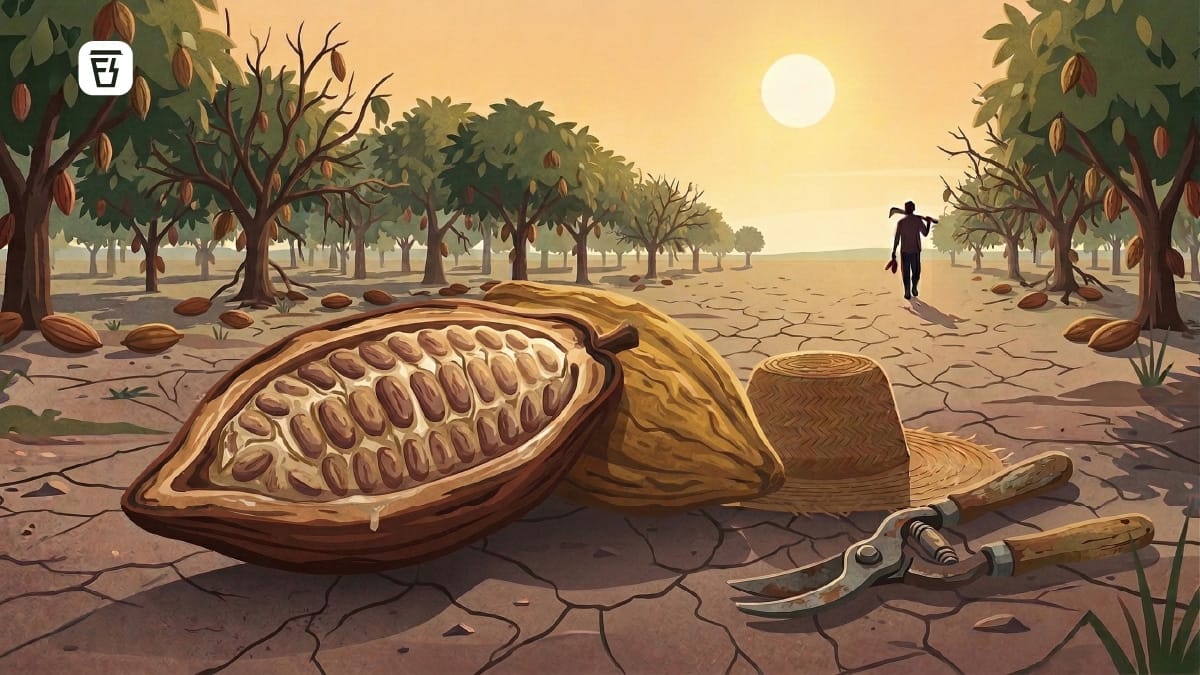
In today’s Finshots, we explain why cocoa farmers in Ghana and Ivory coast are abandoning cocoa farming.
But before we begin, if you love keeping up with the buzz in business and finance, make sure to subscribe and join the Finshots club, loved by over 5 lakh readers.
Already a subscriber or reading this on the app? You’re all set. Go ahead and enjoy the story!
The Story
If you’ve ever looked closely at a chocolate bar wrapper (not the shiny packaging and design, but the back where the truth sits in fine print), you may have noticed something common. The bar has either become smaller, more expensive, or both.
But here’s a little secret. The main ingredient behind chocolate — cocoa, is actually getting cheaper.
Yup, that’s right. Two years ago, chocolate prices went on a wild ride. After raw cocoa prices ranged between $2,000 to $3,000 a tonne, they suddenly shot up to an eye-watering $10,000 a tonne! We even wrote about it here.
That was in 2024. Back then, the spike had a lot to do with El Niño, the warm climate pattern that severely affected harvests. So much so that we expected to see a chocolate deficit never seen before.
But today, that’s all changed and cocoa prices have come down to more realistic levels.
Now, that might make you think that maybe people simply stopped eating chocolate. But that’s hardly true. The demand for chocolate hasn’t vanished.
It’s just that cocoa became too expensive, especially after the ordeal of 2024. As prices surged, chocolate manufacturers like Mondelēz International and Nestlé responded by raising prices, shrinking portions and, in some cases, reformulating products to use less cocoa. Nestlé even altered the recipe of some bars so they no longer met the legal definition of chocolate after cocoa costs spiked.
And all of that meant companies started buying less cocoa beans.
But here’s the thing. While chocolate companies could tweak recipes and raise prices, the people growing cocoa had far fewer options. In Ghana and Ivory Coast, which together produce roughly two-thirds of the world’s cocoa, many farmers are now grappling with falling incomes and unsold beans.
And that’s surprising because cocoa prices had surged not too long ago. So, you’d expect farmers to have benefited from that boom. But most of them didn’t. Even when global prices shot up, farmers saw only a small slice of that increase.
On the contrary, now that prices are cooling again, the economics of cocoa farming look worse for them. In some regions, yields are already falling due to ageing trees, crop disease and climate stress. And the income farmers earn from cocoa represents only a tiny fraction of the value created in the global chocolate industry.
Which raises an obvious question. When cocoa prices fall, farmers struggle. But how can they still struggle when cocoa prices surge?
The answer lies in how the cocoa market itself works.
Unlike most commodities, farmers in Ghana don’t sell their crop directly at global market prices. Instead, cocoa is sold through the Ghana Cocoa Board. The goal is to protect farmers from wild commodity price swings. But it also means that farmers don’t immediately benefit when global prices suddenly surge.
So when cocoa prices exploded in 2024, farmers saw only gradual increases in the price they were paid — far below the global market spike.
That’s because cocoa prices for farmers are fixed ahead of the harvest season.
There are two harvest cycles in West Africa — the main crop between October and March, and a smaller mid-crop from April to September. Before the season begins in October, the government announces the farm-gate price that farmers will receive for their beans.
That means farmers know exactly how much they’ll earn per tonne, regardless of what happens in global commodity markets. For example, last October, Ivory Coast set the farm-gate price at about $5,000 per tonne, while Ghana set it around $5,300 per tonne.
But right now, world cocoa futures (basically, the market price traders expect cocoa to sell for) are trading at around $3,300 per tonne, a far cry from what the board set five months ago.
And that’s where the paradox appears.
The system is designed to protect farmers from volatile cocoa prices. But when market conditions shift suddenly, it can create the opposite problem. If global cocoa prices fall or demand weakens, exporters and processors may hesitate to buy beans at the government-set price. In fact, the International Cocoa Organization (ICCO) recently estimated the global cocoa market could swing into a surplus of about 49,000 tonnes this season.
That simply tells you that the world suddenly has tens of thousands of tonnes more cocoa than chocolate makers currently want to buy. And when cocoa piles up, the shock travels all the way back to the farm.
Because cocoa farming is a slow business. Trees take years to mature, harvests happen only twice a year, and incomes fluctuate wildly with global markets. So when the economics stop working, farmers start looking for alternatives. And no — it isn’t other crops.
In parts of West Africa, those alternatives are increasingly found underground. Quite literally.
Across regions of Ghana, cocoa farms are being leased out for illegal sand mining to feed the construction boom, while others are being converted into small-scale gold mining sites, often through illegal operations locally known as galamsey.
Because mining offers something cocoa farming rarely does — quick cash. A cocoa harvest might bring income once or twice a year. Mining, on the other hand, can generate money almost immediately.
But mining comes with a heavy cost.
The excavation process damages soil, contaminates water sources with chemicals like mercury, and often leaves farmland unusable for agriculture. And once a cocoa farm becomes a mining site, it’s rarely restored to productive farmland again.
Governments know exactly what they’re up against. Cocoa remains a critical export for West Africa, contributing nearly 40% of export revenues in Ivory Coast and about 15% in Ghana. So when farmers abandon cocoa for illegal mining, the stakes extend far beyond the farms.
In Ghana, authorities recently moved to stabilise the sector by announcing a $337 million payment to Licensed Buying Companies (LBCs) to clear outstanding dues pending since November 2025 and support growers struggling with volatile prices.
According to the LBCs, the funds haven’t been released yet, and because of that, farmers are yet to receive their dues. But payments like these are more of a short-term relief measure than a long-term solution.
They also slashed the farmgate prices to $3,580 last month hoping to grow demand, but that also means farmers have to accept lower prices on already thin margins.
Because as long as cocoa farming remains financially uncertain, farmers will continue to weigh the same difficult choice — stick with cocoa, or dig for something more profitable beneath the soil.
All this means that the story of chocolate today isn’t just about prices on supermarket shelves. It’s about what’s happening thousands of kilometres away on cocoa farms in West Africa.
Because if farmers keep walking away from cocoa in search of quicker money underground, the world might soon face a different problem altogether.
Not a shortage of chocolate lovers. But a shortage of cocoa farmers.
Until then…
Liked this story? Share this with someone who’s obsessed with having chocolate on WhatsApp, LinkedIn and X.
Message to All the Breadwinners
You work hard, you provide, and make sacrifices so your family can live comfortably. But imagine when you're not around. Would your family be okay financially? That’s the peace of mind term insurance brings. If you want to learn more, book a FREE consultation with a Ditto advisor today.