
Why can’t the world replace China?
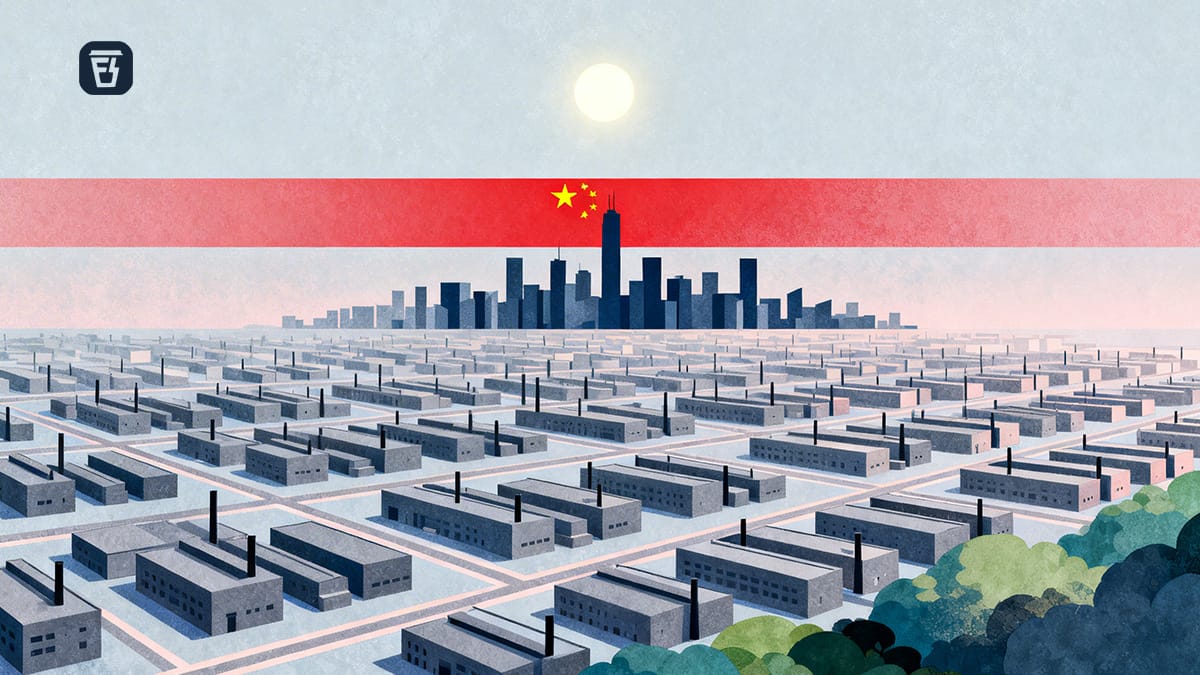
In today’s Finshots, we explain how China’s manufacturing playbook is different and why it’s so hard to replace.
But before we begin, if you’re someone who loves to keep tabs on what’s happening in the world of business and finance, then hit subscribe if you haven’t already. If you’re already a subscriber or you’re reading this on the app, you can just go ahead and read the story.
The Story
Imagine you’re building a new gadget. The funding is secured, the trademarks are filed, and the paperwork is clean. That’s just the red tape. Now comes the tricky part ― manufacturing.
You need 10,000 microchips, custom screws, a battery casing, a display panel, and a printed circuit board prototype by tomorrow morning. In most countries, that means weeks of emails, minimum order quantities, and international shipping.
But in one country, it just means walking across the street.
We’re talking about China.
In fact, that’s how we see China, right? We define it in terms of cheap labour, mass manufacturing, and an obsession with export.
But here’s the thing and also the part we rarely talk about. China, like India and most other Asian countries in the 20th century relied mostly on one industry: agriculture.
It was only in 1978 under Deng Xiaoping, a former high-ranking Chinese Communist Party official, that the country started moving away from its agriculture economy and opening itself to other markets. Special Economic Zones (SEZs) were carved out as experiments. Foreign capital flowed in. And factories replaced farms.
By the time China joined the World Trade Organization in 2001, it had plugged itself directly into global supply chains. The world got cheaper goods. China got scale. And that’s how the “factory of the world” was born.
Now this explanation looks comforting, but it’s also incomplete because the outside world always thought the edge that Chinese manufacturing had was cheap labour. But if that was true, rising wages should have weakened it. And if last year was any indication, tariffs should have crippled it.
Instead, something stranger happened. China didn’t just keep manufacturing. It got better at it.
For 15 years straight, China has remained the world’s largest manufacturer. It produces nearly a third of the world’s manufactured goods. Companies may diversify to other countries. Supply chains may shift at the edges. But the centre of gravity remains intact.
Manufacturing today is not just about assembling goods. That’s what it was in the past, but now it’s more than that. It’s about proximity. When you have suppliers, workshops and component traders all working so closely together, something unusual happens.
In fact, there’s a very interesting theory that economists came up with. When companies cluster together geographically, they tend to become more productive — not just individually, but collectively. Suppliers specialise. Workers circulate. Knowledge spreads informally over coffee breaks and factory floors. The location itself becomes more efficient than the sum of its firms.
In the 1990s, Nobel laureate Paul Krugman formalised this idea, calling it agglomeration or the tendency of industries to cluster and generate increasing returns.
And nowhere in the modern world is agglomeration more visible than in one city ― Shenzhen.
Remember that shift in 1978? The decision to carve out a few experimental capitalist enclaves inside a socialist economy?
One of those experiments was a fishing town bordering Hong Kong. Yup, Shenzhen was just a small town back then. It was supposed to be a policy trial, designated as one of China’s first Special Economic Zones in 1980, and had a population of around 30,000.
Today, it’s something else entirely. Shenzhen is home to around 17 million people and generates a GDP larger than many countries.
But the skyline is not the story. The supply chain is. At the heart of Shenzhen is Huaqiangbei, often described as the world’s largest electronics market. This isn’t a mall or shopping complex. It’s a vertical system.
One building may house hundreds of component traders. One specialises in microcontrollers. Another in lithium batteries. Another in display drivers. Need a niche chip discontinued five years ago? Someone likely has old inventory. Need 5,000 units by Friday? A call is made.
In most countries, supply chains stretch across continents.
But in Shenzhen, they stretch across blocks.
This density compresses time.
A design flaw discovered in the morning can be corrected by night. A supplier underperforming can be replaced within hours. Engineers move between firms, carrying tacit know-how that never appears in formal manuals. This is what agglomeration looks like in practice.
As of 2025, the Shenzhen-Hong Kong-Guangzhou cluster is ranked first among the most innovative regions in the world by the World Intellectual Property Organization (WIPO). In simple terms, it had the most number of patents filed in 2025 than any other region in the world.
Shenzhen didn’t remain a low-cost industry hub. Over time, it upgraded and now global giants like Huawei, Tencent and BYD call it home.
And here’s the part that makes Shenzhen difficult to replicate.
Once suppliers cluster together, they lower costs for each other. Once costs fall, more firms arrive. Once more firms arrive, specialisation deepens. And once specialisation deepens, productivity rises. The ecosystem simply begins to feed itself.
So yeah, it’s no longer about labour cost.
At some point the cluster becomes so dense that companies don’t choose it for convenience. Rather they choose it because leaving would slow them down.
But Shenzhen is not unique.
Across China, entire cities specialise in entire product lines. China hosts more than two dozen large-scale industrial clusters around specific sectors. Dongguan specialises in footwear and manufacturing. Entire towns specialise in soles, stitching, foam moulding, and packaging. A brand can coordinate thousands of suppliers within a short radius.
Suzhou is known for electronics, semiconductors, and precision components, anchored by the Suzhou Industrial Park.
Now all this would make you wonder, if this model is so powerful, why hasn’t the world replicated it? Why haven’t subsidies and industrial parks elsewhere created the same density?
Well let’s start with time. Shenzhen did not wake up one morning as the world’s hardware capital. It compounded over four decades. Every supplier that arrived reduced friction for the next one. And every engineer trained another.
Another reason is because today, you can’t import supplier webs. Sure, governments can attract investments and provide tax breaks. They can even subsidise the land. But what they can’t recreate is a web of thousands of small suppliers sitting within a 10 kilometre radius.
When one strand is removed, the system adjusts. But try building that web from scratch and you only discover the missing strands when something breaks.
At some point, an ecosystem stops being a collection of firms and starts becoming economic infrastructure. It becomes the invisible system that makes speed normal and friction rare.
Recreating something like this is easier said than done. But it reminds us of one thing: manufacturing is not a short-term boost. It is a long-term bet.
In this year’s Economic Survey, the case was made for manufacturing-led exports as a way to stabilise currencies, lower borrowing costs, and bring discipline to the broader economy. The lesson from Shenzhen adds another layer: manufacturing is not just about output, but about building ecosystems that endure.
Because the countries that build dense ecosystems don’t just compete. They tilt the playing field quietly, structurally, and for decades.
Until then…
If this story helped you make sense of China’s manufacturing ecosystem, share it with a friend, family member or even strangers on WhatsApp, LinkedIn and X.
"I should’ve bought health insurance sooner."
That's what 85% of Indians who paid hospital bills from personal savings & debt ended up saying.
Medical emergencies don't come with a warning. They can strike anyone, anytime, causing years of savings to go down the drain.
So don't wait until a crisis hits you. At Ditto by Finshots, we make insurance simple. Our advisors explain all the policies in simple English and help you pick the right plan. Book a FREE 30-minute consultation today. No spam, no pressure.