
What’s driving SSD and RAM stick prices to the moon
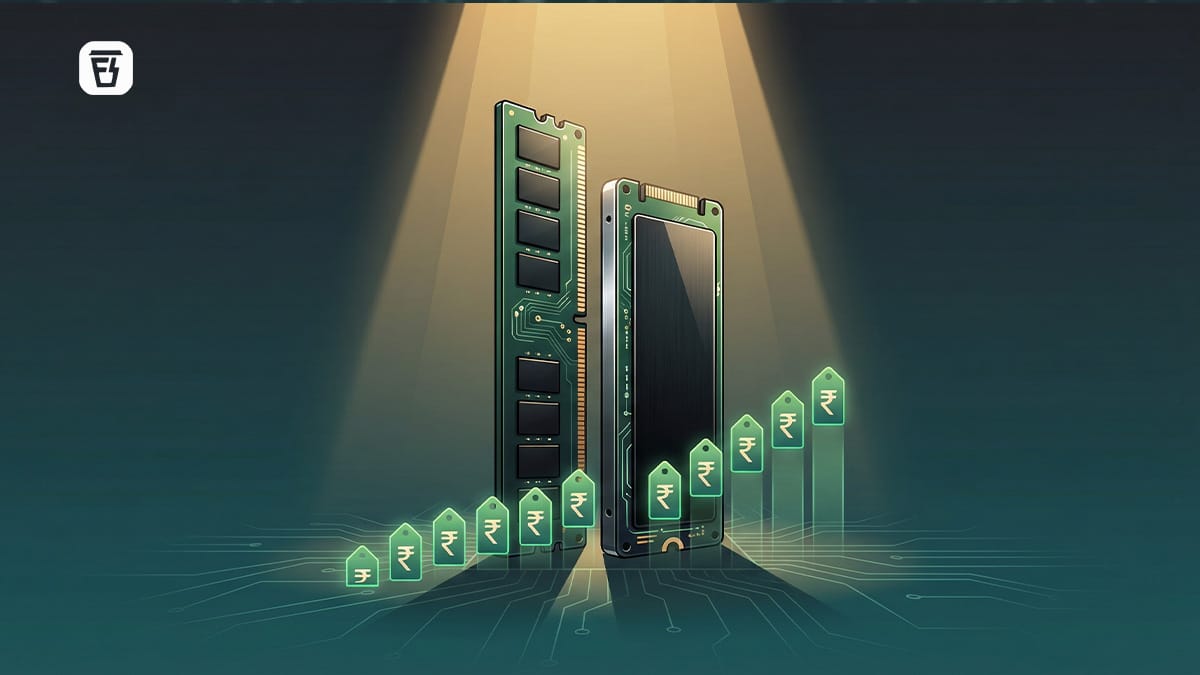
In today’s Finshots, we talk about why RAM sticks and SSD prices have shot up in the past few months, and whether it will stabilise in the near future.
Did you know? Nearly half of Indians are unaware of term insurance and its benefits.
Are you among them?
If yes, don't wait until it's too late.
Term insurance is one of the most affordable and smartest steps you can take for your family’s financial health. It ensures they do not face a financial burden if something happens to you.
Ditto's IRDAI-Certified advisors can guide you to the right plan. Book a FREE 30-minute consultation and find what coverage suits your needs.
We promise: No spam, only honest advice!
Now onto today's story
The Story
Last week, a colleague of mine came up to me asking for suggestions to build his own SSD (Solid State Drive) with an enclosure. For the uninitiated, an SSD is the memory stick that sits inside your laptop or computer, and it stores all the memory for your device. I was walking him through it and since I bought all the items on Amazon, naturally I opened the website to show him the exact same products. That’s when I froze.
The prices were nowhere near what I had paid for it in 2024. A 1 terabyte SSD with an enclosure set me back about ₹6,000 last year. That same SSD today, from the same brand, ranges anywhere from ₹10,000 to ₹14,000 depending on the seller.
This sudden price spike was abnormal and reminded me of the crypto mining era when GPU prices ballooned, breaking the hearts of all the PC gamers, editors and 3D artists who’d have to pay heavy premiums for the same hardware.
But this price hike isn’t limited to SSDs. Even the RAM sticks (Random Access Memory) have doubled in price in the recent months. Some Japanese retailers have gone a step further and restricted retail purchases to one unit per customer to discourage hardware hoarding. In fact, things aren’t looking better on the manufacturer’s side either because most of the memory hardware we see and use today are made by three major companies — Samsung, SK Hynix and Micron. And almost all of them have hiked the prices of memory sticks by a minimum of 30% in the last few months.
This sudden price spike has everyone clutching their wallets because you’re essentially paying more for the same product, with no improvements or difference in features and specifications. So how did prices rise to where they are today?
Let’s zoom out and take a look at what’s happening this year. Every major tech company, be it OpenAI, Meta, Google and so on are building massive data centres unlike anything seen before. And they’re not isolated to any one country or continent. Google recently announced that it’s building a billion-dollar AI data hub in Visakhapatnam. OpenAI, through the Stargate Project, set up a data centre in Norway.
All around the world, these firms are setting up data centres and that means hardware — lots of it. GPUs, coolants, and of course RAM and storage drives. All these companies have placed massive orders for DRAM and NAND chips.
Sidebar: DRAM stands for Dynamic Random Access Memory. It’s a specific type of RAM used in modern computers and laptops to keep the system running. NAND chips on the other hand, are non-volatile storage memory. Think memory space used to save your photos, videos and documents on all your devices.
This has become a literal frenzy and suppliers just don’t have enough to match demand.
Now this might sound and feel like a conspiracy by way of the manufacturers to price storage drives higher, but the reality is something much more grounded.
You see, AI companies don’t rely on regular consumer grade hardware for their needs. Rather, they go for something called HBM (High Bandwidth Memory) — a specialised form of ultra-fast DRAM used in AI accelerators. But if they’re buying different types of storage, why is there a consumer-side crunch right now?
Well it’s because the memory going into your devices and the HBM modules that AI companies are mass-buying are all made by the same companies, and right now, there’s a manufacturing bottleneck because of this demand. Some call it the very first memory shortage in the past thirty years. Large orders for servers means overdemand from the supply side, translating to fewer wafers for consumer parts. That’s why retail SSDs and RAM kits are expensive right now, not because they’re being replaced, but because they are out-prioritised. Right now, AI memory is the fastest growing and top priority segment for Samsung, SK Hynix and Micron.
It’s also why they’re scrambling to set up more manufacturing facilities. Micron Technology is setting up a $9.6 billion plant in Hiroshima, Japan. While that sounds like good news, construction won’t begin until May next year, and the first real output will start shipping in 2028. Fabricators take about 2 to 3 years to come online because chip design and manufacturing is a highly specialized and complicated process.
Seeing all this, you’re probably wondering ‘When will this madness end?’
Well, the short answer is: not anytime soon.
Suppliers themselves have been raising prices quarter after quarter, and analysts expect both DRAM and NAND costs to continue climbing through 2025. In fact, some industry voices are even more pessimistic. The CEO of Phison Electronics — a major supplier of NAND flash controllers, warned that current supply tightness could extend to ten years, with shortages worsening in 2026 as demand outpaces planned capacity. So unless something dramatic changes over the coming years, retail buyers like you and I have to deal with elevated prices for a while.
Anybody using a Windows PC might remember that Microsoft announced that Windows 10 support would end. That milestone alone could push millions of older computers into upgrades or full replacements, as users and businesses move to machines that meet Windows 11 hardware requirements. All of this only adds more pressure on an already stretched supply chain.
And that ‘something dramatic’ basically comes down to three companies — Samsung, SK Hynix and Micron, who together control almost the entire supply of DRAM and NAND’s output in the world. Whether prices rise, fall or flatline depends on how these three allocate their wafer capacity. And here’s how far that shift has already gone: Micron has formally exited the consumer SSD and RAM market. It announced that it will wind down its consumer brand Crucial — a well-known name behind some of the most popular SSDs and memory kits, so it can focus more on its enterprise and AI customers. This was a brand that spent 29 years in the market. When a major supplier steps away from consumer storage entirely, it tells you everything you need to know about where the demand, and the profits, have moved.
The relief will only come when the industry’s production priorities shift again. Once AI demand stabilises and new fabrication lines for server-grade memory come online over the next 12–18 months, manufacturers are expected to reallocate more capacity back to consumer DRAM and NAND. Several chipmakers are also expanding advanced-node fabs specifically for high-bandwidth memory, which should reduce the pressure on older lines that feed the consumer SSD and RAM market.
Until this shift happens, prices will remain high and supply will fall short. This isn’t a crypto-style bubble or a sudden PC-upgrade wave you can just ride out. It’s the ripple effect of an AI infrastructure boom that sent the memory supply chain in an unexpected direction. Once the wave settles, things should cool off. Oh, and if you’re wondering, that SSD I bought a year ago? It was from Crucial. :-)
Share this story if you know someone trying to build a PC, upgrade their storage or just tired of paying for cloud storage on WhatsApp, LinkedIn or X.