
What the Airbus scare tells us about modern infrastructure

In today’s Finshots, we look at how a burst of energy from 150 million kilometres away managed to unsettle a $100 million aircraft and what it means for the rest of our hyper-connected world.
But before we begin, a quick (and exciting!) sidenote — Last few days left to register for Finshots Idea LabSeason 2!🥳
Students, this is your chance to bag ₹2.25 lakh in cash, pre-placement interviews, cool goodies, and serious bragging rights.

Click here to apply. You don’t want to miss this!
The Story
Earlier this week, Airbus issued an urgent advisory to ground most of its fleet worldwide after an A320 briefly lost altitude mid-flight. Engineers quickly traced the anomaly to something strange and quite literally out of this world.
A burst of solar radiation had interfered with the aircraft’s flight-control computers, causing the elevators and ailerons to respond sluggishly. Although the pilots regained control and landed safely, the incident triggered an immediate technical investigation by Airbus and aviation authorities across Europe, the US, and India. And for good reason. Modern jets are built with layers of redundancy, backup systems, and hundreds of hours of testing. So when something 150 million kilometers away can nudge an aircraft into an unexpected dip, it gets everyone’s attention.
But why did radiation suddenly affect the aircraft in the first place, you ask?
After all, the Sun has been flinging radiation toward Earth for millions of years, and our magnetic field usually absorbs or deflects these cosmic tantrums.
Turns out, the reason this is suddenly back in the spotlight is because of the solar cycle we’re in.
You see, the sun has a cycle in which solar activity peaks and troughs. This cycle lasts for approximately 11 years. And in November, we had the strongest solar flare of 2025.
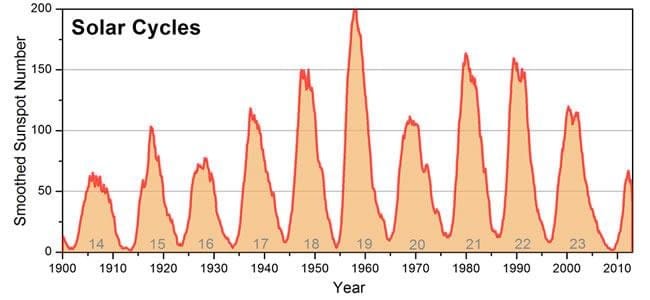
If a flare is strong enough to breach parts of the Earth’s magnetic shield, it can disrupt pretty much everything the modern world depends on. Aviation may have got the headlines this time, but it is far from the only sector at risk.
As the Sun approaches the peak of its current cycle, these flares have begun nudging at the weak spots in our digital world.
Back in the 1980s and 1990s, when satellite technology was still young, the worst that happened during a solar storm was patchy radio communication or occasional satellite drift. But today, we’ve wired the entire planet to depend on satellites for timing, navigation, communication, weather forecasting, surveillance, and even basic internet routing. With this level of interconnectedness, a significant solar flare isn’t merely a cosmic event. It’s a supply-chain shock, a financial-market hazard, and a national-security risk bundled together.
Take GPS, for instance. The system relies on ultra-precise timing signals. A strong flare can distort these signals enough to throw off navigation by several meters. That’s dangerous for aircraft, but it also hurts shipping routes, farm equipment, and even Google Maps accuracy.
When it comes to satellites, high-energy particles can fry onboard electronics, force operators to switch to backup batteries, or push satellites into temporary shutdowns. Starlink, for example, lost dozens of satellites in 2022 after a geomagnetic storm heated up the upper atmosphere and increased drag.
And ground infrastructure isn’t immune either. Power grids can pick up excess current when the Earth’s magnetic field fluctuates. That’s exactly what happened in 1989 when a solar storm plunged Quebec into a nine-hour blackout.
Apart from this, undersea internet cables, which carry over 95% of global data, rely on repeaters placed at regular intervals. These repeaters can malfunction when bombarded by electromagnetic interference.
Even the global financial markets feel the ripple! High-frequency trading and international payments depend on GPS-synchronized timestamps. A slight timing drift can throw off settlement systems and even force exchanges to halt trades.
So yes, in a nutshell, solar flares are bad for pretty much everything.
But the good news is that we’re better prepared than we used to be.
Forecasting models now give power operators and airlines at least a few hours’ warning before a major solar storm hits. Newer satellites come with better shielding and internal redundancy. Power grid engineers are also studying how to isolate vulnerable sections of the network (islanding) so a surge in one region doesn’t cascade across an entire grid.
But the bigger question is whether these solutions can scale quickly enough.
Much of the global communications and power backbone was built in a different era, when solar activity cycles were milder, and our dependency on digital systems was far lower. Upgrading satellites, modernizing grids, and hardening cables is expensive and slow. Yet the cost of ignoring the risk keeps rising.
So yeah, the Airbus warning may have been short-lived, but it served as a timely wake-up call. A reminder that our digital world isn’t just vulnerable to hackers, outages, or geopolitical tensions. It’s also vulnerable to physics.
And while we can patch software or tighten security protocols, we cannot negotiate with the Sun.
So as solar activity escalates through 2025 and 2026, this may be the test that forces governments and companies to rethink how resilient our infrastructure really is.
Until then…
Liked this story? Share it with a friend, family member or even strangers on WhatsApp, LinkedIn and X.
Don't Miss This Insurance Masterclass Series!
Insurance matters only once in your life: the day your family needs to make a claim. And that’s usually when people realise they bought the wrong policy which don't fit their needs, missed a crucial detail, or trusted an agent who didn’t tell them the full story. But you shouldn’t have to learn this the hard way!
This weekend, we’re hosting a free 2-day Insurance Masterclass built around real claim cases we’ve handled and simple, practical rules for shortlisting the right plan.
📅 Saturday, 6 Dec ⏰ 10 AM: Life Insurance
How to protect your family, choose the right cover amount, and understand what truly matters during a life claim.
📅 Sunday, 7 Dec ⏰ 10 AM: Health Insurance
How hospitals process claims, common deductions, the mistakes buyers usually make, and how to choose a policy that won’t disappoint you when you need it most.
👉🏽 Click here to save your spot, seats are filling fast.