
The Pesticide Management Bill explained
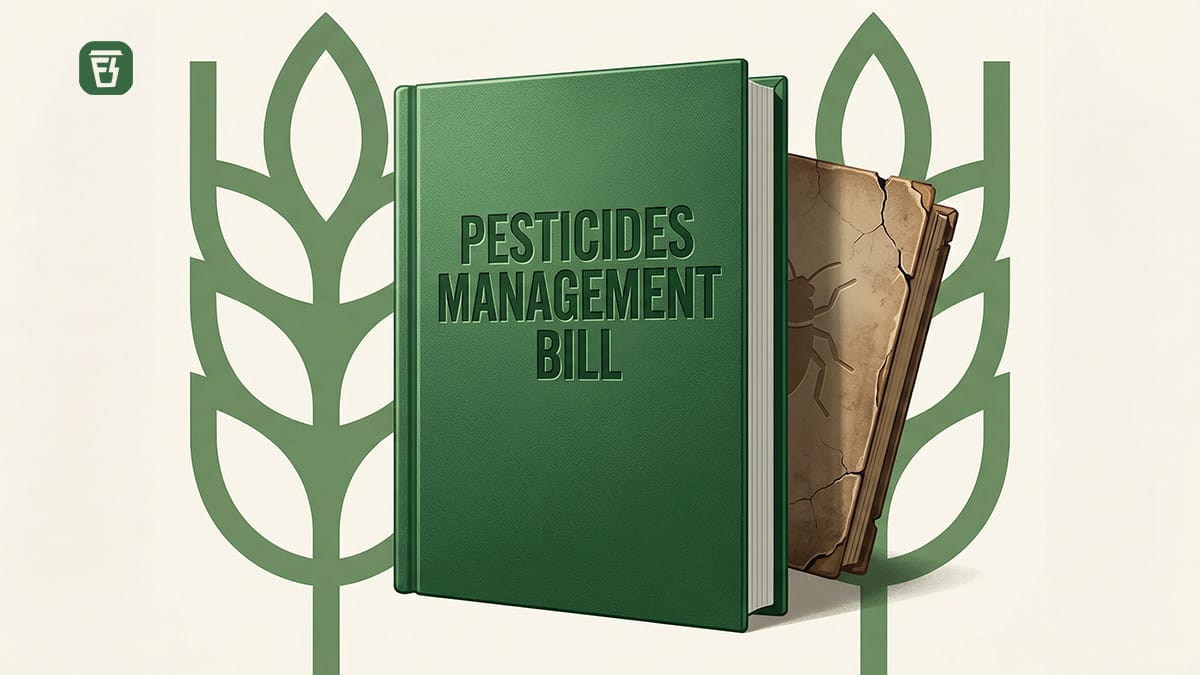
Hey folks, Happy Sankranthi! Today's the festival of harvest and speaking of harvest, today we're talking about the Pesticide Management Bill.
But here’s a quick note before we begin. If you’re someone who loves to keep tabs on what’s happening in the world of business and finance, then hit subscribe if you haven’t already. If you’re already a subscriber or you’re reading this on the app, you can just go ahead and read the story.
The Story
A lot of people in India still earn their living from agriculture.
And because farming sits at the centre of everything, there’s a whole world built around it — everything from tractors and seeds to fertilisers and, crucially, pesticides.
Now, these chemicals aren’t some side activity. India is the 4th largest producer of agrochemicals in the world, after the US, Japan and China. We’re also the third largest exporter, shipping $3.3 billion in FY25. That’s three times as much as what we exported a decade ago.
Besides, pesticides are also part of how crops survive pests and diseases. Without them, a lot of food would never make it from the field to our plates.
Yet for all that scale, India doesn’t use a lot of pesticides compared to many other countries. For context, India uses just 0.4 kg of pesticides per hectare, which is less than China’s 1.83 kg or even other countries like Brazil and Argentina.
Now you might think, less chemicals are a good thing because you’re getting cleaner produce. But that’s not always how it works.
Pests don’t magically disappear just because fewer chemicals are used. Because when crops start getting damaged, farmers feel pressure to act fast. That often means using stronger sprays, using them more often, or using them without clear guidance. And when these chemicals are handled badly, say with wrong labels, wrong doses, or weak oversight, the harm doesn’t stop at farms. It spills over into people’s health.
So India ends up in a not-so-good situation. To put things in perspective, India records over 7,700 deaths from accidental and intentional pesticide poisoning every year.
Put these facts together, and what you essentially have is a paradox. A country that feeds more than a billion people, sells pesticides to the world, battles massive crop losses and poisoning deaths.
And all of it is governed by an obsolete law written in 1968, when India had far fewer people, far fewer pesticides and far less data.
The original Insecticides Act was framed at a time when India looked very different from today. It was designed for an era with fewer people, food scarcity, fewer pesticide options and very little scientific data to tell us about health and environmental effects. It was never built for drone spraying, digital supply chains, or export markets that reject entire consignments over microscopic traces of pesticide residue.
Despite that, the law did establish some strong ideas for its time. For example, it required a mandatory registration for every pesticide manufactured. This made sure that nobody could just make and sell their own chemicals without proper documentation.
And even if the registration was received, you’d need state licenses to make and sell them. Along with that, it had rules for some basic toxicity and safety checks. There were even separate provisions for what a manufacturer should do with expired products and how they should store and dispose of them. Overall, it gave the government some power with regards to pesticides.
But over time, when agriculture modernised, the law didn’t. In the past two decades, we’ve seen a lot of changes in how India as a country sees and consumes food, which naturally means it changes how we grow it as well. This mismatch started creating problems, some of which still linger today.
There are fakes and counterfeit fertilizers entering the market every year. Those chemicals come in direct contact with consumers who eat the produce grown from those substandard chemicals.
Then there’s the export hurdle. Chemicals being shipped abroad face higher regulations than back home, so if they fail testing, exporters end up facing rejections. But most importantly, the older laws don’t have space for environmental risk assessments, digital traceability and even protective gear norms.
This gap meant that everything from the registration to inspection was still paper-driven and manual. And with no national digital trail, tracking a pesticide from manufacture to use is almost impossible.
That is the gap the Pesticide Management Bill is trying to fill. The new bill takes the 57 year old Act into the digital era, and introduces rules that make sense with today’s agriculture.
To start with, the Bill creates two central bodies — a Central Pesticides Board for scientific guidance and a strengthened Registration Committee that decides what gets approved, renewed or rejected.
Unlike the 1968 Act, which only broadly mentioned “safety and efficacy”, the new framework spells out clear scientific criteria: environmental impact, toxicity, residue behaviour, human exposure risk and even how the product behaves under India’s diverse climate conditions.
But of all the new rules, the biggest shift is digitalisation. Every pesticide — whether imported, manufactured or sold, must now be digitally registered. This data feeds into a national pesticide registry, a central database that traces a pesticide through its entire lifecycle. Instead of paper files sitting in different state offices, regulators can now track where a product was made, how much was produced, where it was shipped and who sold it. For an industry historically plagued by fakes and spurious products, this level of transparency is a game changer.
The Bill also tightens rules around labelling, packaging, transport and disposal. Labels must be clearer, packaging more standardised, and expired products must be collected and disposed of following stricter norms. Testing laboratories need accreditation, which means farmers are far less likely to end up with adulterated or poor-quality chemicals.
Another important addition is worker and farmer safety. For the first time, the law acknowledges the need for protective gear, training and safe-handling norms. It also builds a framework to monitor pesticide poisoning cases, something the 1968 Act never elaborated clearly.
States also get more power. They can temporarily ban a pesticide or a specific batch for up to a year if they detect problems. Penalties for misbranded, substandard or spurious pesticides go up sharply, and enforcement officers have clearer authority to suspend or cancel licences.
The Pesticide Management Bill, 2025 tries to turn a scattered, paper-driven system into a transparent, digitally traceable one. It doesn’t change the core idea of registration — that existed even in 1968. What it changes is everything around it: how pesticides are approved, how they move through the market, how they’re monitored, and how violations are punished.
But even with all these upgrades, the new Bill isn’t without gaps. Its language on risk reduction is soft, asking regulators to merely “strive” to minimise harm, rather than mandating it. The states, meanwhile, can only issue temporary bans for up to a year and still lack the power to tailor pesticide rules to their own ecological needs. The Bill brings in digital systems, but doesn’t address how small dealers or farmers will adapt to it.
Sure it might not answer every question, but for the first time in over five decades, India is rewriting the rulebook for the chemicals that touch our soil, our crops and our plates. It may not close every gap. But it finally starts to bridge the distance between where Indian agriculture is, and where its laws need to be.
Until then….
Liked this story? Share it with someone who is obsessed with organic food on LinkedIn, WhatsApp and X.
🚨Term Life Insurance Prices are About to INCREASE!
A prominent insurer is set to raise their term insurance rates in the next few days. This means if you don’t secure a term plan now, your premiums could significantly go up!
Here’s why this matters: When you purchase a term life insurance policy, you pay a premium or a small fee each year to protect against financial risks. In the unfortunate event of your passing, the insurance company pays out a substantial sum to your family or loved ones.
The best part? By buying early, you can lock in your premiums, ensuring they're not affected by any future rate hikes.
If you've been considering a term plan, now is the perfect time to act. To assist you in the process, our advisory team at Ditto is here to help. Click on the link here to book a FREE call with our IRDAI-certified advisors.