
The MUFG–Shriram Finance Deal explained
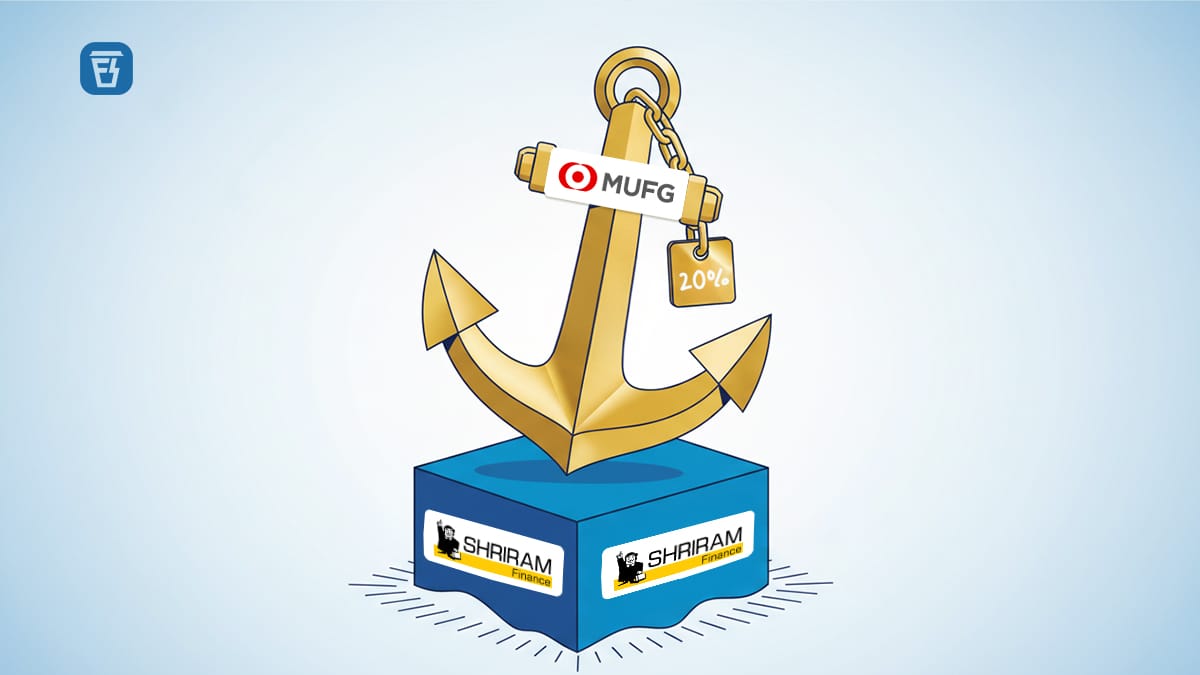
In today’s Finshots, we explain why MUFG, one of Japan’s largest banks, has announced to buy a 20% stake in Shriram Finance, the second largest NBFC by market capitalisation, loan portfolio and net profit.
The Story
2025 has quietly turned into a landmark year for foreign money entering India’s financial sector. One deal after another has landed on Dalal Street — Emirates NBD buying into RBL Bank, Warburg Pincus backing IDFC, and before that, Sumitomo Mitsui Banking Corporation stepping in to support Yes Bank.
Each deal appears to have broken the record set by the last. What began as selective capital infusions has turned into a full-blown race for ownership in Indian finance.
And now MUFG Bank is rewriting the record books entirely with Shriram Finance.
A few days ago, the Japanese banking giant announced a ₹39,600 crore deal to acquire a 20% stake in Shriram Finance. It’s the largest finance-sector deal of 2025 so far and values Shriram Finance at nearly ₹2 lakh crore.
On the surface, it looks like just another foreign investment headline.
But it isn’t because this isn’t a turnaround story. MUFG isn’t rescuing a stressed bank or sneaking in through a backdoor. It’s choosing to enter India through a well scaled, profitable, and dominant non-banking financial company (NBFC).
So why this route? And why now, you ask?
To understand that, you first need to understand where NBFCs sit in India’s financial system.
NBFCs do many of the things banks do — lend to individuals and businesses, but without holding a full banking licence. Shriram Finance, for instance, specialises in commercial vehicle and MSME lending, along with gold loans, two-wheelers, and passenger vehicles.
In other words, it operates right at the heart of India’s real-economy credit engine.
And for foreign investors, NBFCs offer something banks don’t: flexibility.
Because in India, banks come with tight promoter ownership caps, long approval timelines, and heavy regulatory scrutiny before a deal even gets off the ground. NBFCs, by contrast, offer breathing room. Strategic stakes are easier to acquire, board representation is more straightforward, and influence can be exercised without years of regulatory limbo.
That makes NBFCs a far more practical entry point for global banks looking to tap India’s credit growth.
And Shriram Finance stands out because it isn’t just another large lender riding the NBFC wave.
It has over 3,200 branches across India, serves more than 9 million customers, and manages assets worth over ₹2.6 lakh crore. In FY25, it clocked profits of ₹8,272 crore, making it the second-largest NBFC in the country by scale and profitability.
And crucially, it isn’t growing off speculative bets. Its core businesses — commercial vehicle financing and passenger vehicle loans, are deeply tied to India’s economy and generate repeat borrowing cycles.
Which tells you that it isn’t a company looking for survival capital. It’s a company looking for its next ceiling.
And this is where things get interesting.
Being the second-largest player sounds impressive. But in NBFCs, the gap between first and second isn’t cosmetic, it’s structural.
Sitting above Shriram Finance is Bajaj Finance, a market leader with a valuation north of ₹6 lakh crore. Bajaj Finance also has something most NBFCs don’t: a large and growing deposit base, with annual deposits of nearly ₹71,400 crore.
That deposit engine gives it a funding advantage that compounds over time. Lower cost of capital means more competitive lending, faster scaling, and higher profitability.
But for Shriram Finance, matching that purely through organic growth is tough. The issue isn’t demand. It’s access to cheaper, stable capital.
And the obvious long-term solution to that problem is a universal banking licence. For context, a banking licence unlocks what NBFCs lack: low-cost deposits through savings and current accounts.
But in India, banking licences are rare. They’re tightly regulated, granted cautiously, and usually only after decades of operating history, proven governance, and regulatory comfort. Which is why even well-run institutions can sit in limbo for years.
So while a banking licence may be the destination, it isn’t an immediate lever Shriram Finance can pull.
Which brings us back to why MUFG needs India. This deal isn’t shaped only by India’s growth story. It’s equally shaped by a country sitting thousands of miles away — Japan.
For decades, Japanese banks have operated in a low-interest-rate environment, backed by an ageing population and a culture that prefers saving over spending. That’s stable for citizens, but brutal for banks chasing loan growth.
Yes, Japan recently raised interest rates for the first time in 30 years. But even after the hike, rates sit at around 0.75%. Domestic growth opportunities remain limited.
And the deeper issue isn’t monetary, it’s demographic.
Japan has one of the world’s oldest populations and a shrinking workforce. Fewer young borrowers mean fewer home loans, vehicle loans, and business expansions. Banks aren’t short of capital. They’re short of places to deploy it profitably.
That’s where India fits in.
With a young population, expanding middle class, and rising credit penetration beyond tier-1 cities, India offers exactly what Japanese banks lack: sustained loan demand.
Seen this way, the MUFG–Shriram deal starts to look less like a transaction and more like a structural match.
MUFG gets immediate exposure to India’s fastest-growing credit segments without building a retail banking presence from scratch. The deal also comes with two board seats, giving MUFG a long-term strategic foothold rather than a passive stake.
Shriram Finance, in return, gains a global partner with deep pockets, international credibility, and the ability to lower funding costs over time. These are advantages that matter when competing with much larger peers. In short, it’s just two structural constraints finding each other at the right time.
Sure, this deal doesn’t guarantee a banking licence. If history is any guide, the RBI remains cautious about handing those out, prioritising asset quality and governance over growth alone. Even well-capitalised institutions can wait years before seeing approval.
Still, what this partnership does buy Shriram Finance is something just as valuable: credibility, patience, and optionality.
And in Indian finance, those three often matter as much as capital itself. What do you think?
Until next time…
If this story helped you understand the MUFG-Shriram Finance deal, share it with a friend, family member or even strangers on WhatsApp, LinkedIn and X.
Did you know? Nearly half of Indians are unaware of term insurance and its benefits.
Are you among them?
If yes, don't wait until it's too late.
Term insurance is one of the most affordable and smartest steps you can take for your family’s financial health. It ensures they do not face a financial burden if something happens to you.
Ditto's IRDAI-Certified advisors can guide you to the right plan. Book a FREE 30-minute consultation and find what coverage suits your needs.
We promise: No spam, only honest advice!