
The India-EU Free Trade Agreement Explained
In today’s Finshots, we’re talking about the recent India-European Union trade deal and analyzing who stands to gain and lose from this agreement.
But here’s a quick sidenote before we begin. This week, we’re hosting a free 2-day Insurance Masterclass where we’ll walk you through simple rules to pick the right insurance plan and the common mistakes you should avoid.
📅 Tomorrow (Friday), 30th Jan ⏰at 6:30 PM: Life Insurance
How to protect your family, choose the right cover amount, and understand what truly matters during a claim.
📅 Saturday, 31st Jan ⏰at 10:00 AM: Health Insurance
How hospitals process claims, common deductions, the mistakes buyers usually make, and how to choose a policy that won’t disappoint you when you need it most.
👉🏽 Click here to register while seats last.
Now onto today’s story.
The Story
After nearly two decades of on-and-off negotiations, India and the European Union announced the conclusion of the India–EU Free Trade Agreement at the 16th India–EU Summit on January 27, 2026. On paper, this links India to one of the world’s largest trading blocs, spanning 27 countries and more than 450 million consumers. But in practice, it also ties India more tightly to the Western trading system at a time when global trade itself is being reorganised.
For context, trade between India and the EU is already huge. In 2024–25, goods traded between them were worth about $137 billion, with India exporting $76 billion and importing $61 billion. This also makes the European Union India’s third-largest trading partner.
That’s also why the India-EU FTA isn’t about opening new avenues of trade. It’s about improving an existing relationship at a time when global supply chains are being reshaped and trade policy is increasingly being driven by geopolitics rather than pure economics.
Against that backdrop, the India–EU FTA is less about headline tariff cuts and more about positioning India as part of an alternative supply-chain network that reduces over-reliance on a single country.
With that out of the way, let’s get into the meat of the deal.
India’s top exports to the EU are manufactured goods and energy, while our top imports from the EU are high-tech and capital goods such as nuclear reactor parts and aircraft.
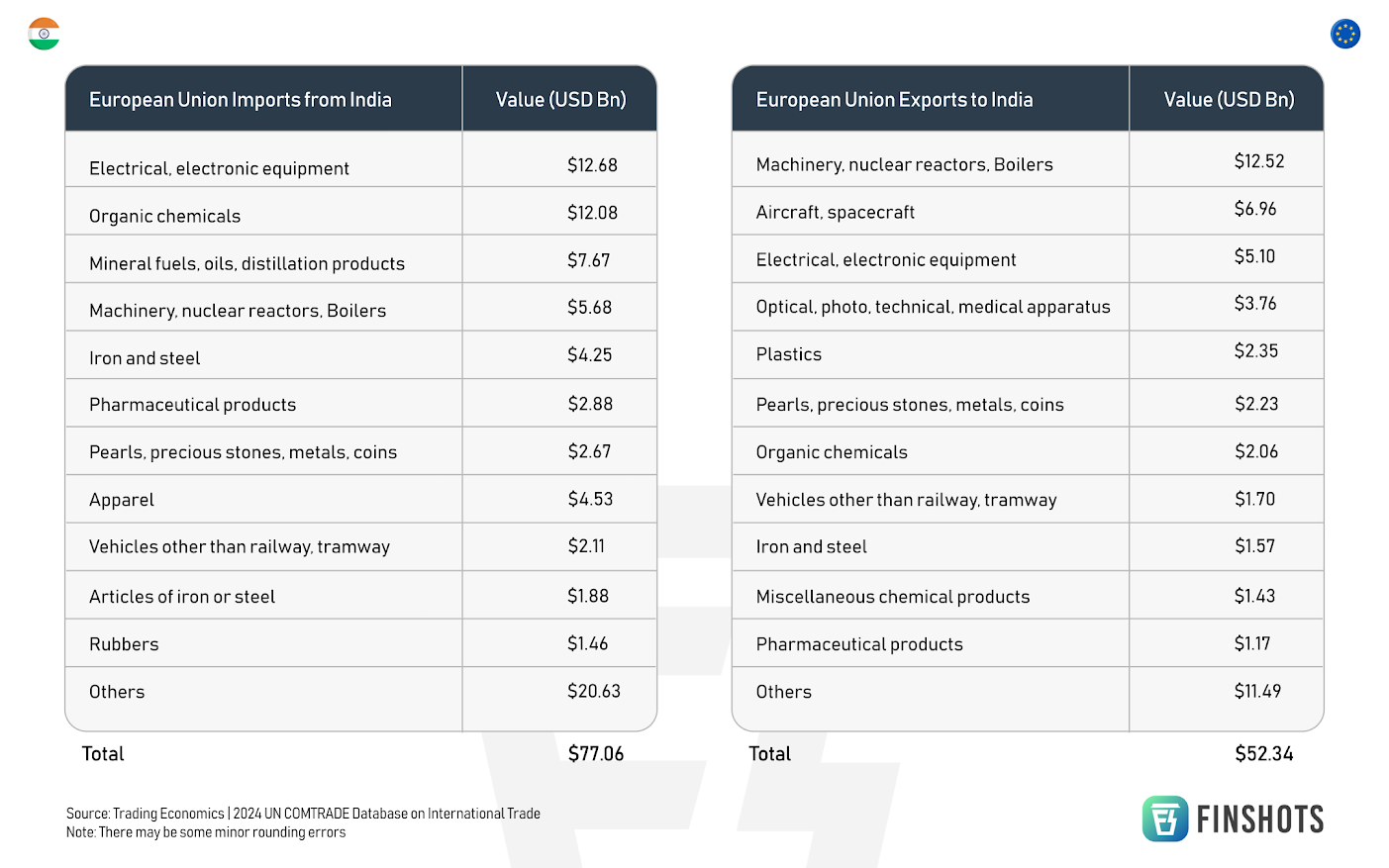
And this FTA slashes or removes tariffs on the vast majority of goods. India will eliminate duties on 93% of EU imports by value; the EU will do so for 99% of Indian exports. This is a big boon for labour-intensive and export-oriented industries in India. Let’s take a look at this in more detail, starting with the industries that stand to gain from the India-EU Trade deal.
Textiles, apparel, leather goods, footwear, and gems and jewellery are sectors where tariffs still matter a great deal. Eliminating this can swing orders from countries such as Bangladesh and Vietnam, in India’s favour, especially for firms that already operate at scale and meet European quality standards.
Electronics manufacturing and engineering goods could also gain over time, with the elimination of the up to 10% tariff that currently exists. European firms are actively diversifying supply chains to reduce exposure to China for political and regulatory certainty.
Another industry that is particularly well-positioned is the rubber industry, where India already enjoys a strong natural advantage as one of the world’s largest producers of natural rubber and a key supplier to global tyre and automotive value chains.
In fact, India has already been working towards meeting the EU’s anti-deforestation rules with the Bharat Sustainable Natural Rubber (BSNR) initiative, which aims to promote environmentally friendly and ethical rubber production, including reducing deforestation.
Apart from this, India already supplies a good amount of pharmaceutical products to Europe. An ageing European population will mean greater healthcare demand, which makes this FTA structurally important for our pharmaceutical industry, too. Given the US’ uncertainty, this is quite welcome.
That said, trade agreements rarely create only winners. While several Indian sectors stand to gain, others may find this deal slightly challenging.
To begin with, Indian automobile manufacturers have long enjoyed heavy protection from European manufacturers through high import duties that kept premium European cars largely out of reach for Indian consumers. This FTA is set to reduce duties from 70-100% to 10-40% in the coming years. While this may expand consumer choice, it could squeeze Indian manufacturers operating in the mid to premium segments. Over time, the pressure could force consolidation or push Indian automakers to accelerate partnerships, technology transfers, and exports to stay competitive.
India’s wine and spirits industry has also been heavily shielded by steep import duties, which kept European alcohol expensive and limited to a niche audience. But under the India–EU trade deal, these tariffs will be reduced in phases, from 150% to 20%, making European wines and spirits far more price-competitive. This could put pressure on domestic producers, particularly premium Indian whiskey, vodka, and wine brands that have been trying to move up the value chain. With well-established European labels entering at lower price points, Indian players risk losing market share at home before they have fully built global scale or brand recognition.
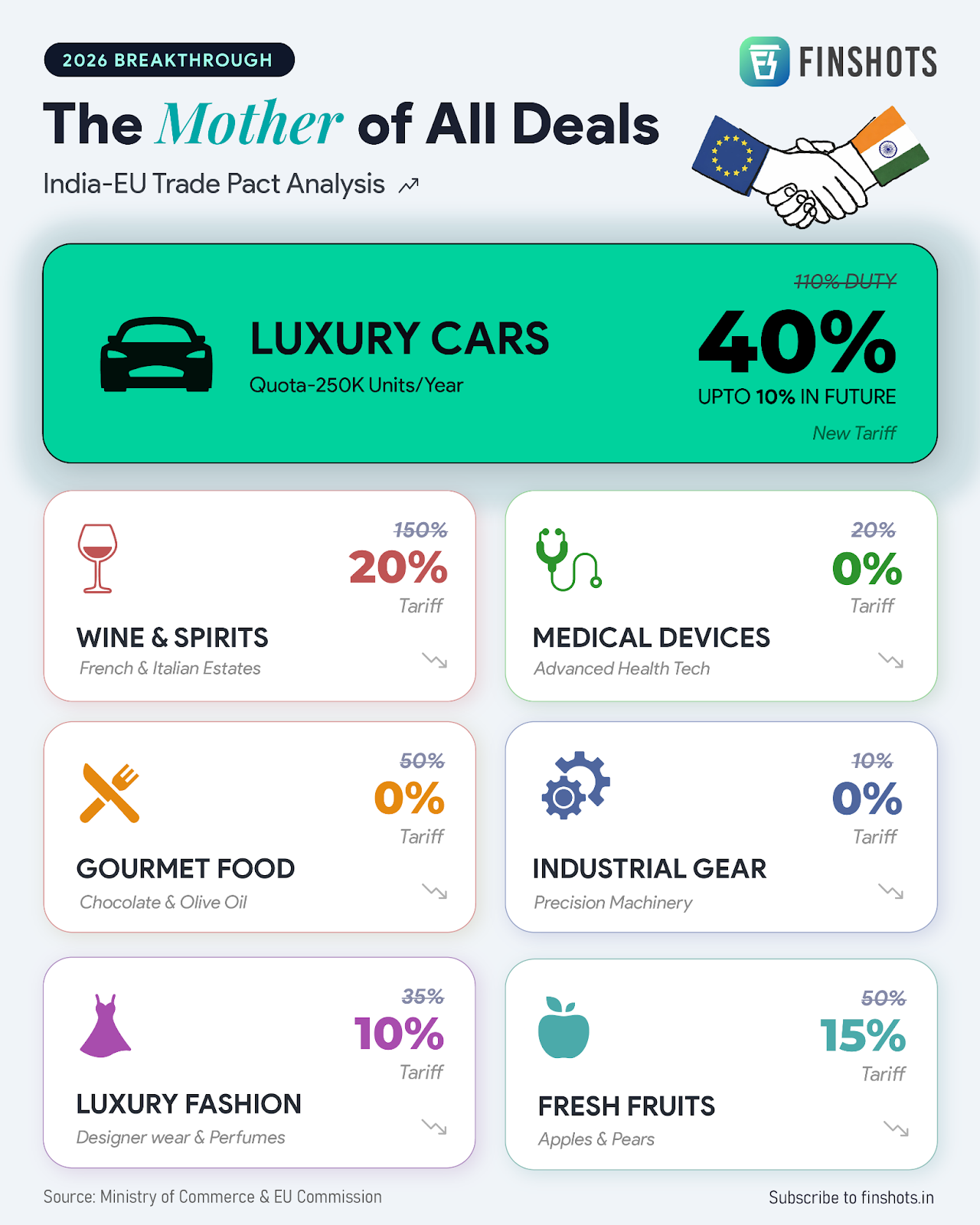
A similar challenge could emerge in the gourmet food segment. Products such as cheeses, chocolates, olive oil, and specialty processed foods from Europe enjoy strong brand recall and established quality perceptions. Lower tariffs would make these imports more accessible to Indian consumers, increasing competition for domestic artisanal and small-scale producers. Many Indian gourmet brands are still early in their growth cycle and operate with higher costs and thinner margins, which could make it difficult to compete with large European producers that benefit from scale, subsidies, and mature supply chains.
However, what is perhaps the most underplayed aspect of the India-EU free trade agreement is services and people. The deal goes far beyond tariffs and includes a comprehensive mobility framework for professionals. This means that Indian engineers, IT professionals, doctors, and even traditional medicine experts can find it easier to work short-term in Europe.
For instance, the agreement allows Intra-Corporate Transferees (ICTs) and Contractual Service Suppliers (CSS) to move between India and EU member countries in dozens of sectors, from software to R&D to education. In fact, the FTA explicitly expands IT and IT-enabled services, professional services, education, and research sectors. So in practice, an Indian IT consultant on an EU project or an engineer sent to a German factory will face fewer visa hurdles.
Students and young professionals stand to gain, too. The deal includes a framework for student mobility and post-study work. In other words, talented Indian graduates may find it easier to study in Europe and stay on to work. This “brain circulation” can build global skills and networks. Naturally, this also means India is ‘exporting’ people alongside goods.
And while Indian professionals abroad become bridges for technology and investment, there’s a flipside: a genuine brain drain risk. Even before this FTA, India was sending an enormous number of students overseas. A NITI Aayog report notes that in 2024, outbound student migration was roughly 25 times the number coming in, and the gap is only growing.
This means that while young professionals and researchers gain opportunities, the challenge will be to ensure talent flow becomes a win-win for both India and Europe.
So, there you have it, folks. The India-EU free trade agreement rewards our strength in labour-intensive industries and growing service exports. But it also means some Indian industries must step up their game. And as talent and skills become as tradeable as products, we will need to manage the balance between brain gain and brain drain.
That said, there will be winners and losers on each side of the bridge, but the hope is that the overall traffic will boost growth, jobs, and innovation in India, as well as Europe.
As Commerce Minister Piyush Goyal put it, this FTA is the mother of all trade deals. It’s India’s largest-ever trade pact, and a chance to plug into 25% of the global economy at a scale that few other agreements can offer. And one that could reshape India’s trade, talent, and industrial linkages with the world for decades to come.
Until then…
If this story helped you understand the recent India-European Union Free Trade Agreement, feel free to share it with your friends, family, and colleagues on WhatsApp, LinkedIn, and X.
Also, if someone recommended Finshots to you, why not subscribe to our newsletter? We cut through the jargon and deliver crisp financial insights straight to your inbox. Just one email every morning. Promise!