
The end of forced selling at banks?
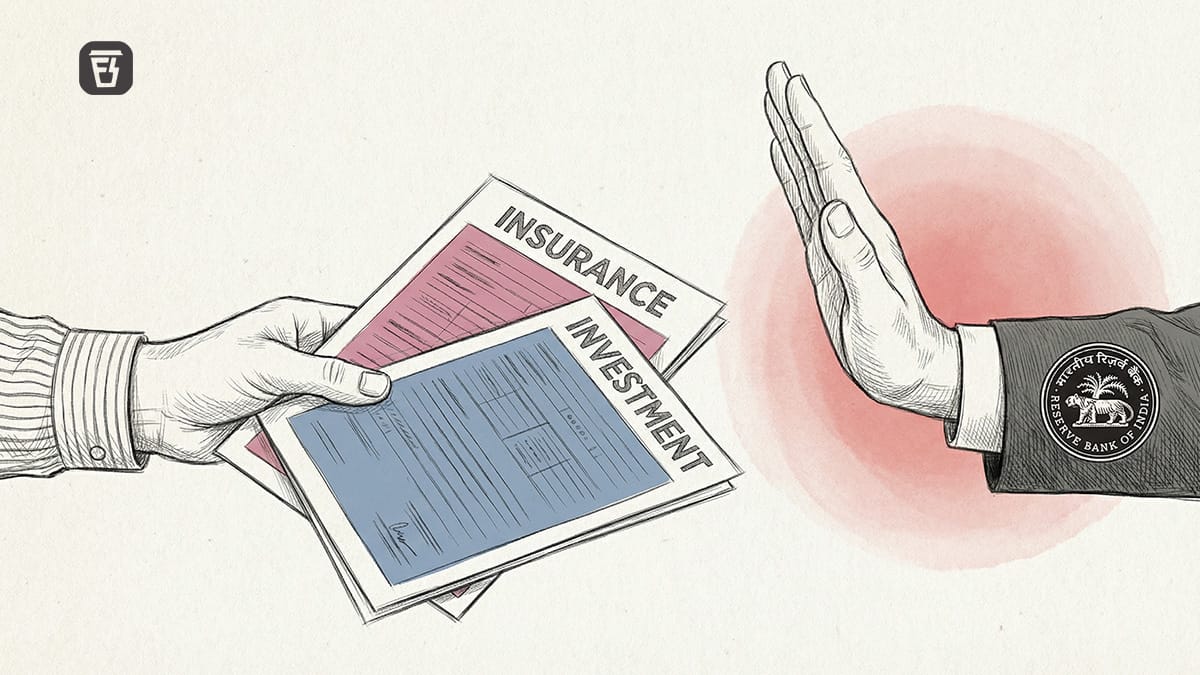
In today’s Finshots, we explain why the RBI wants banks to stop mis-selling.
But before we begin, if you love keeping up with the buzz in business and finance, make sure to subscribe and join the Finshots club, loved by over 5 lakh readers.
Already a subscriber or reading this on the app? You’re all set. Go ahead and enjoy the story!
The Story
If you want to apply for a home loan today, you walk into a bank or, if you’re online-savvy, you simply apply through an app. A bank representative calls you. Credit scores are checked, income statements verified, property documents uploaded. Everything seems routine. Then comes the paperwork. Dozens of pages filled with legal and financial jargon that only a lawyer could decode. Somewhere buried in that stack is an insurance policy you didn’t realise you agreed to. But your signature says you did. This is the reality of what’s happening in Indian banking right now. And it’s not just us saying it.
Versions of this play out across bank branches and apps every day. And it’s widespread enough for the government and even regulators to start paying attention.
For context, take the insurance that banks or NBFCs (Non Banking Financial Companies) often describe as “good to have” when you apply for a home loan. You’re told it will protect the loan in case of default, disability, or untimely death. But a home loan already comes with built-in protection for the lender — the property itself is pledged as collateral. In the event of a default or even the borrower’s death, the bank has a legal claim on the house. So what exactly is this extra insurance protecting, and for whom?
Well, here’s the logic banks usually give. They’ll say this extra insurance policy protects the family. If the borrower passes away and the home loan is still outstanding, the bank can legally claim the house. And that could leave the rest of the household without a roof over their heads. So the insurance steps in. It pays off the outstanding loan. The bank gets its money back. And the family gets to continue living in the same house. On paper, that sounds reasonable.
But this explanation only really works in one situation — when the borrower doesn’t already have life insurance. Or when the policy they do have isn’t large enough to cover the loan amount. Because think about it. If someone already has a life insurance policy that comfortably covers all their liabilities, including the home loan, why should they be forced to buy another one?
In that case, the bank could simply ask for an undertaking. Something that says: if the borrower passes away, the bank has the first right over the insurance proceeds to recover the loan. That’s clean and logical.
But that’s rarely what happens. In most cases, whether you already have insurance or not, the bank nudges or sometimes practically compels you to sign up for their insurance policy if you want the loan approved. And it quietly becomes part of the package.
This is exactly the kind of thing that the government has started calling out. In fact, recently the Finance Minister made a simple point: if a home loan is already backed by the house itself, why is an extra insurance policy being pushed alongside it? Her argument wasn’t that insurance is useless. It was that when such products are sold as a near-default part of the loan process, without clearly explaining what extra protection they actually offer, it stops being advice and starts looking like mis-selling.
That’s the backdrop against which the RBI stepped in — not to ban insurance or cap fee income, but to change how products are sold and who bears responsibility when customers don’t fully understand what they’ve signed.
And the changes are significant.
For starters, banks can no longer engage in compulsory bundling — where taking one product quietly means buying another. If you walk in for a home loan, the conversation has to stay about the loan. Insurance or investment products can still be offered, but they can’t be positioned as mandatory or necessary for approval.
Even when a product is genuinely required as part of a larger service, customers don’t have to buy it from the bank itself. The new rules make it clear that people must have the option to purchase such products elsewhere, not just from the bank’s preferred partner.
Then comes the biggest shift of all. It used to be that once you signed a consent form, the bank could simply point to it and say, “Hey, you agreed.” That defence doesn’t carry the same weight anymore. Signing a form or clicking “I agree” won’t automatically protect the bank. Even if consent exists, a product can still be treated as mis-sold if it wasn’t suitable for the customer. The question changes from “Did you sign?” to “Why was this sold at all?”
That’s where suitability comes in. Before selling a product, banks are now expected to assess whether it actually fits the customer — looking at income, age, risk appetite, financial literacy, and the product’s complexity. Sales are expected to move away from pure targets and closer to relevance.
The change doesn’t stop at the point of sale. Banks will also be expected to check in with customers within 30 days of a sale — to confirm they understood what they bought.
And it’s not just what happens in branches. Think about how often you’ve clicked through a banking app without really reading what’s on screen. The RBI has formally called out “dark patterns” — hidden checkboxes, pre-selected options, false urgency messages — and wants banks to redesign digital journeys so consent is clear and deliberate. After all, financial products aren’t clearance sales.
Many of these techniques aren’t new. Casinos use them to keep people playing. Shopping apps use them to increase cart sizes. But banking isn’t entertainment or impulse retail. It deals with long-term financial commitments. And when design nudges start shaping decisions about debt and savings, regulators begin to worry.
There’s also a change in pace. Products can’t be quietly sold and closed in a single sitting. Banks are expected to give customers time to understand what they’re buying, instead of folding add-ons into routine paperwork or rapid digital flows.
And if something does go wrong, explanations won’t be enough. If mis-selling is established, banks must refund the full amount paid and compensate customers for any losses. Accountability is no longer optional.
For anyone tired of endless spam calls, there’s relief here too. Cold calls and follow-ups can’t spill into odd hours anymore. Banks and their partners are expected to stick to defined calling windows (between 9 AM to 6 PM), closer to normal working hours. And customers must be clearly told whether they’re speaking to a bank employee or an external sales agent. No more blurred identities where every caller sounds “official”.
Finally, banks can’t hide behind intermediaries. Whether a product is sold by a relationship manager, a call-centre executive, or a third-party agent, the responsibility stays with the bank. Sales agents must be clearly identified, properly trained, and visibly separate from core bank staff. “It was our partner” is no longer an escape route.
Since these are draft directions, the RBI is still inviting public comments before finalising the rules. But if the framework broadly goes through in its current form, the immediate change will be felt not just by customers but even by banks.
For customers of course, there will be fewer surprise add-ons, fewer confusing calls, and fewer complaints that show up years after a product is sold.
For banks, especially the ones that have been posting record results, the shift may not look huge on the surface, but it runs deeper.
To put things in perspective, income from bancassurance (business that comes from banks acting as agents of insurance companies) doesn’t form a large chunk of total income. For SBI, the largest public sector bank, it contributes less than 0.5% of overall income. That sounds insignificant until you look at the growth in numbers. Over the last decade, for instance, SBI’s bancassurance income has grown nearly six times to ₹2,766 crore. In comparison, its total interest income has only doubled to ₹4.9 lakh crore over the same period.
HDFC Bank, the largest private bank, tells a similar story. Income from third-party business, which includes insurance commissions, mutual fund commissions and marketing fees from promoting third-party products in branches and ATMs, has grown eight times in ten years to ₹6,600 crore. Its interest income, meanwhile, has risen nearly five times to ₹3.3 lakh crore. And while that gap may not look dramatic at first glance, HDFC Bank’s annual report notes that this third-party income made up just 14% of total fee income a decade ago. But today, it accounts for 25% (as of FY25).
So yeah, the RBI’s directive may slow sales down and banks will need to find more deliberate ways to grow this stream meaningfully.
But the bigger impact could be on insurance companies as bancassurance contributes roughly half of the sector’s premiums and as much as 80% for some insurers. That tells you how critical banks are as a distribution channel.
Which means conversations that once ended in quick signatures will now need explanations, follow-ups and checks. The numbers may still grow. But sustaining them will take more time, more effort and far more restraint than before.
Until then…
Don’t forget to share this story with a friend, family member or even strangers on WhatsApp, LinkedIn and X.
The Silent Crisis in India’s Public Banks
And since you’ve already read about how banks are being accused of mis-selling, and how the RBI and the government have warned them to stop, here’s a Finshots TV video you should check out to understand what really nudges banks to push these third-party products.
A small hint: hefty targets and relentless work pressure.