
The economics of stolen KitKats
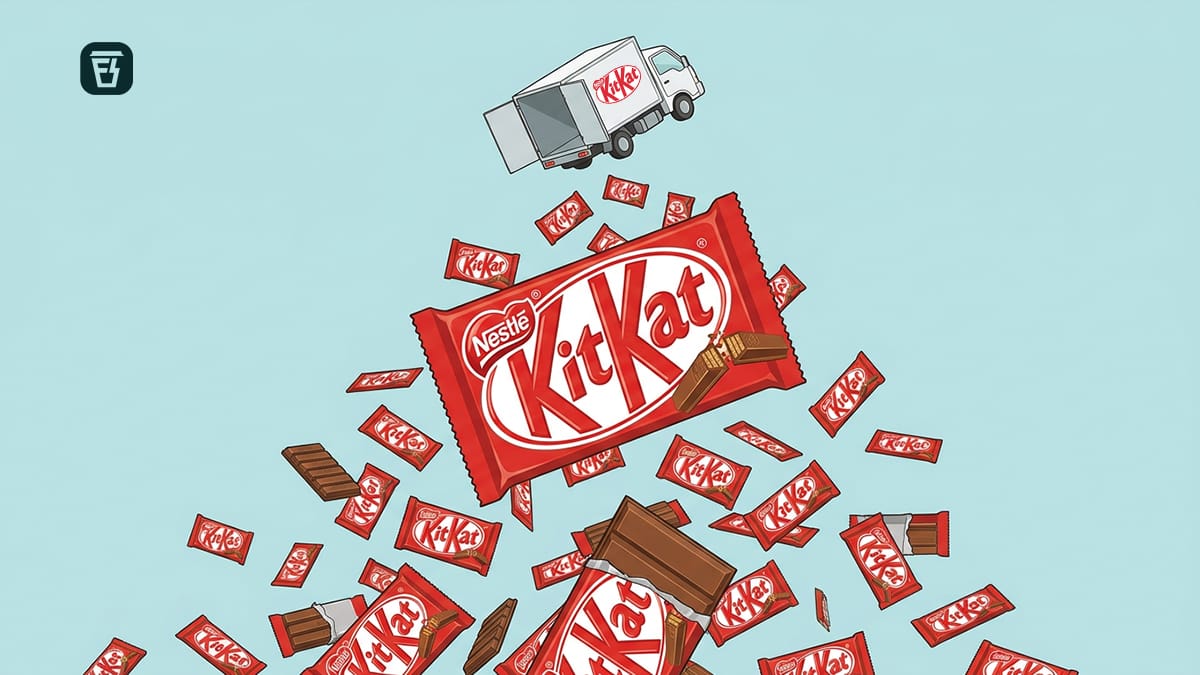
In today’s Finshots, we tell you how cargo theft affects a country’s economy, using the stolen KitKat shipment as an example.
The Story
A couple of days ago, the internet went a little crazy over a stolen shipment of KitKats. For context, roughly 12,000 kg or about 4 lakh KitKat bars went missing while being transported from Italy to Poland. The truck carrying them simply vanished.
Nestlé confirmed the theft with a cheeky line in its statement, before following it up with something far more serious:
Whilst we appreciate the criminals’ exceptional taste, the fact remains that cargo theft is an escalating issue for businesses of all sizes.
And this makes it more than just a meme-worthy incident. Cargo theft has, in fact, been rising sharply across the world. In the US alone, losses from cargo theft touched $725 million in 2025, according to CargoNet, a theft prevention and recovery business for insurers. That’s a 60% jump from the previous year. And while we’re using US data because reports offer a measurable estimate of losses, the problem is global. Countries like Brazil, Mexico, Germany, South Africa, and India are all seeing a surge. In fact, India accounts for nearly 63% of cargo theft cases in Asia.
Which raises a simple question. What actually happens when 4 lakh KitKats get stolen? And more importantly, how does something like this ripple through the economy?
To answer that, you first need to understand what thieves actually target.
Now, you’d expect high-value items like electronics, jewellery, or fuel to top the list. But reports on cargo theft suggest that the most stolen category globally is… wait for it… food.
Yup. Food and beverage products account for about 22% of all cargo theft incidents, followed by agricultural goods, electronics, and fuel. In one recent case in the US, thieves were caught stealing 33,750 pounds of frozen crab worth $325,000.
At first, that sounds weird. Why go after chocolate bars, seafood, or dairy instead of expensive gadgets?
But it starts to make sense when you realise that food is incredibly easy to sell. Unlike a stolen phone, which can be tracked through IMEI (International Mobile Equipment Identity) numbers or locked remotely, a box of chocolates or a crate of juice has very little traceability. There are no unique identifiers that instantly flag it as stolen. Sure, there are batch codes, but someone in the supply chain or a consumer would have to flag the item for a company to act on it. And because these are everyday products, they can be quietly pushed into small shops, roadside vendors, or local markets — places where buyers don’t always ask for proper invoices, without raising suspicion.
Now, if you put this into perspective for the KitKat case, the shipment was on its way from Italy to Poland. And Italy, with its local and street markets, could be a more convenient place for the thieves to offload the goods compared to Poland, where retail is more heavily dominated by large, formal chains and convenience stores. That said, this is just our hypothesis and not an official update on the case.
But that’s not the only reason food works so well for thieves. A lot of food items such as milk, dairy products, meat, seafood, fruits and vegetables are also perishable. Even packaged goods like chocolates come with expiry dates. So thieves are forced to sell quickly. And ironically, that urgency works in their favour. The faster they move the goods, the harder it becomes for authorities to track where they went. So in a strange way, food isn’t just easy to steal but also easy to liquidate.
But there’s also another interesting question that you might want to ask…
If stolen goods are being sold and consumed, does any of this actually contribute to the economy? After all, money changes hands, goods move, and people buy and sell.
In reality, though, it does nothing to add to GDP or Gross Domestic Product, which is simply the total value of goods and services a country produces over a given period. That’s because GDP only counts new production. And in this case, the KitKat bars were already produced in Italy. When they’re stolen, nothing new is created. The goods simply move from one owner to another.
In economic terms, this is just a transfer of assets. Nestlé’s inventory reduces because the finished goods it produced are now gone. And whoever ends up stealing those chocolates will see their inventory go up. But overall, the economy hasn’t produced anything new. And it’s just a reshuffling of existing goods. So instead of showing up in GDP, this kind of loss is recorded under a line item in national accounts that’s far less glamorous — “other changes in the volume of assets”.
There is, however, a small twist. If someone adds value to those stolen goods before reselling them, that portion can show up in GDP.
Just to give you an example, let’s say a thief steals my car. If they sell it as is, GDP doesn’t change. But if they add value by repairing it, repainting it, replacing the engine, or refurbishing it, then the value added through those services becomes part of economic activity, typically through the informal economy, even if not fully captured in official data. The same logic could apply to Nestlé’s stolen KitKats.
But here’s another catch. Nestlé has already issued public communication asking retailers and wholesalers to check batch numbers. If a product matches the stolen shipment, they’re supposed to report it. This makes reselling these chocolates in their original form quite risky.
So what options do the thieves really have?
Firstly, they could try repackaging everything. But repackaging lakhs of chocolate bars isn’t exactly easy, practical or even wise.
Which leaves another possibility — quietly exporting the chocolates and selling them in markets where traceability is weak and buyers are less likely to check batch codes or report anything suspicious.
But even if they manage to pull that off, the GDP story doesn’t really change. From the exporting country’s perspective, these goods leave without being officially recorded as exports. And since GDP calculations rely on formal data, this illegal movement doesn’t show up in them. Even if someone later traces the goods, it still doesn’t count as new production.
And that’s why cargo theft, despite all the activity it creates, is fundamentally a drag on the economy.
For businesses, it’s a direct hit as they lose inventory, which eats into profits and margins. They’re forced to hold extra safety stock, which increases costs. And insurance premiums go up.
And for a country like India, where efficient movement of goods is critical for growth, rising cargo theft makes logistics more expensive and less predictable. Besides, estimates suggest that cargo theft leads to losses worth nearly ₹12,000 crore to the Indian economy. That’s the measurable part.
Which is why companies aren’t sitting idle. Some of the responses are fairly straightforward — better locks, stronger truck seals, stricter checks on drivers and transport partners. This is because nearly 76% of cargo thefts happen from trucks, often when drivers stop for breaks or to rest along long routes.
Companies are also turning to technology. GPS tracking, smart locks that send alerts if a container is opened, and route-planning software that avoids high-risk areas are becoming more common. Nestlé, in particular, has introduced a digital tracker that allows consumers to check whether their chocolate comes from the “missing batch”. Firms are also tightening documentation, improving due diligence on logistics partners, and using data analytics to identify patterns in theft. In some cases, they are even changing routes and warehouse locations to reduce the risk of theft.
So yeah, that’s how stolen goods or in this case, the missing KitKats, affect the economy, beyond just companies like Nestlé writing off the loss.
When you look at it this way, the missing shipment starts to feel like a small window into a much larger problem of how goods move, how they get stolen, and how something that looks like economic activity on the surface is, in reality, just a silent loss.
Until next time…
Liked this story?
Share it with someone you’d share a KitKat with on WhatsApp, LinkedIn, or X. Actually, even a stranger will do.
Insurance Masterclass Series: Build Financial Security That Lasts
This weekend, we’re hosting a free 2-day Insurance Masterclass that helps you build real financial security by understanding health and life insurance the right way.
📅 Saturday, 4th April at 11:00 AM: Life Insurance
How to protect your family, choose the right cover amount, and understand what truly matters during a claim.
📅 Sunday, 5th April at 11:00 AM: Health Insurance
How hospitals process claims, common deductions, the mistakes buyers usually make, and how to choose a policy that won’t disappoint you when you need it most.