
The economics of space exploration
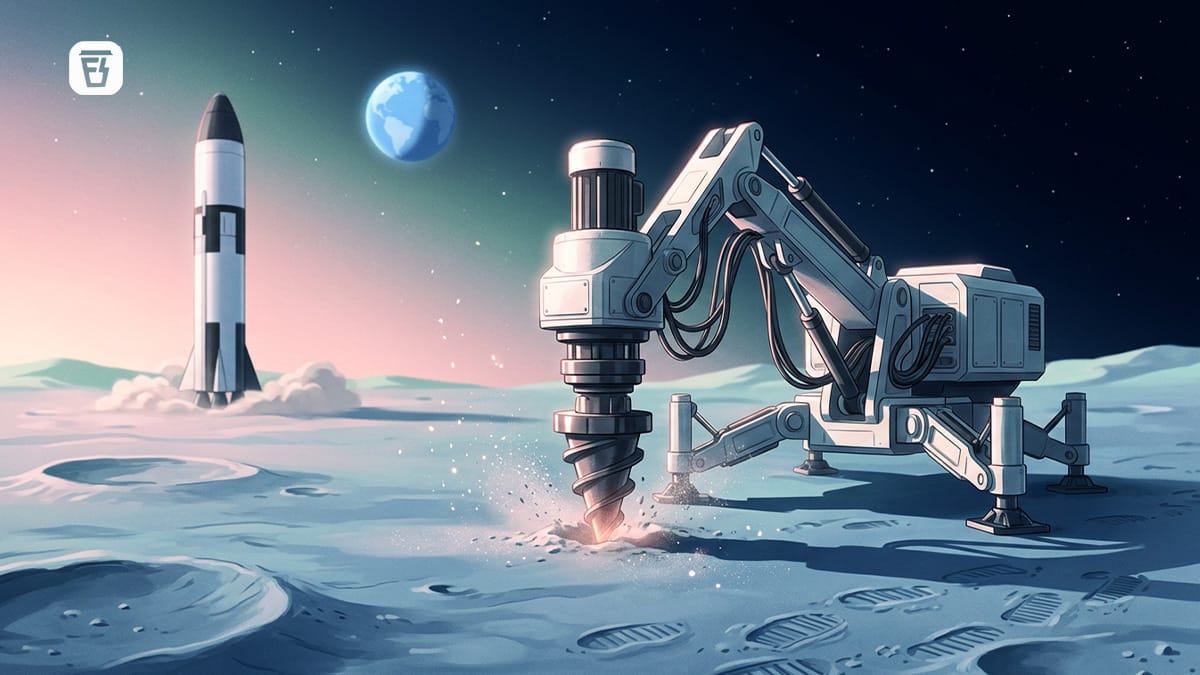
In today’s Finshots, we take a look at why humans are heading back to the Moon.
But before we begin, if you love keeping up with the buzz in business and finance, make sure to subscribe and join the Finshots club, loved by over 5 lakh readers.
Already a subscriber or reading this on the app? You’re all set. Go ahead and enjoy the story!
The Story
On December 13, 1972, Commander Eugene Cernan of the final Apollo lunar mission said: “We leave as we came, and, God willing, we shall return, with peace and hope for all mankind.”
And after more than fifty years, humans are finally heading back to the Moon again.
But this is not a repeat of the Apollo era. Back then, the objective was to land on the Moon, plant a flag, collect lunar samples, and return safely.
This time, the objective is different.
With Artemis II, NASA is not attempting a landing. The mission is a crewed flyby designed to test spacecraft systems, life-support capabilities, and deep-space operations. It is part of a broader roadmap that moves step by step: validate the technology, attempt sustained lunar landings later in the decade, and eventually use that experience as a foundation for missions to Mars.
That shift in intent is what makes the current phase of space exploration economically interesting. Because it is not cheap. The Apollo missions between 1960 and 1973 cost NASA around $26 billion. Adjusted for inflation, that’s over $300 billion! And the estimate for the Artemis programme is around $93 billion (for now).
Which raises the obvious question: Why go back to the Moon if it costs so much?
You see, NASA’s answer rests on three broad ideas.
The first is that the Moon acts as a testing ground. Deep-space missions introduce challenges that have not been fully solved. We’re yet to fully understand the effects of long-duration human survival in deep space, radiation exposure, closed-loop life-support systems, and logistics in environments with no immediate return options. The Moon, being relatively close to Earth, offers a controlled environment to test these systems before attempting something far more complex, such as a mission to Mars.
The second reason is scientific. Recent missions, including our own Chandrayaan explorations, have confirmed the presence of water ice near the Moon’s south pole. And this discovery changes the economics of space travel in quite a meaningful way.
This is because it costs over $22,000 to carry 1 litre of water from Earth to the International Space Station. So one can imagine how much it would cost to go to the Moon and beyond. And water is not just a resource for survival. It can be split into hydrogen and oxygen, which can then be used as rocket fuel.
So, if we can successfully use the water on the Moon, it could turn the Moon into a refueling station for space missions, drastically reducing costs for journeys to Mars and beyond.
The third reason is infrastructure. The long-term vision is not limited to isolated missions. It involves building a sustained human presence. That includes habitats, energy systems, communication networks, and supply chains that operate beyond Earth. Once that infrastructure exists, the cost of future missions could decline significantly, much like how infrastructure on Earth reduces the cost of economic activity over time.
But this is where the story shifts from science to economics.
If you’re building infrastructure in space, the natural next step is asking what it can be used for. That’s where ideas like lunar bases, space mining, and eventually colonies come in. The Moon could become a hub for mining, microgravity manufacturing (producing materials and medicines in near-weightlessness to avoid gravity-related issues), and supporting missions to Mars.
Let’s take mining as an example.
The Moon is not just a barren rock. It is home to a wide range of valuable materials, many of which could reshape the economics of space if they can be extracted efficiently. Among these, the most talked about is Helium-3, an isotope that has accumulated on the lunar surface over billions of years due to exposure to the solar wind. It can be described as the holy grail of space resources because of its potential applications.
Helium-3 could play a key role in clean nuclear fusion energy, offering a low-emissions alternative to current energy systems. It is also relevant to advanced technologies such as quantum computing and medical imaging. What makes it especially attractive is its scarcity on Earth.
Even small quantities brought back from the Moon could command millions of dollars, making it one of the few resources where the economics might justify the extreme costs of space extraction.
Beyond helium-3, lunar regolith (a layer of dust covering the Moon's surface, formed over billions of years by meteorite impacts) contains metals such as titanium, aluminum, and iron. Extracting and processing these materials in space could reduce the need to launch heavy materials from Earth, which is probably one of the most expensive aspects of space missions.
There’s also another, lesser-known layer to this. Certain regions of the Moon, called KREEP terrains (short for potassium, rare-earth elements, and phosphorus), are believed to contain concentrations of rare-earth materials. These include elements such as yttrium and neodymium, found in trace minerals like apatite, monazite, and merrillite. On paper, the scale is enormous, with estimates suggesting hundreds of trillions of kilograms of these elements embedded in the lunar surface.
But here’s the catch. Unlike deposits on Earth, these materials are highly dispersed. They exist in such low concentrations that, with current technology, extracting them in economically viable quantities is nearly impossible. In other words, while the Moon may look like a treasure trove of rare earths, it doesn’t yet qualify as a mine. At least not in the way we understand mining today.
Besides, these possibilities come with significant uncertainty.
Space exploration remains one of the most capital-intensive activities undertaken by governments and private companies. Despite reusable rockets bringing down the cost of launches, they are still high, timelines are long, and returns are uncertain. Unlike in traditional industries, there is no immediate revenue model to justify large-scale investment in lunar infrastructure.
As we’ve explained in a previous story about SpaceX:
The cost of developing the Starship, transporting cargo and humans, setting up habitats, and sustaining repeated missions could easily run north of $1 trillion. And more importantly, there is no obvious revenue model at the end of it.
From a shareholder perspective, that is a sinkhole, and history often suggests that the markets win those arguments.
This is where the current phase differs from the Apollo era.
Apollo was primarily driven by geopolitical tensions between the US and the Soviet Union. Economic returns were not the objective. Today, while national prestige still plays a role, there is a growing emphasis on long-term economic viability.
The expectation, however, is not that space exploration will generate immediate profits, but that early investments will create options for the future. If certain technologies mature, such as reusable rockets, space mining, or nuclear fusion, the economic landscape could shift dramatically.
Until then, much of the spending remains speculative.
This is why Artemis II is significant despite being a non-landing mission. It represents a transition from proving that something is possible to understanding whether it can be sustained. The focus is on reliability, consistency, and scalability rather than one-time achievement.
So yeah, if these early missions succeed, they set the stage for sustained lunar presence later in the decade (or century). That, in turn, opens the door to experiment with infrastructure, resource utilisation, and new economic activities.
If they fail, the timeline stretches further, and the economics become harder to justify.
Until then…
If you liked this story on the economics of space exploration, feel free to share it with your friends, family or even strangers on WhatsApp, LinkedIn or X.
Also, If you’re someone who loves keeping tabs on the world of business and finance, hit subscribe if you haven’t already. And if you’re already a subscriber, thank you! Maybe forward this to someone who’d enjoy our stories but hasn’t discovered us yet.
Myth Alert: I'm Too Young to Buy Life Insurance!
The other day, one of our founders was chatting with a friend who thought life insurance was something you buy in your 40s. He was shocked that it was still a widely held belief.
Fact: Life Insurance acts as a safety net for your family. The younger you are, the cheaper it is. And the best part? Once you buy it, the premium remains unchanged no matter how old you get.
Unsure where to begin or need help picking the right plan? Book a FREE consultation with Ditto's IRDAI-Certified advisors today.