
The Draft Electricity Amendment Bill 2025 explained
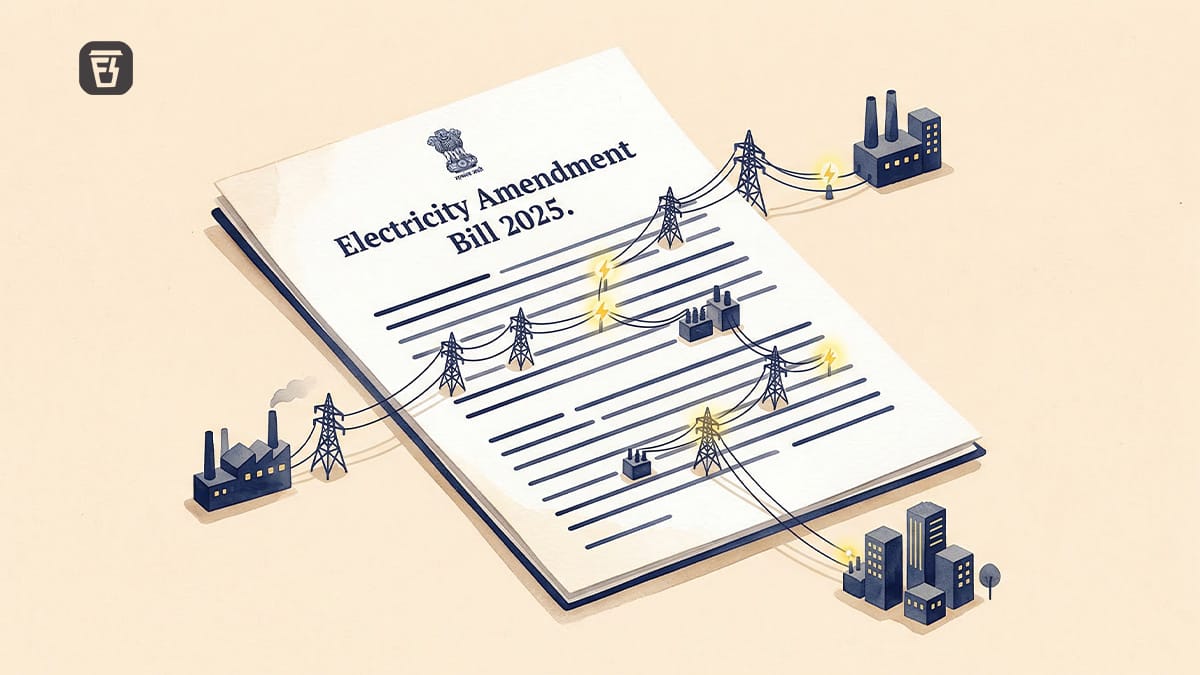
In today’s Finshots, we take a look at why unions are protesting against the Draft Electricity (Amendment) Bill, 2025, which will soon be tabled in the Indian Parliament.
But before we begin, if you love keeping up with the buzz in business and finance, make sure to subscribe and join the Finshots club, loved by over 5 lakh readers.
Already a subscriber or reading this on the app? You’re all set. Go ahead and enjoy the story!
The Story
A couple of days ago, employees from state-run electricity utilities walked off their desks during lunch hour and gathered outside offices, power plants, and district headquarters, holding placards and chanting slogans.
They were protesting the Centre’s proposed Electricity (Amendment) Bill, 2025, a reform that aims to overhaul how electricity distribution works in India.
In Hyderabad, protests erupted outside Vidyut Soudha, the headquarters of Telangana’s power utilities. In Haryana, it happened at the Nuh Substation, and in Delhi, the National Coordination Committee of Electricity Employees & Engineers (NCCOEEE) organised a meeting against the bill.
But why?
You see, India’s electricity sector lives with a curious contradiction. Demand for power is rising steadily as the economy grows, electric vehicles expand, and data centres multiply. And even electricity production from renewable energy is increasing year by year. India is even exporting record amounts of electricity to neighbouring countries like Bangladesh and Nepal. All of this needs a network of grids that’s capable of handling all this demand.
And maintaining such a vast and expanding network isn’t cheap. Electricity has to be generated, transmitted across high-voltage lines to substations, and finally distributed to homes, farms, and factories. And in this last step of the chain is where financial stress tends to show up most.
Many of India’s state-run electricity distribution companies, known as DISCOMs, remain financially fragile. Years of politically driven tariffs, delayed subsidy payments, and losses from electricity transmission have left the sector with losses in the lakhs of crores. While reforms in recent years have improved their profitability, the underlying structural weaknesses have not fully disappeared.
This persistent imbalance between rising demand and fragile distribution finances is what the government is trying to address through the Electricity (Amendment) Bill 2025.
The idea itself is not new. Earlier versions of the bill appeared in 2020 and again in 2022, but faced resistance from unions, as it paves the way for privatisation and potential job losses.
To understand why this matters, it helps to look at how the electricity system actually works. Power first flows through generation companies (GenCos) that produce electricity at power plants. It is then carried across long-distance transmission networks before finally reaching consumers through distribution companies, or DISCOMs.
While generation and transmission have fared well over the past two decades, the distribution segment has not. Most of the financial stress in India’s power sector sits with DISCOMs, which are responsible for supplying electricity to homes, farms, and businesses. These companies often buy power from generators but struggle to recover the full cost from consumers due to subsidised tariffs and delayed government payments. And at the end of the day, it is the humble taxpayer who foots the bill.
The proposed reforms include allowing multiple electricity distributors to operate within the same geographic area. In theory, this means consumers could choose their electricity provider in much the same way they choose telecom operators today. The bill also proposes stricter payment mechanisms for power purchases, ensuring that electricity-generating companies such as NTPC, NHPC, JSW Energy, and Adani Energy are paid on time.
In addition to this, they propose to increase regulatory oversight so that tariffs (electricity tariffs, not the other kind) more transparently reflect the actual cost of supplying electricity rather than political considerations alone.
One could argue that these changes could help address one of the biggest inefficiencies in the power sector. Even after years of reform, distribution companies continue to struggle with high losses, delayed payments, and inadequate investment in infrastructure. Structurally changing how DISCOMs operate and, more importantly, introducing competition could encourage greater efficiency and innovation. Because if multiple suppliers compete for consumers, it could eventually lead to better service quality, fewer outages, and potentially lower electricity prices.
However, the proposal has triggered protests from several groups, including farmer unions and the NCCOEEE. Their concerns revolve around how these reforms could reshape the economics and governance of electricity distribution.
One of the biggest fears relates to agricultural electricity subsidies. In many states, farmers receive heavily subsidised or even free electricity for irrigation. They worry that introducing private distributors could reduce or even eliminate these subsidies. Private firms, they argue, may be less willing to serve customers who pay low tariffs, especially when those tariffs are set for political reasons.
Another concern involves the autonomy of state governments. Currently, electricity distribution falls under state jurisdiction. Tamil Nadu has TANGEDCO, Karnataka has KTPCL, Maharashtra has MSEDCL, and so on. This lets state governments control electricity prices, which they use as a policy control measure. And subsidised tariffs often form part of broader political commitments. If the reform shifts more authority toward national regulators or private operators, states fear losing this influence over how electricity pricing and subsidies are managed.
Besides, electricity workers’ unions view the proposal through yet another lens. From their perspective, the reform resembles a gradual pathway toward privatisation. Their concern is that private distributors will focus on profitable urban consumers while state-run DISCOMs remain responsible for rural areas and heavily subsidised users. If that happens, public utilities could be left with the most financially difficult segments of the market while losing the revenue streams that help cross-subsidise them.
These fears also extend to employment, where they worry that increased private participation could lead to outsourcing, restructuring of state utilities, and potential job losses across the sector.
Even from a consumer perspective, the effects of competition are not entirely straightforward. In many industries, competition drives better services and lower prices. Let’s take telecom, for instance. The entry of multiple private players has dramatically reduced call and data prices over the past two decades.
But competition does not always produce perfectly competitive markets. In many cases, industries eventually consolidate into a handful of dominant firms, creating an oligopoly. The telecom sector itself illustrates this perfectly. After years of intense competition and price wars, the market has narrowed to a few major players today.
So, even if multiple electricity distributors are allowed to operate in the same area, the market could eventually settle around a small number of large companies. In such situations, competition may improve service quality and efficiency, but it does not always guarantee lower prices for consumers.
The outcome will depend heavily on how regulators design the market structure, ensure fair access to electricity networks, and prevent excessive concentration of power (pun intended 😉).
Despite these concerns, the reform responds to a growing reality. India’s electricity demand is expected to expand rapidly in the coming decades. Electric vehicles, increased industrial activity, and the growth of renewable energy are all adding pressure on the grid. Meeting that demand requires sustained investment in distribution infrastructure and better overall financial health across the sector.
The Electricity Amendment Bill attempts to address this long-standing contradiction. India’s power sector has become more capable of generating electricity, yet the companies responsible for delivering that electricity to consumers often struggle financially. Without addressing this imbalance, the system risks repeating cycles of debt accumulation and government bailouts.
Whether the reform succeeds will depend less on the language of the legislation and more on how the competitive framework is implemented. If the rules ensure that private distributors cannot simply select profitable customers while leaving difficult segments to state utilities, the reform could strengthen the sector. If those safeguards are weak, the reform may deepen existing financial pressures.
Power sector reforms in India have always been complex because electricity sits at the intersection of economics and politics. Apart from influencing the electoral outcome, tariffs and subsidies also influence household budgets, farm incomes, and industrial competitiveness.
The Draft Electricity (Amendment) Bill 2025, therefore, represents an attempt to modernise a system that has struggled with structural inefficiencies. Whether it succeeds will depend on how carefully policymakers balance financial discipline and social obligations. Because they inevitably touch politics, livelihoods, and the price every household pays to keep the lights on.
Until then…
If this story helped you understand the Draft Electricity (Amendment) Bill 2025 better, feel free to share this with your friends, family or even strangers on WhatsApp, LinkedIn or X.
Message to All the Breadwinners
You work hard, you provide, and make sacrifices so your family can live comfortably. But imagine when you're not around. Would your family be okay financially? That’s the peace of mind term insurance brings. If you want to learn more, book a FREE consultation with a Ditto advisor today.