
The 10-minute delivery promise is gone. What now?
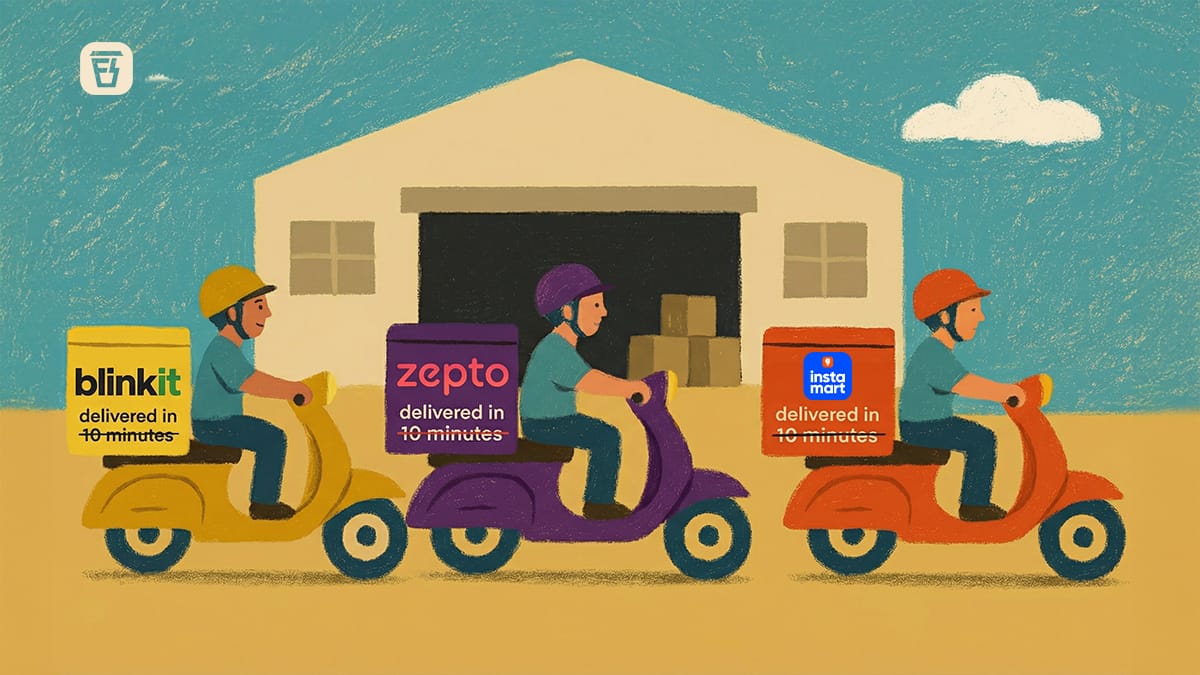
In today’s Finshots, we break down whether removing the 10-minute branding really changes how quick commerce businesses like Zepto, Blinkit, or Instamart make money.
But before we begin, if you’re someone who loves to keep tabs on what’s happening in the world of business and finance, then hit subscribe if you haven’t already. If you’re already a subscriber or you’re reading this on the app, you can just go ahead and read the story.
The Story
New Year didn’t start very well for India’s quick commerce market. While you and I were partying and counting down to midnight, gig workers represented by unions went on strike to push back against unpredictable payouts, the lack of social security in their jobs, and, most importantly, time-bound or 10-minute deliveries that consumers have grown to love.
And as you already know, it didn’t go in vain. One of their demands was met a couple of days ago, when the Union Labour Ministry intervened and asked quick commerce platforms to do away with 10-minute deliveries.
Blinkit blinked first and quietly removed its promise of “10-minute delivery” across all platforms. And while no peers have followed suit, at least at the time of writing this story, we’ll have to see if they do so eventually.
This must have made you wonder, “Does this change anything for India’s quick commerce sector?”
After all, if you remember how Zepto started, you might recall its co-founder, Kaivalya Vohra, once saying, “...customers love a rapid delivery experience. The data speaks for itself – once we started delivering in 10 minutes, our NPS shot up and has constantly remained at around 85 with a 50%+ week-on-week user retention rate, which shows the incredibly strong customer love for our product”.
For context, this was way back when Vohra was running KiranaKart, Zepto’s predecessor. Along with Aadit Palicha, Zepto’s co-founder and CEO, he partnered with nearby kirana stores to deliver groceries to neighbourhoods during the pandemic-induced lockdown, using a simple app.
Back then, large online platforms took up to a week to deliver, while local kirana stores struggled to keep up with the surge in demand. That gap is what pushed Vohra and Palicha to build KiranaKart in the first place.
On average, deliveries still took around 45 minutes. But they noticed something interesting. Whenever they managed to deliver faster — say, in under 15 minutes, customer retention improved noticeably.
They measured this using NPS, or Net Promoter Score, which captures how likely users are to recommend a platform to a friend or colleague. Customers rate this likelihood on a scale of 0 to 10, and the score is calculated based on the percentage of promoters (those who rate it 9 or 10), passives, and detractors (those who rate it 6 or below).
That insight is probably what gave the duo the confidence to build an entire business around the idea of 10-minute deliveries.
And now that this promise is being rolled back, there are two things that could happen.
The first possibility is actually quite simple. Nothing really changes.
That’s because, plainly put, it’s just the “10-minute” label that’s gone, not the underlying promise of fast delivery. The time cap was one of many marketing hooks (and a very successful one) that helped consumers quantify how quickly groceries could arrive, unlike apparel, gadgets, or electronics. But in reality, deliveries were never always under 10 minutes anyway.
Most of us have experienced 15–20 minute deliveries, which is closer to the actual average. As Karan Taurani of Elara Capital told NDTV Profit, gig workers on these platforms typically fulfil about 2.5–3 orders per hour. That math naturally translates to lead times of 20 minutes or more across platforms.
So if orders still arrive within, say, 30 minutes, very little changes. After all, the idea of getting things “now” — that hit of instant gratification, is something social media and quick commerce have already wired our brains for.
In fact, if you look at Blinkit’s performance over the last few quarters, you’ll notice that its Net Order Value (NOV) or the total value of orders after discounts, has consistently grown by about 107–137% quarter-on-quarter over the past year.
In its earnings calls, the management has largely attributed this growth to higher order density per dark store (a nearby fulfilment hub that looks like a store but serves only online orders, helping platforms deliver faster) and a strategic shift from a marketplace model to an inventory-led one. In simple terms, Blinkit moved from being a connector, i.e., linking customers to kirana stores and earning a commission, to acting more like a retailer itself.
Earlier, the inventory belonged to third-party retailers, who set prices while Blinkit handled logistics. Now, Blinkit procures the inventory, controls pricing, and manages delivery end-to-end. That shift naturally boosts NOV and could improve margins over time.
The highlight though is this: nowhere does the management credit 10-minute deliveries as a key driver of NOV growth. And if speed alone were doing the heavy lifting, it would have featured prominently in earnings discussions, no?
That brings us to the second possibility. What could change is the psychological side of things for consumers, and as a result for the business.
You see, the “10-minute delivery” promise quietly messed with our brains in a very predictable way.
Behavioural economists call this ‘hyperbolic discounting’, which is just a fancy way of saying we value things that happen right now far more than things that happen later, even when waiting is cheaper or more sensible.
So when a platform says “get it in 10 minutes”, your brain treats speed as something special. You stop comparing prices rationally. Even if a competitor offers the same product for a few rupees less but delivers it tomorrow, you don’t think, “I could get this tomorrow for free.” Instead, you think, “I want it now.”
That’s why people are often happy to pay extra delivery fees for 10-minute delivery. In short, speed sells.
But now that this marketing label can’t be used anymore, platforms may have to find new, and possibly more expensive ways to convince people to place orders. This becomes especially tricky for categories like gadgets or apparel, where urgency is naturally lower and “10 minutes” was never the real need.
To maintain the same order volumes, platforms might have to lean more heavily on discounts. And discounts, as you know, are expensive. Many platforms have already tried to limit these while quietly raising platform, handling, or convenience fees to push unit economics closer to profitability.
So that’s one thing we’ll have to see: what will platforms do to retain their most impulsive buyers once speed stops doing the psychological heavy lifting?
The other thing to watch is how this might affect repeat purchases on these apps.
Studies on quick commerce show that if a delivery arrives late, people subconsciously wait longer before placing their next order. But when a delivery comes earlier than expected, the opposite happens and they place repeat orders sooner.
Blinkit’s higher net average order value hints at this dynamic. Customers seem to trust it more, which makes them comfortable placing bigger orders and ordering more often, largely because it usually delivers when it says it will.
So even if the “10-minute” label disappears, the underlying idea still holds. Platforms need to deliver quickly and consistently, or at least stick to the time they promise on the screen once an order is placed. Without that, frustration creeps in. In other words, even without the 10-minute badge, complacency isn’t an option.
So yeah, losing this marketing tool may not hurt platforms in a big way. The real challenge though, will probably be holding on to the most impulsive buyers.
And if, in that process, platforms come up with new or more creative ways to signal who delivers the fastest, we’re unlikely to see any real change in how fast or carefully quick commerce delivery personnel ride on the roads or the pressure they face to deliver quickly.
What do you think?
Liked this story? Share it with a friend or family member who loves ordering from quick commerce platforms on WhatsApp, LinkedIn, or X.
Insurance Masterclass Series: Claims made Simple!
A prominent insurer is set to raise term insurance rates in the next few days. Which makes this a good time to understand how life and health insurance actually work, beyond just premiums.
That’s why we’re hosting a free Claims Webinar Series, where we break down how claims are processed in the real world, why delays and rejections happen, and what truly makes a difference when it matters most.
📅 Saturday, 17th Jan | ⏰11:00 AM
Health Insurance Masterclass
How hospitals process claims, common deductions, the mistakes buyers often make, and how to choose a policy that won’t let you down when you need it most.
📅 Sunday, 18th Jan | ⏰11:00 AM
Life Insurance Masterclass
How to protect your family, choose the right cover amount, and understand what really matters during a term insurance claim.