
🍳Qatar Airways vs. Airbus, to the moon and back, and more...
Hey folks!
It’s been over half a century since humans last went to the Moon. Back in 1969, under NASA’s Apollo program, Neil Armstrong and Buzz Aldrin lifted off from Cape Canaveral and did something that felt almost unreal — they put human beings on the lunar surface for the very first time.
For a moment, it felt like anything was possible. The Moon wasn’t a distant dream anymore. And around 650 million people tuned in to watch grainy black-and-white footage of men walking on another world, as Neil Armstrong uttered the words that would echo through history: “One small step for man, one giant leap for mankind.”
That world looked very different from ours today. There were no smartphones, no social media, no electric cars — and “space tech” back then ran on computers that would look laughably basic today.
And yet, we made it to the Moon.
So here’s the real question: if we could do it in 1969, why is NASA sending astronauts back only now — with Artemis II?
We’ve all seen Interstellar. A future where humans leave Earth, travel deep into space, and search for new frontiers feels like pure science fiction.
But what if deep-space travel isn’t fiction for much longer?
That’s the vision behind Artemis II — NASA’s mission that will send four astronauts around the Moon, marking humanity’s first crewed journey beyond Earth orbit in over 50 years.
Before deep-space exploration and long-duration space travel can become a reality, the Moon is the ideal training ground from Earth. It’s our only natural satellite — close enough to reach in days, yet far enough to simulate the conditions of deep space. Over decades, scientists have built a deep understanding of its environment, gravity, radiation exposure, distance, and orbital mechanics.
That makes the Moon the safest place to test the hardest parts of space travel — especially how the human body copes outside Earth’s protective bubble. Unlike the International Space Station, which still orbits within Earth’s magnetic field, lunar missions expose astronauts to real deep-space radiation, communication delays, and prolonged isolation.
In other words, if something goes wrong, astronauts can still return to Earth relatively quickly. But if everything goes right, the data collected becomes the blueprint for missions far beyond the Moon — including Mars.
That’s exactly where Artemis II comes in. According to NASA, the mission is designed to be the first real test of whether humans, spacecraft, and mission systems are ready to operate together in deep space. The crew — Commander Reid Wiseman, Pilot Victor Glover, and Mission Specialists Christina Koch and Jeremy Hansen — will travel aboard the Orion spacecraft, launched by NASA’s powerful Space Launch System, fly around the Moon, and return to Earth on a roughly 10-day journey.
There’s no landing planned. Instead, the focus is on testing life-support systems, navigation, communication, radiation exposure, and emergency procedures — all with humans onboard, far beyond low-Earth orbit. It’s a full dress rehearsal meant to uncover risks before they turn catastrophic.
Artemis II isn’t about reaching somewhere new.
It’s about proving that after more than half a century, humans can safely leave Earth — and come back — before we try to stay longer, go farther, and aim for places like Mars.
And as a quiet, honourable nod to history, the Artemis II crew isn’t going alone. They’ll be carrying keepsakes from the Apollo era, a symbolic bridge between the astronauts who first took humanity beyond Earth orbit, and the ones now preparing to go farther than ever before. It’s the astronaut’s way of saying: We wouldn’t be here without you.
Here’s a soundtrack to put you in the mood 🎵
Azadi by Ditty
That’s one recommendation from us. But keep your music recommendations coming. We’d love to feature them in our Sunday editions, especially gems from underrated Indian artists many of us haven’t discovered yet. Can’t wait to hear them!
What caught our eye this week 👀
How Qatar Airways almost lost Airbus
Imagine you buy a brand new Ferrari. A few months down the line, the paint starts peeling off. You would probably march back to the dealer and demand a refund or a fix, right? After all, the customer is king.
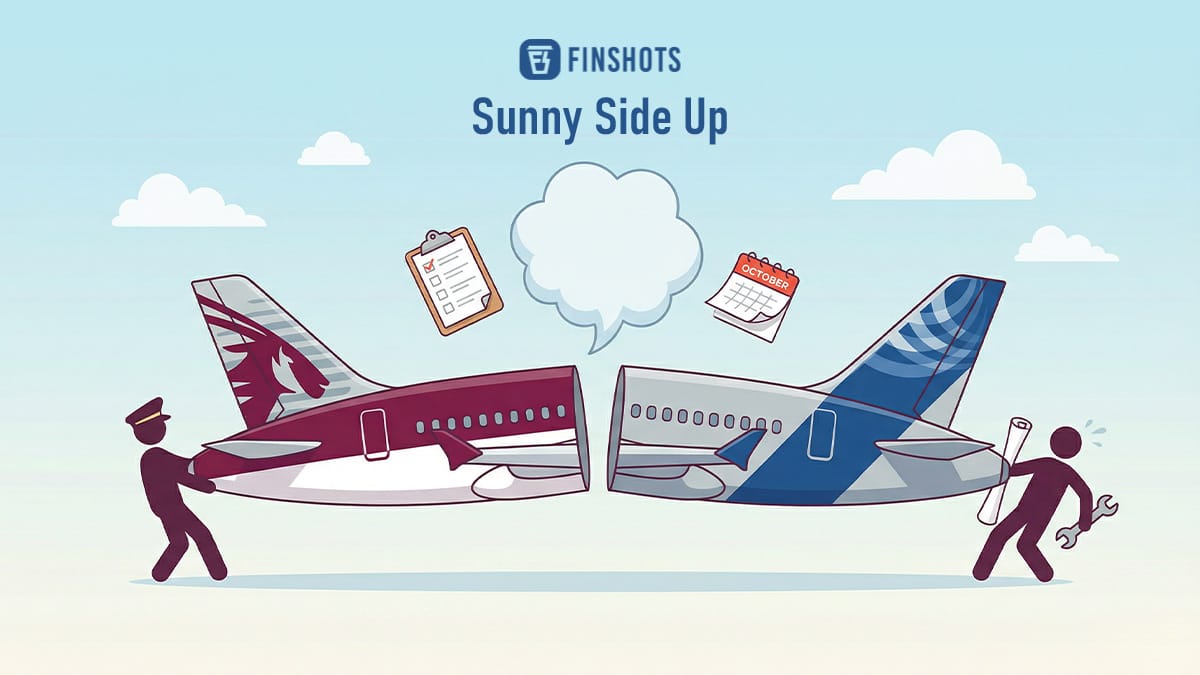
Well, that’s exactly what Qatar Airways thought when they noticed the paint cracking on their shiny new Airbus A350 jets. But instead of a quick fix, they ended up in one of the most brutal corporate wars in aviation history.
Qatar Airways is a stickler for perfection. So, when they saw the paint degrading and exposing the lightning protection mesh on their A350s, they were furious. They claimed it was a massive safety risk. Airbus, on the other hand, shrugged. Alongside the European safety regulator, Airbus assured that it was just a cosmetic defect and the plane was otherwise safe.
But Qatar Airways wasn’t having it. They decided to play hardball and grounded 13 of their A350s while refusing to take delivery of new ones. Qatar Airways slapped Airbus with a lawsuit demanding $618 million in compensation. They expected Airbus to fold, given Qatar Airways was one of the biggest spenders in the sky. But then, Airbus did the unthinkable.
Usually, manufacturers often bow down to their biggest clients. Airbus wasn’t going to be one of those. They realized in a duopoly (with the only other option being Boeing), they held more cards than people thought. So, the French aeroplane manufacturer retaliated with the ‘nuclear option.’
Airbus countersued Qatar Airways and cancelled the outstanding order for 19 A350s. And the kicker? They invoked a “cross-default” clause to cancel a completely separate order for 50 A321 Neo jets. This was a disaster for Qatar Airways. The A321s were crucial for their future expansion but suddenly, there were no planes coming.
The timing of this couldn’t have been worse. The 2022 FIFA World Cup was right around the corner and Qatar Airways was the host airline. They desperately needed capacity. But with their A350s grounded and their new orders cancelled, they were struck. In this case, they had to scramble.
Qatar Airways went knocking on Boeing’s door for 737 MAXs. Even worse, they had to bring their retired A330s and A380 superjumbos back from the dead. This was humiliating because the CEO, Akbar Al BAker, had previously vowed never to fly the gas-guzzling A380s ever again. Now, they were spending millions just to get them airworthy.
So, how did this story end?
The courts sided with Airbus and it became clear that Qatar Airways had overplayed its hand. In early 2023, the two giants reached for a settlement. While the details are secret, the outcome was clear - Qatar Airways got their orders reinstated but they lost their place in line. Instead of getting planes now, they’re facing massive delays. And shortly after, the airline’s outspoken CEO stepped down.
In the world of aviation, the customer is always right…unless the seller is part of a duopoly and you have nowhere else to go.
Infographic 📊

Readers Recommend 🗒️
This week, our reader Rishav Jain recommends watching The Game Changers, a BBC documentary about the rise of Rockstar Games and how Grand Theft Auto went from a controversial experiment to one of the most influential video game franchises ever.
Thanks for the recommendation, Rishav!
That’s it from us this week. We’ll see you next Sunday!
Until then, send us your book, music, business movies, documentaries or podcast recommendations. We’ll feature them in the newsletter! Also, don’t forget to tell us what you thought of today's edition. Just hit reply to this email (or if you’re reading this on the web, drop us a message at morning@finshots.in).
🖖🏽
Don’t forget to share this edition on WhatsApp, LinkedIn and X.