
Nike's athlete branding playbook, brain powered AI, & more...

Hey folks!
If we asked you what AI is, what would you say? Maybe you’d think of AI models you use for everyday tasks like coding, work or even the bizarre things people make them do on social media.
But the idea behind AI actually comes from the human brain.
Many AI systems are built using something called Artificial Neural Networks (ANNs). These networks loosely mimic how neurons in the brain connect with each other. They use layers of artificial “neurons” to process information, identify patterns, and learn from data. And that’s how machines can recognise images, translate languages, recommend videos, and even hold conversations.
But there’s a problem with AI. Training large models requires enormous computing power. Data centres packed with GPUs (Graphics Processing Units) often draw megawatts of electricity. Meanwhile, the human brain, which performs astonishingly complex tasks like learning and decision-making, runs on roughly 20 watts of power. About the same as a dim light bulb.
So some scientists thought “If AI is inspired by the brain, could we actually use real brain cells to compute?”
Well, we know that sounds extremely sci-fi, but scientists are actually trying to turn it into reality.
A company called Cortical Labs has been working with miniature “brain organoids” grown from human stem cells. These are tiny clusters of neurons grown in the lab. Not full brains, of course, but small networks of living brain cells.
Scientists place these neurons on specialised silicon chips covered with dense grids of electrodes. Those chips are connected to a computer system that can send electrical signals into the neurons and read signals back out, creating a two-way electrical conversation between biology and silicon.
In one experiment, the neurons even learned to play the video game Pong.
To do that, scientists used the computer to send electrical signals to the brain cells through the chip. These signals represented where the Pong ball was on the screen. The brain cells then sent signals back, which the computer interpreted as instructions to move the paddle up or down.
When the signals coming from the cells were steady and predictable, the system kept things stable. But when the responses were messy or wrong, the signals became more chaotic. So over time, the neurons naturally adjusted their activity to avoid the chaotic signals.
Within minutes, the brain cells began responding in ways that helped the paddle hit the ball more often.
In other words, the cells learned how to play the game.
And that’s why researchers are excited.
Biological brains as we mentioned are extraordinarily energy-efficient. So if scientists can harness even a fraction of that efficiency, computing could become far more energy-efficient than today’s GPU-powered AI systems.
And this emerging field is called organoid intelligence.
Companies like Cortical Labs are now exploring ways to package these neuron–silicon hybrids into small server-like systems or early prototypes of what could one day resemble miniature “wetware” data centres.
Sure, they’re fragile for now, besides being experimental, and nowhere near replacing traditional chips. But if the field progresses, the world’s most powerful AI systems in the future might not run only on chips from Nvidia.
They might also run on living neurons! How crazy is that?
Here’s a soundtrack to put you in the mood…
Pavazha Malli by Sai Abhyankkar and Shruti Haasan
You can thank our reader, Ramesh Kumar, for this recommendation. And if you’d like your music recommendation featured too, send them our way, especially hidden gems from underrated Indian artists many of us haven’t discovered yet. We can’t wait to hear them!
What caught our eye this week
How Nike turns athletes into brands
Whenever you hear the moniker ‘Black Mamba’, you think of the NBA legend Kobe Bryant and not of the actual snake or the Kill Bill movie. Well, that’s not an accident but a successfully implemented marketing strategy by Nike.
In late 2002, Nike staffers sat around a conference room table examining a space-age material called Tech Flex. Black and tube-like, it had commonly been found inside cars and airplanes. Gentry Humphrey, a Nike executive, looked at its braided sleeving and thought: "It kind of looks like a snake." He searched for the most badass black snake on the internet and found the black mamba. The campaign was built around it, pitched to Michael Jordan, who was reportedly terrified of snakes, and eventually scrapped.
Years later, Kobe Bryant independently adopted the nickname after watching Kill Bill. Nike recognised the moment and ran with it, turning it into one of the most iconic athlete identities ever built. And that's exactly Nike’s playbook.
Going back to 1984, Nike was primarily viewed as a running brand. The basketball market was led by Converse, Adidas, and Reebok. Converse had Magic Johnson, Larry Bird, and Julius Erving all wearing the same shoe. The shoe was the product and the player was just a vehicle. Nike flipped that and the player became the product.
The Air Jordan 1 didn't conform to NBA uniform rules. Three games in, the league banned it. Nike ran a commercial that slowly panned down Jordan's body and stamped a big "X" on his shoes. The announcer said: "Banned." Nike sold $70 million worth of Air Jordans within two months. This way, Nike won the narrative game.
That has always been Nike’s formula for success. Find an athlete with a compelling tension in their story and build an identity around it. Nike makes their shoes a part of the narrative and never the other way around. Then they go ahead to amplify what’s already organic and give it a name.
Nike knew that merely attaching a famous name to its products wasn’t enough. So to captivate audiences, it crafted compelling narratives that built genuine emotional connections — often making you forget it was Nike behind it all.
Infographic
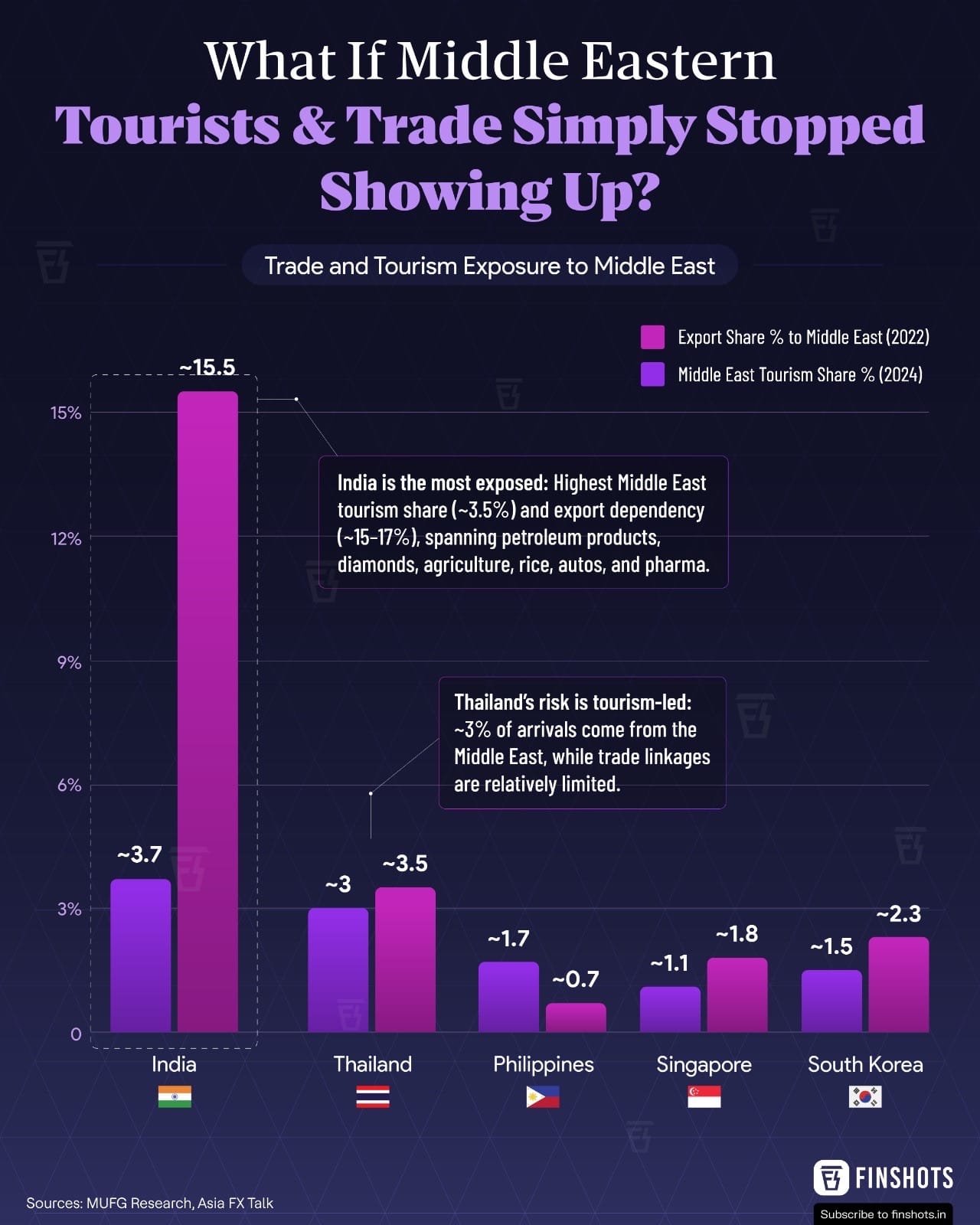
Most eyes are on oil prices. But India and Thailand have a second problem: the Middle East is also where their tourists come from and where their exports go.
India sends ~15–17% of its exports to the region, while 3.5% of its tourism arrivals originate there. For Thailand, it’s the travel disruption that stings most. A prolonged conflict doesn’t just spike fuel costs; it quietly freezes trade flows and empties hotel lobbies. Here’s a look:
Readers Recommend
In our last Sunny Side Up edition, we wrote about dwindling children’s films. So in that context, this week our reader Suhani Tiwari recommends watching Moana.
While most of us may have already seen it, for those who haven’t, the film follows a young girl who sets out on a dangerous ocean journey to save her island and discover who she truly is.
Thanks for the recommendation, Suhani!
That’s it from us this week. We’ll see you next Sunday!
Until then, send us your book, music, business movies, documentaries or podcast recommendations. We’ll feature them in the newsletter! Also, don’t forget to tell us what you thought of today's edition. Just hit reply to this email (or if you’re reading this on the web, drop us a message at morning@finshots.in).
Don’t forget to share this edition on WhatsApp, LinkedIn and X.