
Lost children's films, chinpanzees, and more...
Hey folks!
Whenever you’re in deep thought, there’s one part of the face you reach for above all else — the chin.
But here’s the strange part: no other primate has one. Not chimpanzees. Not gorillas. Not orangutans. Only us.
So why is that?
Well, the story behind it is surprisingly fascinating. Nature has usually given us features that serve a clear purpose — opposable thumbs to grip tools, forward-facing eyes to judge distance, arches in our feet to walk efficiently.
So for years, scientists assumed the chin must have some function too. Maybe it helped us chew tougher food. Maybe it strengthened the jaw. Maybe it played a role in speech.
But what if the chin wasn’t assigned any such function at all?
What if it’s what biologists call a spandrel — a feature that exists not because it was directly useful, but because it emerged as a by-product of other evolutionary changes?
A new study suggests that most aspects of the human chin show little evidence of direct natural selection. Natural selection is simply the evolutionary process where certain physical traits become more common because they help a species survive or reproduce better. The research, led by Noreen von Cramon-Taubadel, studied chin variation across 532 skulls of humans and modern apes like chimpanzees, gorillas, bonobos, orangutans and more. The skull samples were taken from museums of course.
They looked at 46 distances between the head and jaw and wondered what true benefit it served having a chin. If a trait is strongly shaped by natural selection, you expect to see certain statistical signatures such as consistent directional changes that suggest the feature was being “pushed” by evolutionary pressures.
But that’s not what they found.
Only a minority of chin-related traits showed signs consistent with directional selection. The chin likely wasn’t directly targeted by natural selection at all.
So how did it appear?
As Homo sapiens evolved, our faces became smaller and flatter compared to earlier hominins and other apes. Our jaws reduced in size. Our teeth shrank. The lower face retracted. The overall architecture of the skull reorganised itself.
When that happened, the front of the lower jaw didn’t simply disappear. Changes in growth patterns and facial shortening altered the geometry of the jaw in such a way that a small bony projection remained at the base.
That projection is what we call the chin.
This is where the idea of a spandrel comes in. In buildings with arches, triangular spaces automatically appear between structural elements. They aren’t designed for their own sake. They are structural by-products of the way the building is constructed.
Similarly, the chin may be the architectural footprint of a shrinking human face.
This doesn’t mean the chin has no function today. It may play roles in muscle attachment, facial aesthetics or even social signalling. But the study suggests that those functions weren’t necessarily why it evolved in the first place.
So yeah, while we’re used to thinking of evolution as a careful designer, sometimes it behaves less like a designer and more like physics. So you could say that the chin may not be a triumph of adaptation. But a quiet reminder that not everything about us exists for a reason.
Here’s a soundtrack to put you in the mood…
Sun Saawariya by Accha Insaan, AtharvaMusic, and Yaani Karnawat
You can thank our reader, Sujay, for this lovely rec. And if you’d like your recommendation featured too, send them our way, especially hidden gems from underrated Indian artists many of us haven’t discovered yet. We can’t wait to hear them!
What caught our eye this week
What happened to all the children’s films?
If you’ve observed Indian films, especially Bollywood, you’ll notice that the mid-2000s to early-2010s had the densest cluster of widely released child-centric films. Some popular ones you’ve probably watched include Makdee, The Blue Umbrella, Chain Kulii Ki Main Kulii, Taare Zameen Par, Bhoothnath, Chillar Party, Stanley Ka Dabba, Ferrari Ki Sawaari — there’s quite the list.
But over time, the output of these films reduced to a trickle. And today we hardly see any being made. For context, in FY25 alone, fewer than 10 children’s films were produced across all Indian languages out of more than 1,800 films made every year. That’s less than 1% of Indian cinema’s output.
And the reason we’re suddenly talking about children’s films today is because a couple of weeks ago the Manipuri film Boong won the Best Children’s and Family Film award at the BAFTAs (British Academy of Film and Television Arts). And yet, we see very few such films being made today. So what ever happened to all the children’s films in Indian cinema?
Well, three things.
First, bad economics. As viewers, we tend to see films as art and storytelling. And sure, they are partly that. But making a film also means putting a lot of money on the line. Children’s films often need imaginative worlds, animation, and emotional storytelling that can require even more effort and money than a regular film. And once producers invest that kind of money, they naturally start asking where the returns are.
Because here’s the thing. The viewers are children, but the buying power lies with their parents. So a children’s film makes money only when parents decide to take their kids to the theatre.
But that’s where the problem begins. Children mostly can’t watch films on weekdays, so footfalls are naturally low. Weekends are the only option. And even then, kids have to convince their parents that the film is worth the trip compared to other family activities. That doesn’t always work because parents may not be excited about spending two hours in a theatre watching a theme they themselves may not enjoy.
Add to that the cost. Ticket prices for major films in cities now range between ₹250 and ₹600. A trip to the theatre often means a family of three or four buying tickets, plus travel, food, and beverages. This means that the entire experience becomes expensive very quickly. And for parents, it may not even feel rewarding if they can’t relate to the film.
So instead, many parents simply let their kids watch the content they enjoy on OTT platforms. It’s easier, cheaper, and far more convenient. But that makes theatrical children’s films a very expensive gamble for filmmakers.
Because of this, filmmakers tried something clever. They began making films with big Bollywood stars, you know, like Bajrangi Bhaijaan, Krrish , etc. that could appeal to both children and their parents. Big stars brought attention and footfalls, while the story still involved children in some way.
But if you look closely, you’ll notice a very neat pattern. Many of these films revolve around vulnerable children who need adult help, and through that journey the adult changes or softens and gains a new perspective on life.
As filmmaker Amole Gupte, also former Chairperson of the Children’s Film Society of India (CFSI), director of Stanley Ka Dabba and writer of Taare Zameen Par, once put it, “The gaze was rarely the child’s… The child was present, important even, but the emotional centre belonged to adults.”
In other words, these films were about children, but not truly made for children. They missed the idea of treating kids as a distinct audience with their own intelligence, emotional range, and perspective.
That’s also why imported animated titles like The Lion King, Spider-Verse or Kung Fu Panda often outperform Indian animated films in India. Indian cinema tends to chase the audience that will bring in money rather than build films that can compete globally. Besides, many Indian children’s films lean heavily on themes of innocence, childhood nostalgia, or preachy moral lessons, which may not always be what young audiences want.
Children today have evolved and can enjoy many kinds of stories from action to drama, even horror, if told from their own point of view.
And finally, a structural change in 2022 created another hurdle. Until then, the Children’s Film Society of India (CFSI) commissioned 3–4 films every year. But when it merged with the National Film Development Corporation of India (NFDC), that dedicated mandate for children’s films disappeared. Which meant that such projects now had to compete with market-driven adult films. So it’s easy to see how that further reduced the output of children’s cinema.
But maybe not all is lost. India could still reimagine children’s films by understanding their audience better and treating kids as a separate audience with their own tastes, rather than just as data points or future consumers.
The moment filmmakers change their storytelling lens and the way these films are produced, it could spark a revival in Indian children’s cinema.
After all, countries like Sweden, Denmark, Japan and others treat children’s films as mainstream cinema in their own right. Some of their films have even competed with global blockbusters like Avatar because they appeal to everyone while still staying firmly rooted in a child’s perspective.
So maybe what Indian cinema truly needs is a new generation of writers and filmmakers — people who can please both producers and audiences, and in the process make more truly child-centric Indian films.
Infographic
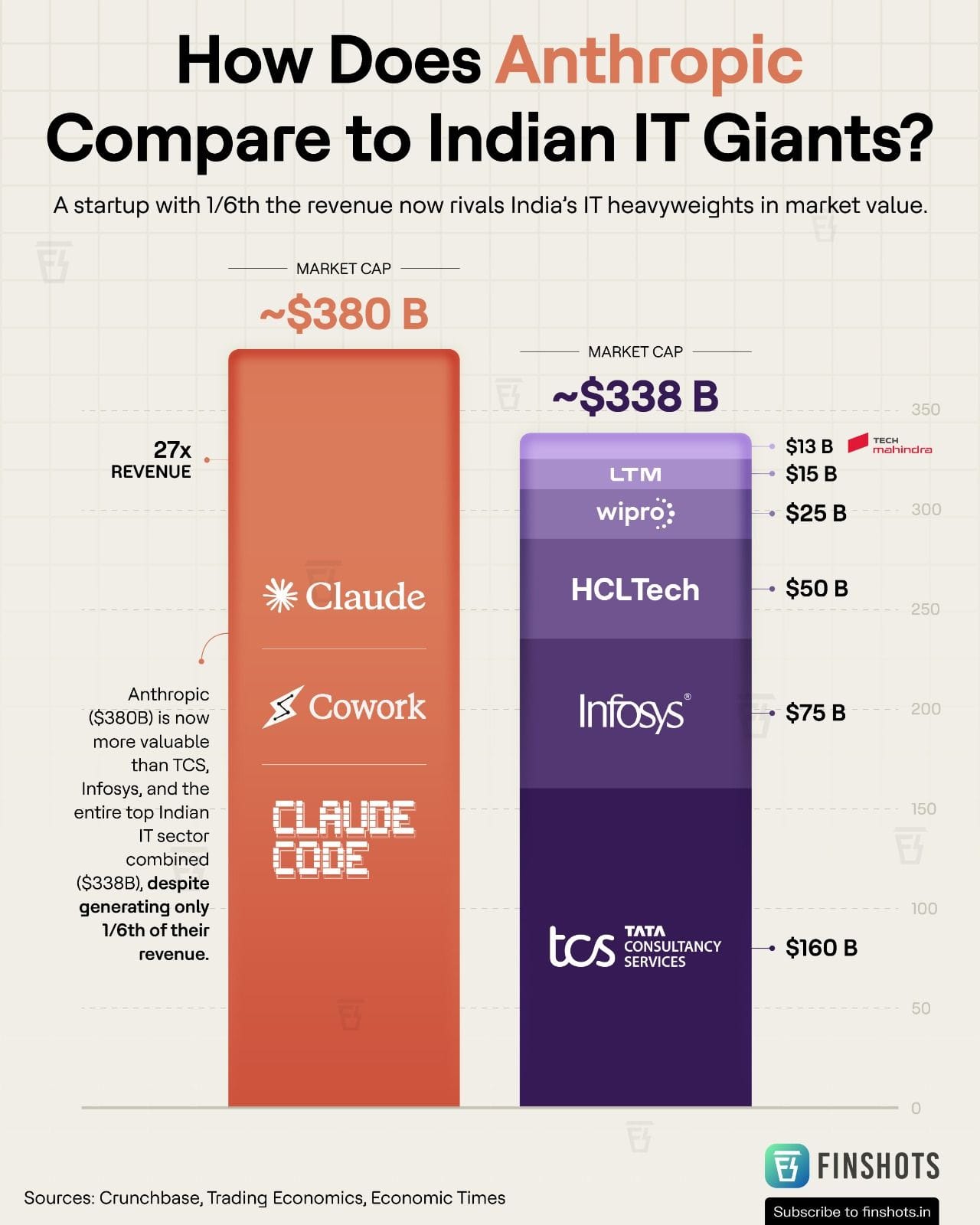
Anthropic, with just one-sixth the revenue, has outvalued India’s entire top IT sector combined. Here’s a look.
Readers Recommend
This week, our reader Inakshi Kar doesn’t want you to read a book or blog, listen to a podcast, or watch a documentary. Instead, she wants you to try a fun trivia game called References, which is a daily word-puzzle where you guess a single common answer word based on four clues or “references”.
Thanks for the recommendation, Inakshi! That was quite unique.
That’s it from us this week. We’ll see you next Sunday!
Until then, send us your book, music, business movies, documentaries or podcast recommendations. We’ll feature them in the newsletter! Also, don’t forget to tell us what you thought of today's edition. Just hit reply to this email (or if you’re reading this on the web, drop us a message at morning@finshots.in).
Don’t forget to share this edition on WhatsApp, LinkedIn and X. And Happy Women’s Day to all the lovely women reading this.