
Is Anthropic overvalued?
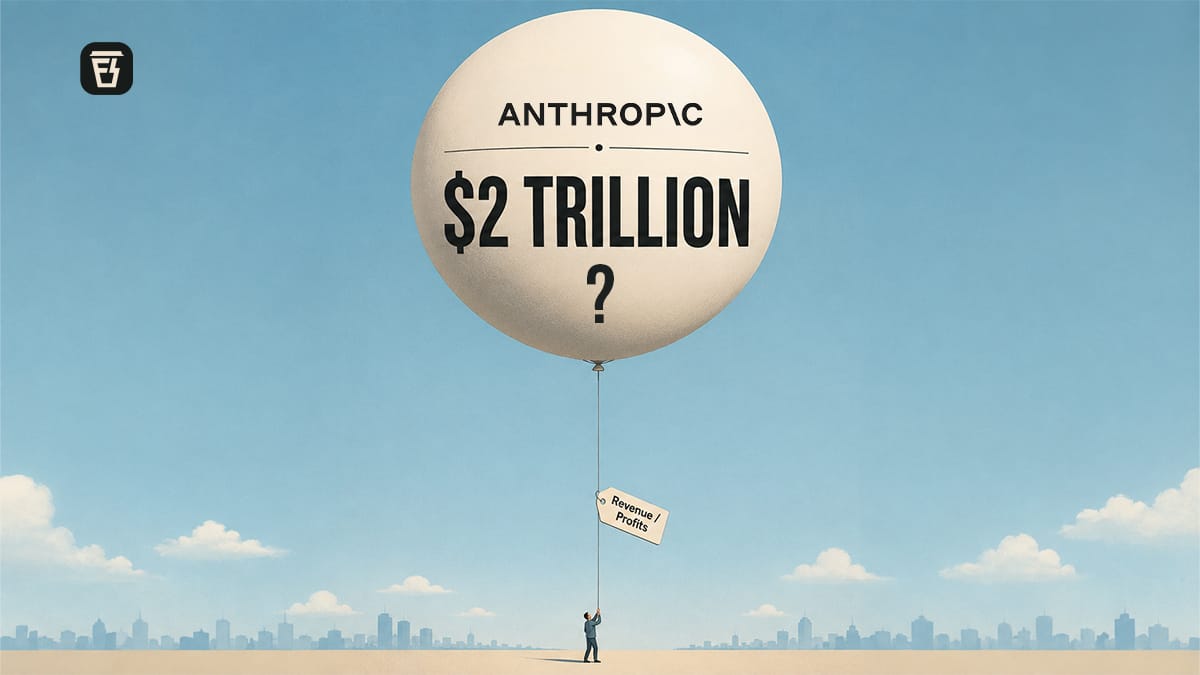
Anthropic could go public as early as the end of this month or next. So, in today’s Finshots, we thought we’d give you a pre-IPO (initial public offering) sneak peek into Anthropic’s business and the debate around its valuation.
But before we begin, if you love keeping up with the buzz in business and finance, make sure to subscribe and join the Finshots club, loved by over 5 lakh readers.
Already a subscriber or reading this on the app? You’re all set. Go ahead and enjoy the story!
The Story
When Anthropic raised money in its latest funding round a few months ago, it was valued at $965 billion. That made it the most valuable private AI company in the world, overtaking even OpenAI, which was valued at $852 billion after its latest funding round.
Sidebar: That’s pretty ironic because Anthropic was founded by several former OpenAI employees, including CEO Dario Amodei, who left OpenAI to build a rival AI company.
But if you’ve been following the news lately, you’ve probably seen the chatter about Anthropic going public. The company confidentially filed a draft IPO proposal with the US Securities and Exchange Commission (SEC) in June. And the valuation being discussed now is a staggering $2 trillion
Yup, you read that right. That’s more than double its valuation less than three months after its latest fundraise.
So, how did Anthropic get here, and is it really worth $2 trillion?
To understand that, we first need to go back to basics on how the company actually makes money.
Well, in one simple line, Anthropic makes money by selling access to its AI models.
For starters, there are developers and companies that pay to use Claude through Anthropic’s API. API stands for Application Programming Interface, but all you really need to know is that it lets companies plug Claude’s AI models directly into their own apps and products. And they pay Anthropic based on how much they use those models.
Then there’s Claude Code, its AI coding tool, which has quickly become a major source of revenue. Enterprise customers alone account for more than half of Claude Code’s revenue, with companies such as Netflix, Spotify, KPMG, L’Oréal and Salesforce among its customers.
Anthropic also makes money from paid Claude subscriptions for individuals and businesses. And finally, it has large partnerships with companies such as AWS, Google and Microsoft, which help distribute Claude to millions of users and enterprises.
Put it all together, and Anthropic has several different ways to turn its AI models into revenue.
And it’s a lot of revenue. For context, Anthropic’s annualised revenue run rate is roughly $65 billion, about seven times what it was at the end of last year. For the sake of comparison, OpenAI’s latest annualised revenue is around $40 billion.
But here’s precisely where the problems begin.
Because you see, Anthropic reports revenue on a gross basis. In other words, if a customer pays for Claude through a reseller partner, Anthropic records the entire amount as revenue. But it doesn’t get to keep all of it, right? A portion has to go to the companies helping distribute its AI models. So the money Anthropic reports, you could say, is inflated.
And that becomes a pretty big problem when you consider the valuation being discussed. If Anthropic goes public, it would be valued alongside some of the biggest technology companies in the Nasdaq 100. These companies typically trade at around 34 times their trailing earnings (profits the company earned in the last twelve months), or 25 times their forward earnings (expected profits over the next twelve months).
That means Anthropic would need to make annual profits of roughly $59-79 billion to support a $2 trillion valuation at those multiples.
But as you’ve seen, Anthropic’s annualised revenue run rate itself is less than that. And the company has only just started making an operating profit. In Q2 2026, it reported an operating profit of $559 million for the very first time.
And even that number comes with plenty of question marks.
For starters, if you annualise that operating profit, it would be only around $2 billion. And operating profit isn’t even the same as final net profit. It’s what the company makes after deducting expenses such as salaries, research and compute, but before accounting for things like interest on its debt and taxes.
And for a huge AI company like Anthropic, consistently generating those final profits won’t be easy, and may not happen even until 2028.
That’s because its spending on things like multi-year compute commitments with cloud providers such as Amazon and Google, GPUs, data centres and related infrastructure is likely to keep increasing as the business grows.
So Anthropic may be generating revenue. But turning that revenue into the kind of sustainable profits needed to justify such a gigantic valuation is a very different challenge.
Which begs the question, why on earth is Anthropic expected to be valued at such a huge price tag?
Well, the thing is, Anthropic’s revenue has been growing incredibly quickly.
If you look at the numbers, the company made about $9 billion in revenue in 2025. Now, the expectation is that it could reach annualised revenue of around $65 billion, and that could potentially grow to $100–120 billion by the end of the year.
And the biggest reason for this is pretty straightforward: Claude Code.
Claude Code has grown incredibly quickly since its launch in May 2025. It reached $1 billion in annualised revenue within six months, and estimates suggest that its annualised revenue could touch $8 billion this year. That’s remarkable when you consider that the product didn’t even exist a little over a year ago. And because developers pay based on how much they use Claude Code, the revenue grows as they spend more time using it.
There’s another important shift happening too.
For a while, companies were mostly experimenting with AI. But starting this year, many began treating AI as a regular business expense and setting aside proper budgets for it.
Anthropic’s customer numbers back this up. The number of customers spending more than $100,000 a year on Claude grew sevenfold, while the number spending more than $1 million a year more than doubled, from over 500 to over 1,000 in less than two months.
And finally, Anthropic is also winning customers from OpenAI. Its share of company spending on large language models rose from 24% in 2024 to an estimated 40%, while OpenAI’s share fell from 50% in 2023 to 27% in 2024.
So, for a company that’s technically seeing revenue growth equivalent to 800% every year, the Financial Times suggests that it could easily be valued at 30 times its revenue. And that could mean a valuation touching a whopping $3 trillion too.
What makes investors even more confident that this valuation is justified is that Anthropic doesn’t have a similar publicly listed US company that investors can easily compare it with. So, they are probably looking at other AI companies, such as Palantir and Nebius, which trade at around 55 times their sales, to estimate what Anthropic could be worth.
And because Anthropic is seen as a rare, dedicated AI company, investors may also be willing to pay a premium for it.
Besides, you also have to remember that it has the first-mover advantage. If Anthropic goes public before OpenAI or other popular AI startups, it could become the first major AI lab on the stock market. That would give it a chance to help set the standards for how these companies report their finances and how investors value them.
So yeah, that’s exactly why Anthropic is being tied to these eye-popping valuations. Whether it’s overvalued or not ultimately depends on how you look at what the company is worth today versus what it could become tomorrow.
It’s a bit like what happened with SpaceX. When it went public, its $1.77 trillion valuation was considered massive. Yet it remains one of the most valuable publicly traded US companies today, ahead of even giants like Amazon and Meta.
So we’ll just have to wait and see if and when Anthropic goes public, how it all pans out.
Until then…
If this story helped you understand Anthropic’s valuation debate, feel free to share it with your friends, family or even strangers on WhatsApp, LinkedIn or X.
Myth Alert: I'm Too Young to Buy Life Insurance!
The other day, one of our founders was chatting with a friend who thought life insurance was something you buy in your 40s. He was shocked that it was still a widely held belief.
Fact: Life Insurance acts as a safety net for your family. The younger you are, the cheaper it is. And the best part? Once you buy it, the premium remains unchanged no matter how old you get.
Unsure where to begin or need help picking the right plan? Book a FREE consultation with Ditto's IRDAI-Certified advisors today.