
How Spotify Wrapped took over the internet and more...
Hey folks!
In the early years after Independence, India was learning to be modern—slowly and carefully.
There were things we had always made ourselves: spices, coffee, khadi. But there were others we depended almost entirely on imports for. Cosmetics were one of them.
Today, it’s hard to imagine an India without homegrown beauty brands. But in the 1950s, that was the reality of a young country still finding its footing.
That began to change in 1952, when Lakmé quietly entered the market. Its origins weren’t purely commercial. In fact, Lakmé was born out of a policy concern. Then Prime Minister Jawaharlal Nehru was alarmed by how much foreign exchange India was spending on imported cosmetics, simply because there were no domestic alternatives.
In many ways, Lakmé wasn’t India copying the West. It was India deciding it could do things for itself. Even the name reflected that intent. Lakmé was inspired by a French opera that drew heavily from Indian themes and took its name from Lakshmi, the Hindu goddess of wealth and prosperity.
Simone Tata entered the picture in 1962, when she joined Lakmé’s board. For the next two decades, she steered the brand at a time when many Indians were still cautious about cosmetics, seeing them as indulgent and reserved for the affluent.
That caution shaped Lakmé’s approach. Its advertising blended traditional attire with understated modern beauty, while its products were positioned not as luxuries, but as everyday grooming essentials. Under Simone Tata’s leadership, Lakmé didn’t challenge social norms outright. It worked within them, slowly expanding what was considered acceptable.
Crucially, Lakmé resisted the temptation to simply replicate Western formulations. Shades and textures were developed for Indian skin tones, heat, and humidity. Beauty, in this context, wasn’t about transformation—it was about comfort and confidence.
Over time, Lakmé reshaped the industry itself. By proving that an Indian cosmetics brand could be trusted, scalable, and profitable, it removed the need for those that followed to justify beauty as an idea. That work had already been done.
Simone Tata never positioned herself as a disruptor. Her influence lay in restraint—knowing when to push, and when to adapt. Rather than forcing change, she allowed it to unfold naturally.
Simone Tata passed away last week. By then, cosmetics in India were no longer a borrowed idea. They were an accepted part of everyday life, shaped quietly by a brand—and a leader—that understood the country it was building for.
Here’s a soundtrack to put you in the mood 🎵
Better by Ananya Birla
You can thank our reader, Sneha Bhagwan Bhosale, for this rec!
Ready to roll?
What caught our eye this week 👀
How Spotify Wrapped took over the internet
Every December, like clockwork, millions of people turn into unpaid brand ambassadors of various apps they use. We post colourful cards on Instagram. We argue about whether our music taste is elite or not. We defend that one artist we listened to 83 times in February. And without realising it, we do exactly what Spotify hopes we would do.
But Wrapped didn’t start as a marketing masterstroke. It didn’t begin with billboards or brand strategy decks. In fact, it started much smaller than that.
You see, back in the 2010s, Spotify was experimenting with ways to make its listening data more meaningful to users. So sometime around 2016, Spotify decided to create a summary of what people listened to. They called it Year in Music and sent it out as a simple email with a link to a playlist with their top songs.
Over the next few years, Spotify kept refining it with better visuals, sharper insights, and more personality. A few years later, the recap had evolved into what we now know as Spotify Wrapped.
There’s also a popular origin story floating around about who created Spotify Wrapped.
You may have come across the name Jewel Ham. She is often described online as a Spotify intern who worked on the year-end recap. Here’s the important nuance, though. While Jewel Ham did intern at Spotify and has spoken publicly about working there, Spotify has never officially confirmed that she created Spotify Wrapped or that the feature originated solely from her work. So the “Jewel Ham created Wrapped” narrative sits in a grey zone. It’s plausible, widely repeated, but not formally acknowledged by Spotify.
Anyway, Wrapped stopped being a product feature and became a cultural event when they started the stories format.
People loved it. They shared it. They compared theirs with that of their friends, and used it to signal taste, identity, and personality. Spotify had accidentally turned its users’ private data into a storytelling masterpiece.
Now, let’s zoom out a bit.
Around that same time, the internet was undergoing a subtle shift. Instagram had just borrowed Stories from Snapchat. Facebook followed. WhatsApp wasn’t far behind, and suddenly, platforms realised that people didn’t just want feeds. They wanted moments that were ephemeral, personal, easy-to-share snapshots of life.
Spotify Wrapped fit right into this new behaviour. Once that clicked, Wrapped became unavoidable. And Spotify learnt an important lesson.
You don’t always need to invent a new platform to win attention. Sometimes, all it takes is turning existing data into something people want to show off.
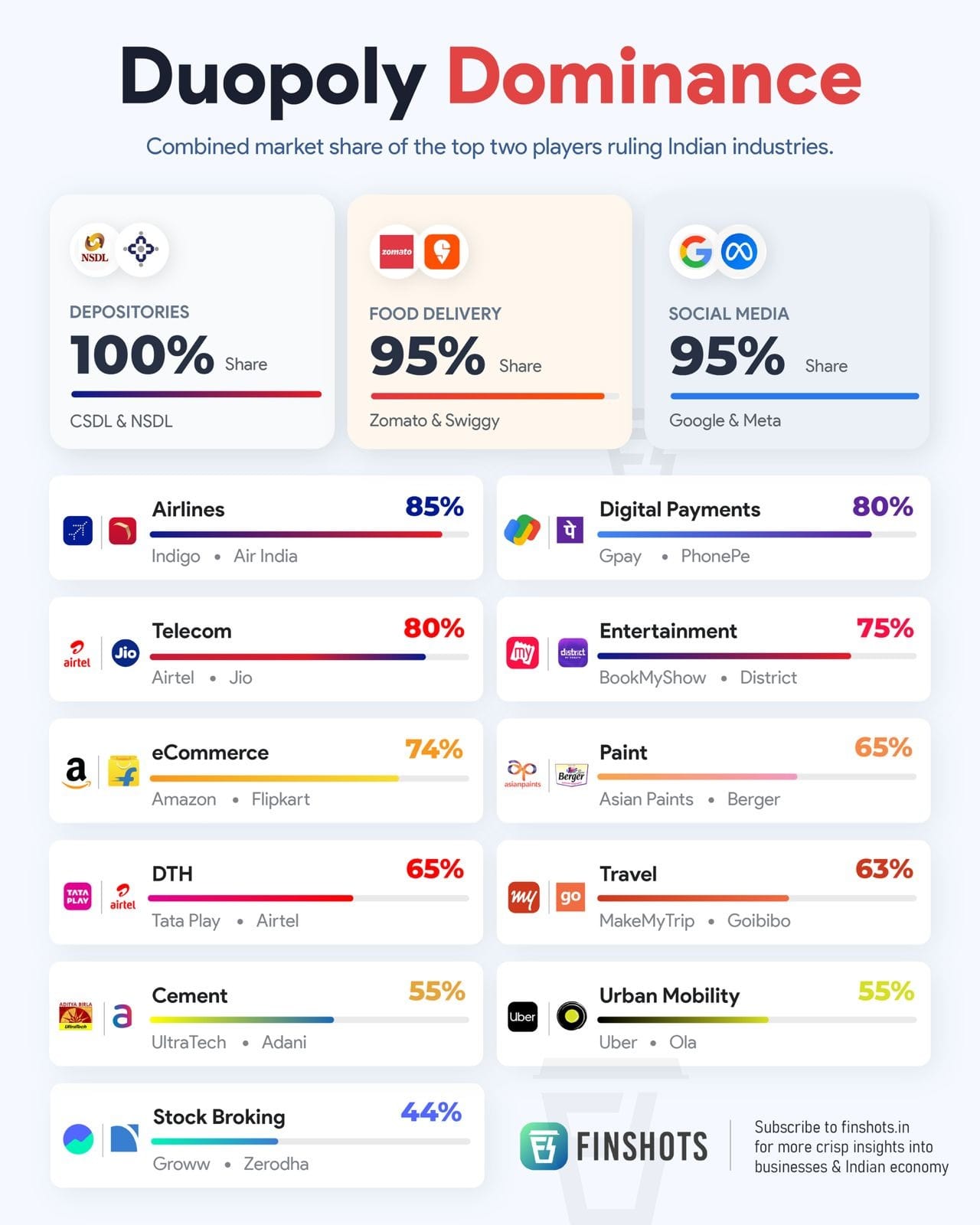
Infographic 📊
Readers Recommend 🗒️
This week, our reader, Rana Pratim Sarma, recommends reading A Field Guide to Lies by Daniel J. Levitin.
Rana says that “it’s a book that dives into why we should take every fact and figure we see on the internet with a grain of salt.” To add to that, it’s basically a guide that helps you spot misleading statistics, bad arguments, and everyday misinformation, while teaching you how to think clearly so you don’t get fooled by numbers, headlines, or half-truths.
Thanks for this interesting recommendation, Rana!
That’s it from us this week. We’ll see you next Sunday!
Until then, send us your book, music, business movies, documentaries or podcast recommendations. We’ll feature them in the newsletter! Also, don’t forget to tell us what you thought of today's edition. Just hit reply to this email (or if you’re reading this on the web, drop us a message at morning@finshots.in).
🖖🏽
Don’t forget to share this edition on WhatsApp, LinkedIn and X.