
How can India become a global shipping superpower?
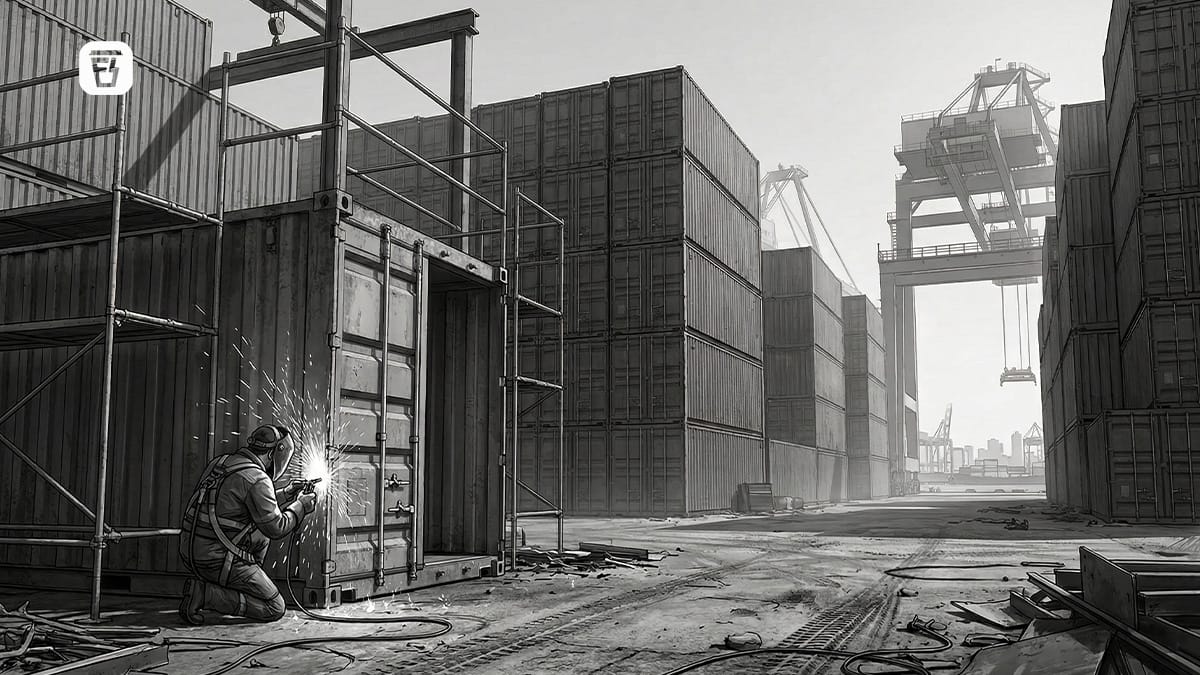
In today’s Finshots, we talk about something in the global shipping industry that is so important, yet rarely spoken about – Freight Containers.
But before we begin, if you love keeping up with the buzz in business and finance, make sure to subscribe and join the Finshots club, loved by over 5 lakh readers.
Already a subscriber or reading this on the app? You’re all set. Go ahead and enjoy the story!
The Story
Alfred Thayer Mahan was a Rear Admiral in the US Navy from 1906 to 1914. He was a very influential man in the Navy who arguably shaped the US' modern naval strategy by advocating for larger battleships and building overseas bases.
In 1890, he wrote in his book The Influence of Sea Power upon History, 1660–1783, that “whoever rules the waves rules the world”. And this statement is something that’s relevant even today. Not just in military contexts but also for commercial shipping.
Shipping is one of the most important industries in any economy. Over 80% of the global trade by volume moves by sea. And for a country like India that exports cars, pharmaceuticals, textiles, electronics, and chemicals, it matters even more. And when this supply chain breaks, you and I feel it.
During COVID, for instance, container shortages pushed freight rates up nearly 3–9 times. Exporters then passed on the costs to us. Imported electronics became expensive. Auto production slowed because components were stuck at ports, and inflation crept into everyday products.
So, to determine whether a nation’s shipping industry is truly self-sufficient, we need to look at three things:
- Our ability to manufacture and own different types of ships,
- Our port and logistics infrastructure, and
- Freight container availability.
In this story, we focus on the third point: shipping containers.
Because, you see, over 95% of the world’s containers are manufactured in China. And when global trade snapped back after lockdowns, China prioritised its domestic exporters. So, containers piled up in the West, and countries like India scrambled for supplies.
So, given that we are an export-oriented economy, why do we not manufacture our own containers?
The real issue is not whether India can manufacture containers. We absolutely can. We produce the steel. We have fabrication expertise. We run automobile plants that are far more complex. The problem, however, lies in the economics.
To determine how India can benefit from container manufacturing, we should first understand how the container business works. Contrary to popular belief, the actual containers onboard the ships are not owned by the shipping company. They are owned by specialised leasing companies from which the shipping company rents them. And here is where the first problem for India arises.
Chinese manufacturers, such as CIMC, Dong Fang, and CXIC, have long-standing relationships with these container leasing companies. When trade booms, they capture most of the surge orders.
And when global trade slows, domestic shipping demand and state-backed industrial policy support cushion cyclical downturns. As a result, orders consolidate within China and help keep factories running, even if margins shrink. This makes Chinese manufacturers structurally better positioned to absorb the swings without facing the risk of underutilisation. Smaller new entrants in other countries do not have that buffer.
More importantly, Chinese manufacturers operate large, integrated clusters close to steel suppliers, paint manufacturers, flooring producers, and ports. That ecosystem reduces costs and allows flexible scaling up or down depending on demand cycles.
So, container manufacturing is a game of volume with razor-thin margins. Chinese firms dominate because they produce millions annually. But it wasn’t always like this. So how did they get here in the first place?
China’s dominance in container manufacturing was the result of deliberate state planning, not market coincidence. The government cultivated large state-owned “national champions” such as CIMC and COSCO, placing them within a centralised control structure so resources, financing, and corporate strategy could align with national objectives.
Between 2010 and 2018, state support for shipping and shipbuilding totaled an estimated $132 billion, including preferential state bank loans and direct subsidies. Container manufacturers received both cash support and indirect benefits, such as discounted land and energy.
This industrial push was also reinforced by vertical integration and consolidation, as mentioned earlier. Since containers are primarily made of Corten steel, China leveraged its enormous, state-subsidised steel sector to ensure a stable, discounted supply of raw material for downstream manufacturers.
The government also engineered market consolidation, reducing domestic competition and concentrating global output among a few state-linked giants, enabling coordinated pricing and capacity management.
Finally, China’s position as the world’s largest exporter created a structural advantage: newly built containers could be immediately filled with cargo at nearby ports. This was a jackpot, avoiding the costly repositioning of empty boxes that manufacturers in other countries must bear. Together, these coordinated steps built an ecosystem that entrenched China’s near-monopoly in global container production.
Which brings us to the obvious follow-up: what would it take for India to replicate even a fraction of that model?
In our 2026 Union Budget, the Finance Minister proposed a ₹10,000 crore Container Manufacturing Assistance Scheme that seeks to build a full-scale domestic container ecosystem rather than just fund isolated factories.
The core financial incentives of the scheme will be delivered through capital subsidies and production-linked incentives (PLI), similar to those implemented by China in the 2010s. And these funds are designed to encourage new entrants to set up manufacturing facilities and help existing manufacturers expand their production lines.
Recognising that containers depend heavily on inputs such as A-grade Corten steel (which India lacks sufficient quantities of), the scheme also focuses on supply-chain development. This reduces the import dependence on something that accounts for 60–65% of costs.
That said, all of this is not just in the planning stage.
In October 2025, the government announced Bharat Container Shipping Line (BCSL), a state-backed company supported by public-sector entities such as the Shipping Corporation of India (SCI) and the Container Corporation of India (CONCOR). BCSL is expected to create assured, large-scale domestic demand by helping the country achieve its target of 1 million containers over time.
This matters for two reasons. First, it helps new container plants achieve economies of scale faster, reducing per-unit costs and improving global competitiveness. Second, it strengthens India’s trade resilience by building a homegrown shipping and container ecosystem that is less vulnerable to external supply shocks.
However, we should still note that capital subsidies alone may not be enough, because Indian-made containers currently cost around 35% more due to higher steel prices and lower scale.
So there you have it, folks. India does not need to dominate global container manufacturing overnight. But building capacity, especially in specialised containers such as reefers for pharmaceuticals or tank containers for chemicals, could reduce vulnerability during future shocks. Once we start off with this, we can then move on to the other types.
If India wants its shipping ecosystem to be truly self-reliant, container manufacturing must be viewed not as a side industry but just as important as building ports and ships. Because Ports and ships move goods. Containers make that movement possible.
And the next time global supply chains crack, the countries that control the box will control the flow of trade.
Until then…
If this story helped you understand the shipping industry slightly better, feel free to share this with your friends, family or even strangers on WhatsApp, LinkedIn and X.
"I should’ve bought health insurance sooner."
That's what 85% of Indians who paid hospital bills from personal savings & debt ended up saying.
Medical emergencies don't come with a warning. They can strike anyone, anytime, causing years of savings to go down the drain.
So don't wait until a crisis hits you. At Ditto by Finshots, we make insurance simple. Our advisors explain all the policies in simple English and help you pick the right plan. Book a FREE consultation today.