
DroneAcharya Aerial Innovations has landed itself in SEBI’s bad books
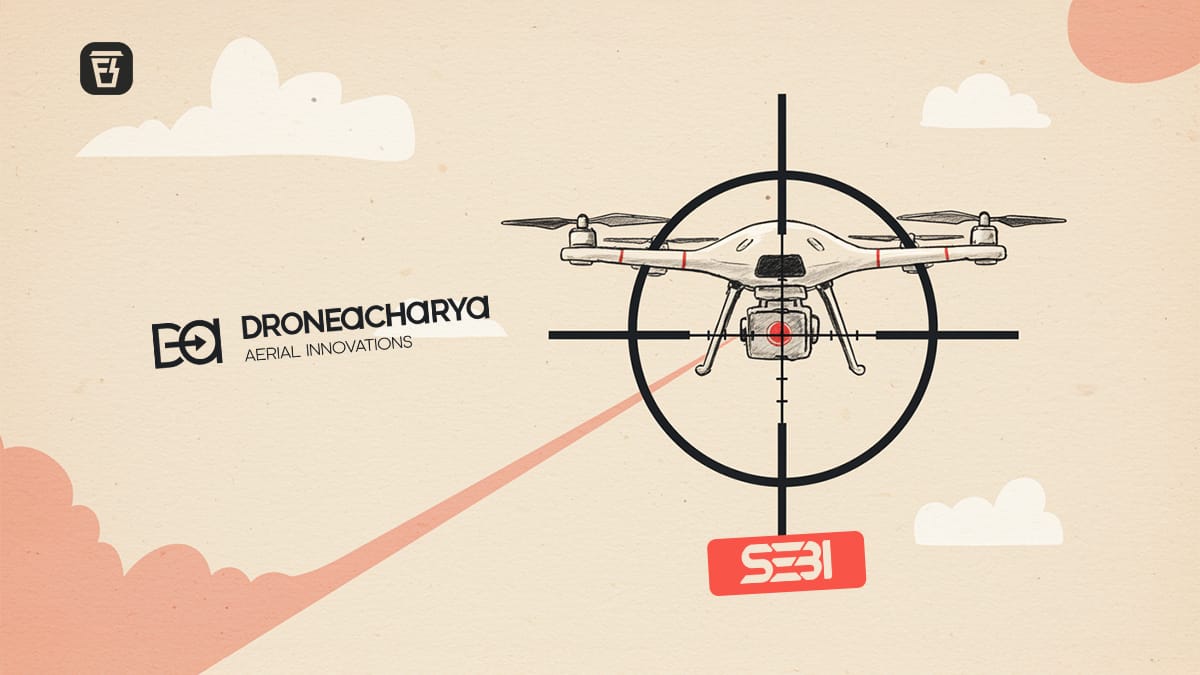
In today’s Finshots, we tell you how DroneAcharya Aerial Innovations, a company that made a splashy debut on the SME exchange a couple of years ago, ended up misusing IPO money and misleading investors.
But before we begin, a quick (and exciting!) sidenote — Last few days left to register for Finshots Idea LabSeason 2!🥳
Students, this is your chance to bag ₹2.25 lakh in cash, pre-placement interviews, cool goodies, and serious bragging rights.

Click here to apply. You don’t want to miss this!
The Story
If you’ve followed the markets long enough, you know that IPO stories usually fall into two buckets. The first is the heart-warming kind — a young company raising money, scaling up, creating value. And then there’s the second kind, where the glossy prospectus is just a shiny cover for a maze of odd transactions, inflated numbers, and accounting acrobatics.
DroneAcharya Aerial Innovations, unfortunately, seems to sit squarely in that second bucket. SEBI recently uncovered a long-running scheme to mislead investors, misuse IPO funds, and dress up the company’s financials. And once the dust settled, it barred the promoters and a few others from dealing in the markets till they paid the penalties.
But you wouldn’t have guessed any of this if you’d seen DroneAcharya’s debut on the BSE SME exchange back in 2022. The stock listed with a dream 90% gain, the kind of performance that usually signals a promising young business. Investors cheered. Celebrity involvement hyped it. Even SEBI didn’t sense anything off at first. But over the next couple of years, as the company filed patchy disclosures and repeatedly missed mandatory filings, the red flags began to pile up. And when SEBI finally started digging, it realised it had stumbled onto something far bigger than sloppy compliance.
It turns out, the playbook had been in motion long before the IPO. The story begins with the company first raising money through something called OCPS or Optionally Convertible Preference Shares. These are preference shares that investors can later convert into equity. Companies like issuing them because they can raise money without immediately giving up voting power, and investors like them because converting at the right time can deliver hefty gains, especially right before an IPO.
Now, OCPS themselves aren’t a problem. But issuing them when your revenues are barely ₹3.5 crore and your profits are negative does raise eyebrows — especially if the people buying them include celebrities like Aamir Khan and Ranbir Kapoor. Yet that’s exactly what DroneAcharya managed to pull off.
It did something really smart. First, it sold OCPS at a low price to nearly 200 pre-IPO investors. Then it began slowly issuing bonus shares. For instance, it once issued a 6:1 bonus, which means that for every 1 share, you get 6 more and then a 99:1 bonus, where for every 1 share, you get 99 more. So if someone had 1 share, after the two bonuses, that 1 share magically became more than 100 shares. And when the OCPS finally converted into equity right before the IPO, investors didn’t just get the number of shares they had paid for, but also a massive pile of extra shares for free.
And because they got so many bonus shares, their effective cost per share dropped drastically, even though the OCPS price sounded high on paper. And when the IPO listed at a much higher price, their profits exploded. Their paper profits surged overnight, and this made it seem like these pre-IPO investors were the “visionaries” who spotted the company early.
And just when you think that’s questionable enough, the trail gets stranger. After this, the company quietly transferred over ₹10.6 crore to a private company called Awyam Synergies Private Limited (ASPL) as a payment for software development. The reality? ASPL was fully owned by DroneAcharya’s own promoters, Prateek and Nikita Srivastava. Even when they claimed to have resigned from ASPL, they still held 100% of the shares, which made ASPL a related party under company law. And related-party transactions must be disclosed to investors, auditors, stock exchanges — everyone.
DroneAcharya didn’t report any of this in its IPO documents, annual reports or even to the stock exchanges after listing. Some of the money sent to the promoter-owned company later came back, but a lot didn’t. And when promoters quietly move company money into businesses they own, without telling anyone, that’s a serious red flag.
Then came the IPO proceeds itself. DroneAcharya raised ₹33.96 crore from the public, promising to spend nearly ₹28 crore on buying drones and accessories, and the rest on general corporate needs. Simple on paper. But when SEBI followed the money, the story it uncovered was anything but simple.
Let’s start with the most obvious example. DroneAcharya paid almost ₹6 crore to a vendor named Micro Infratech for GIS and SQL software. But the thing is that this is the kind of software that usually costs a few lakhs, not a few crores. So firstly, nothing that could remotely justify the ₹6 crore bill. And as if that wasn’t enough, when SEBI checked Micro’s bank statements, the money left the account the same day and was sent to random companies that had nothing to do with software. It didn’t look like a software purchase at all, but rather, like a planned way to intentionally move money elsewhere.
Another example was of ₹8 crore which went to Data Setu Technologies for more software development. Except the invoices were inflated, the deliverables didn’t exist, and even basic quotations weren’t verifiable. The money left the account but left behind no trace of actual work done.
And then there were revenues supposedly earned from companies (customers) like Triconix and IRed. These two alone accounted for ₹12 crore or nearly 35% of DroneAcharya’s operating revenues in FY24. But once SEBI removed that doubtful revenue from the statements, the company would have been staring at a loss of nearly ₹4 crore. Investors who relied on those numbers would have believed the business was growing, when in reality it wasn’t.
It didn’t stop there. DroneAcharya kept putting out misleading corporate announcements about small “potential” orders that might never even happen. But investors assumed the company was winning new business and bought the stock because of it.
You can see this clearly by just looking at the rise in retail investor participation in DroneAcharya’s stock. For context, at listing in December 2022, over 200 pre-IPO investors held 62% of the company. But just three months later, public shareholding had jumped to 72%. By September 2024, the number of public shareholders crossed 6,400. That means thousands of retail investors were now trading a stock whose financial foundation had been quietly hollowed out.
Meanwhile, pre-IPO investors were cashing out. A total of 168 early investors sold over 74 lakh shares in the two years following the IPO, making a combined ₹114.25 crore. That made their total profit ₹89.60 crore, which translates into a stunning 225% return. For perspective, one partner from Instafin Capital, DroneAcharya’s own advisor involved in arranging investors for the OCPS round, made an eye-watering 5,800% return post listing.
But here’s the flipside. Retail investors who were drawn in by the company’s fabricated figures and supposed order wins ended up holding shares they bought at sometimes at peak price of ₹100–₹200 (as opposed to the IPO issue price of ₹54 and listing price of ₹102). But once the truth emerged, their losses ranged anywhere between 30% and 60%, making them the last ones standing when the music stopped.
That brings us back to the obvious question — if things were this messy from the start, how did big celebrities invest?
Well, because celebrity investing rarely works the way people imagine. Celebrities rarely analyse investments themselves. They rely on advisors to spot money-making opportunities. So if someone like Instafin, which worked with DroneAcharya, and probably had a good network, pitched the idea of a future IPO and easy listing gains, celebrities would buy the OCPS for that upside, not for the company’s current financials.
Now, that doesn’t make them part of the fraud because they were just looking for a good return. But when regular investors like you and me see big names on the cap table, we assume the due diligence has been done, and we end up chasing the same dream of quick gains too.
What we’d end up missing in this excitement though — something that only SEBI could uncover after a thorough investigation, was that barely ₹1.64 crore out of the ₹66.31 crore raised through private placements and the IPO was actually spent on drones and the objects the company had promised to use the IPO proceeds for. That’s just 2.5% of what investors thought they were funding. The rest was either diverted, inflated, or misreported.
But despite everything, the penalties imposed ranged from ₹10 lakh to ₹20 lakh per party involved or ₹75 lakhs in total, along with temporary bans from participating in the market, until the fines are paid.
Which also means that the people behind this can simply pay their fines and eventually return to business as usual. But retail investors like you and me don’t get a second shot at recovering the money we’ve lost.
So yeah, DroneAcharya’s story is a reminder that in the markets, trust is everything — and once it’s broken, no amount of drones, software, or glossy announcements can help lift you off the ground again.
Until next time…
Correction: An earlier version of this story flipped the bonus share ratio the wrong way around. For instance, 6:1 was incorrectly written as 1:6, which would imply that one bonus share for every six shares held. We regret the oversight and have corrected the error.
Don’t forget to share this story with your friends, family or even strangers on WhatsApp, LinkedIn, and X. And tell them to subscribe to Finshots too.
Don't Miss This Insurance Masterclass Series!
Insurance matters only once in your life: the day your family needs to make a claim. And that’s usually when people realise they bought the wrong policy which don't fit their needs, missed a crucial detail, or trusted an agent who didn’t tell them the full story. But you shouldn’t have to learn this the hard way!
This weekend, we’re hosting a free 2-day Insurance Masterclass built around real claim cases we’ve handled and simple, practical rules for shortlisting the right plan.
📅 Saturday, 6 Dec ⏰ 10 AM: Life Insurance
How to protect your family, choose the right cover amount, and understand what truly matters during a life claim.
📅 Sunday, 7 Dec ⏰ 10 AM: Health Insurance
How hospitals process claims, common deductions, the mistakes buyers usually make, and how to choose a policy that won’t disappoint you when you need it most.
👉🏽 Click here to save your spot, seats are filling fast.