
Cheetah wasn't the fastest, AI feels like more work and more....

Hey Folks!
If you were asked to name the fastest land animal, chances are you’d say cheetah without blinking. And you’d be right.
But here’s the interesting part.
For a long time, scientists believed that in North America at least, the story of speed belonged not just to the cheetah, but to something else entirely — the American pronghorn.
The common explanation went something like this. Millions of years ago, an animal often referred to as the “American cheetah” roamed the continent. And it hunted the pronghorn.
The pronghorn, in turn, had to run faster and faster to survive. Over time, this evolutionary trait turned the pronghorn into one of the fastest land animals. A neat predator-prey story that’s almost cinematic.
Except new research suggests it may not have happened that way at all.
A recent study from the University of Michigan looked closely at fossils from ancient relatives of the pronghorn. They specifically studied a bone called the astragalus in the ankle, which plays an important role in movement and running efficiency.
And what they found upended that old narrative. The fossils came from the Dove Spring Formation in California’s Mojave Desert, a site that preserves remains from around 12.5 million years ago.
Back then, the American cheetah never existed. In other words, the pronghorn was fast long before it had anything resembling a cheetah to outrun.
That alone changes the story. But it gets better.
When researchers compared the bone proportions of those ancient species with modern pronghorn, they looked remarkably similar.
So why were they so fast if they had no predator to outrun?
One possibility is that speed was less about outrunning a single predator and more about flexibility. In a changing environment, the ability to cover long distances efficiently could mean finding food, water, or a safer habitat faster than competitors.
So yeah, the pronghorn did not become fast because a cheetah forced it to. It was fast because the world back then rewarded this long before a predator showed up.
Here’s a soundtrack to put you in the mood…
Falter by Black Letters recommended by Sarang Menon
What caught our eye this week
Why AI Feels Like More Work
When you first started using AI, it probably felt like cheating — in a good way. Emails took seconds. Drafts wrote themselves. Tedious tasks vanished behind a blinking cursor. For once, work felt lighter.
And then something strange happened.
The time you saved didn’t turn into free time. It turned into more work. Faster deadlines. Higher expectations. And a quiet assumption that if AI could do it, you should be able to do even more.
That’s the argument of a recent Harvard Business Review report. AI, it says, doesn’t reduce work. It intensifies it — reshaping productivity, expectations, and power inside organisations in ways most companies didn’t anticipate.
Most of us signed up for AI tools with one simple goal: to make work easier. And at first, they did. The small wins came quickly. Doing the work of a full team with a handful of subscriptions no longer felt exaggerated.
Job boundaries blurred. A project manager could also code. A writer could design. With each prompt, roles expanded and expectations followed.
Once this became the norm, it didn’t stay personal. Managers noticed. What started as a “nice-to-have” quickly became the baseline. AI wasn’t just speeding up work. It was redefining what normal output looked like.
To see whether this shift was real or merely anecdotal, researchers behind the HBR study observed hundreds of knowledge workers as AI tools entered their daily workflows. Instead of lab experiments or simulations, they focused on real jobs, real tasks, and real deadlines.
The assumption was simple. If AI made people faster, workloads should shrink. Deadlines should loosen. Workdays should get shorter.
But that isn’t what happened.
Across roles and industries, AI did improve efficiency. But the time saved rarely translated into less work. Instead, expectations rose. More tasks were assigned. And projects expanded.
AI didn’t eliminate work. It redefined how much work was considered reasonable.
Think of it like ordering a pizza.
The app says it’ll arrive in 30 minutes. Seems fair. You plan around it. Then, by some miracle, the delivery shows up in 15. You’re impressed. You might even leave a better rating.
But the next time you order, you don’t expect 30 minutes anymore. You expect 15. And if it shows up in 30, it suddenly feels late — even though nothing went wrong.
Now imagine the restaurant quietly updating its internal targets. Delivery partners are given tighter timelines. More orders are stacked per rider. What was once an exception becomes the standard.
That’s what AI has done to work.
That’s not just a metaphor. The data backs it up.
In the Harvard Business Review study, researchers followed around 200 employees over nine months, as AI tools became part of their everyday work despite their employer not making AI use mandatory. It tracked what happened after AI stopped feeling new and started feeling normal.
The pattern was consistent. Employees finished tasks faster and produced more output. But the time saved didn’t convert into lighter workloads. Instead, they quickly reinvested into more assignments, which even sometimes translated into longer work days. That’s simply because doing more felt possible and also rewarding. Apparently, employees even slipped work into moments that they previously designated as breaks because they felt that with a few last prompts, AI could work in the background while they were away. But as it trickled down the organisational line of employees, this simply meant more workload and unreal expectations.
AI, in other words, behaved exactly like that early pizza delivery. The first time felt like a bonus. After that, it quietly reset expectations.
So where does this leave us?
Well, for starters, AI isn’t the problem. Unspoken expectations are.
If companies treat AI-driven efficiency as an individual performance upgrade, workloads will keep expanding. Faster tools will simply justify more work. But if organisations treat AI as something that lifts the system rather than squeezing the worker, the outcome changes.
That means explicitly resetting benchmarks instead of silently raising them. Deciding upfront where efficiency gains should go — better quality, deeper thinking, or yes, sometimes, less work, instead of letting “more output” become the default.
If left on autopilot, AI won’t give us time back. It’ll just make us deliver the same pizza faster, and then wonder why 30 minutes no longer feels acceptable.
Infographic
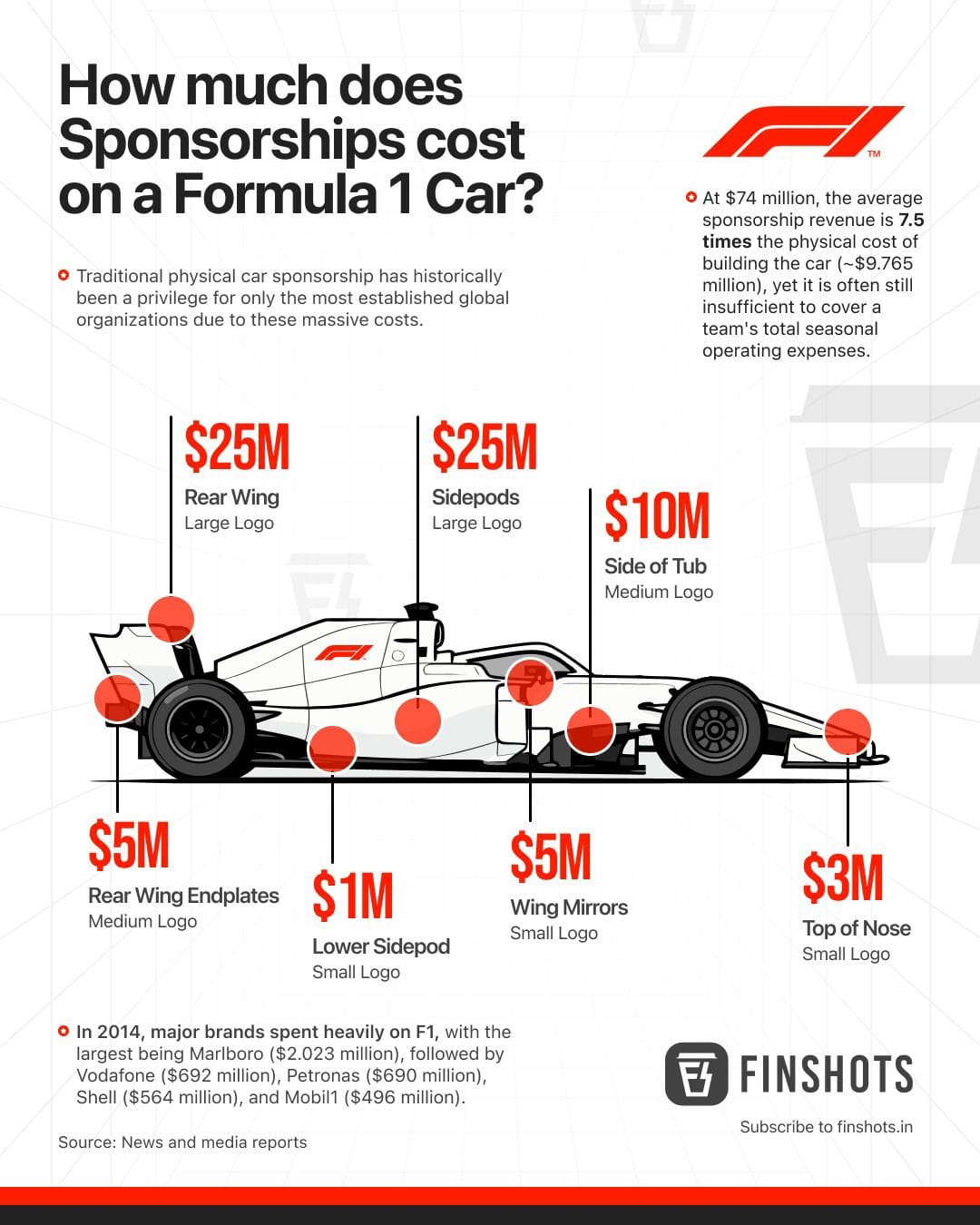
We have seen Formula 1 cars filled with a number of logos and advertisments all around. But have you ever wondered how much they cost to be up there?
Readers’ recommendation: Don’t Lose your Mind, Lose Your Weight by Rujuta Diwekar recommended by Nidhi Dhanani
This is a diet book from Rujuta Diwekar, a celebrity dietician that has guided the likes of Kareena Kapoor and Saif Ali Khan. It's about how to lose weight without drastically changing your diet through three simple steps.
Thanks for the recommendation, Nidhi!
That’s it from us this week. We’ll see you next Sunday!
Until then, send us your book, music, business movies, documentaries or podcast recommendations. We’ll feature them in the newsletter! Also, don’t forget to tell us what you thought of today's edition. Just hit reply to this email (or if you’re reading this on the web, drop us a message at morning@finshots.in).
Don’t forget to share this edition on WhatsApp, LinkedIn and X.