
Bananas could go extinct. Wait... what?
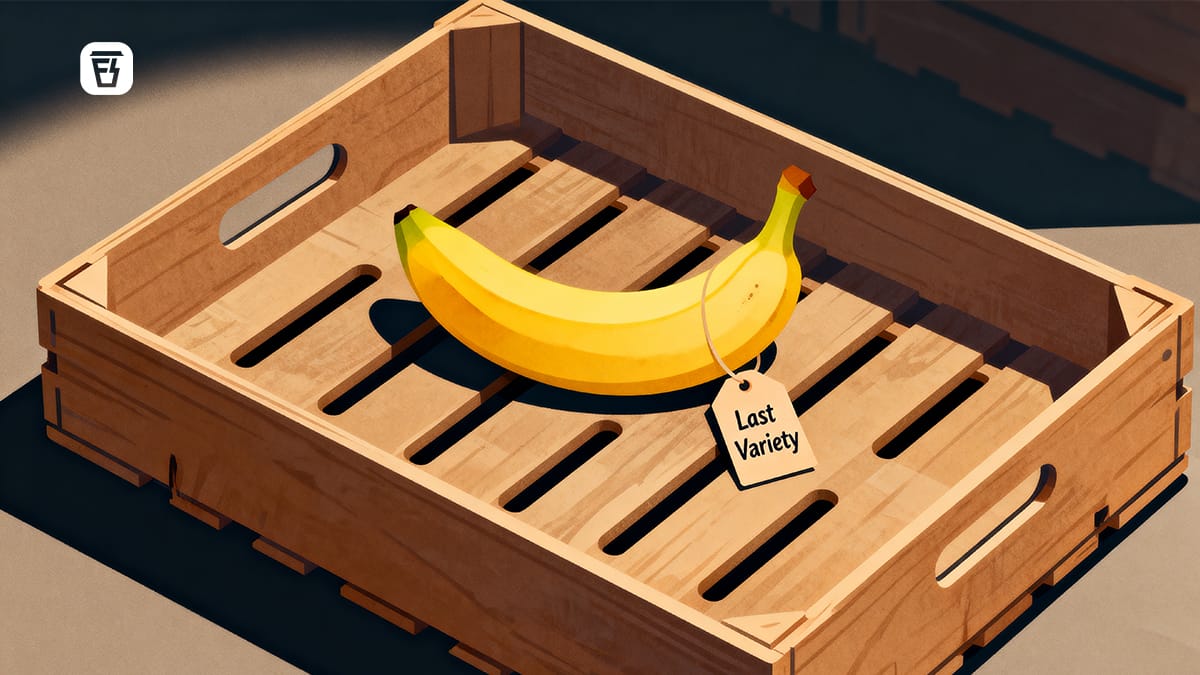
In today’s Finshots, we tell you how bananas, the world’s most popular fruit, could disappear from fruit markets.
But here’s a quick sidenote before we begin. This weekend, we’re hosting a free 2-day Insurance Masterclass that helps you build real financial security by understanding health and life insurance the right way.
📅 Saturday, 21st March at 11:00 AM: Life Insurance
How to protect your family, choose the right cover amount, and understand what truly matters during a claim.
📅 Sunday, 22nd March at 11:00 AM: Health Insurance
How hospitals process claims, common deductions, the mistakes buyers usually make, and how to choose a policy that won’t disappoint you when you need it most.
👉🏽 Click here to register while seats last.
Now, on to today’s story.
The Story
You and I consume roughly 70–80 bananas a year. When we say “you and I”, we mean the average Indian. This makes bananas the most commonly produced and consumed fruit in India, and the world.
India is the world’s largest banana producer, producing about 35 million tonnes of the fruit every year. But nearly 90% of it is consumed within the country. That’s largely because India has smaller landholdings compared to countries like Ecuador and the Philippines, which dominate the global export market.
And smaller landholdings bring their own challenges. It’s harder to use advanced technology to spray pesticides across plantations. Post-harvest logistics aren’t always efficient, so fruits can spoil before they’re export-ready. And maintaining uniform quality — something global markets demand, is difficult. All of this means that despite producing nearly a quarter of the world’s bananas, India’s share in global exports is just about 1%.
But soon, even this market may be disrupted because the banana, as we know it, could actually go extinct.
Yup, you read that right. Okay, that may be a bit of an exaggeration. But hear us out.
There are more than 1,000 banana varieties in the world, with India alone having over 300 native varieties. But there’s just one we know to be a commercial favourite. It’s called the Cavendish, the G9 variety or also the supermarket banana. In India, you commonly know it by names like Grand Naine, Robusta, Bhusaval, Basrai, and Shrimanth.
These bananas trace their origins to Southeast Asia (possibly China) and were eventually shipped to different parts of the world by the 18th century. When they reached Mauritius, British horticulturalist and physician Charles Telfair got hold of them, planted some in his garden, and also sent a sample back to England, where it was grown as an exotic fruit by wealthy plant collectors. The banana eventually reached the garden of the sixth Duke of Devonshire, William Cavendish, whose gardener Joseph Paxton named the variety after his employer.
Now, cavendish bananas were known to be of uniform size and to have a long shelf life. But they weren’t always the preferred variety for global trade, simply because there was an even more commercially favoured banana back then — the Gros Michel (also known as Big Mike). The Cavendish was considered too delicate compared to the Gros Michel because bananas had to be loaded onto ships in bunches for global trade. And since the Cavendish bruised easily and had to be boxed, they couldn’t be shipped as conveniently as the Gros Michel. Some also felt that the Cavendish wasn’t as sweet. So for the next century or so, the Gros Michel was the dominant export variety.
But then a fungal disease called Panama disease, which started in Central America, quickly spread to most of the world’s commercial banana plantations and devastated the Gros Michel. This disease is caused by a soil-borne fungus called Fusarium. Once it infects the soil, it affects the plant’s vascular system, prevents it from absorbing water, and eventually leads to yellowing, wilting, and death of the plant. It can spread through contaminated soil, water, equipment, and even by wind. And since there’s no effective cure, infected plantations often have to be abandoned or shifted to other crops.
So eventually, as the disease spread across the world, it effectively wiped out Gros Michel as a viable export variety by 1965. And producers then switched to the Cavendish, which, while not perfect, was uniform, suitable for exports, and at the time resistant to Panama disease.
But now, nearly sixty years later, the Cavendish too seems to be affected by another strain of this very disease that killed the Gros Michel. This strain, called Tropical Race 4 (TR4), has begun to impact banana plantations across the world, including in India, particularly affecting the Cavendish variety. And if left unchecked, it could lead to significant yield losses and threaten the world’s most widely consumed commercial banana.
Now you might wonder, “Okay, we do have so many other banana varieties. So what’s the big deal?”
The thing is, there’s no other variety that comes close to the Cavendish in terms of uniformity or the fact that it doesn’t ripen and bruise as easily as many other existing banana varieties. That’s exactly why it’s preferred for global shipments where transportation times are long.
Besides, Cavendish bananas, and most other commercial banana varieties, are essentially clones of a seedless banana plant, which makes them all susceptible to this disease. Meaning, long ago, bananas available in markets weren’t seedless. They had hard seeds, which were unpleasant to eat and difficult to bite into. So when farmers found a naturally seedless variety, they began propagating it by cutting a part of the plant (like a sucker) and planting it elsewhere so it would grow into a new plant. And that’s how we got the seedless bananas we commercially consume today.
So since all of these are clones, and the Cavendish banana variety has created a kind of monoculture that the world depends on, a disease that affects one plant can affect all of them, and potentially wipe out the entire variety, just like what happened with the Gros Michel.
So how do we save the world’s most commonly consumed fruit from this disease, you ask?
Well, scientists at the Indian Council of Agricultural Research (ICAR) have been working on a solution in the form of a biopesticide that can help manage the disease. This biopesticide has been developed using a beneficial strain of fungi called Trichoderma. A few years ago, ICAR scientists had already developed a formulation that was effective against Fusarium wilt in crops like tomatoes and chillies. Building on that, they modified it to tackle Panama disease in bananas. It’s called ‘ICAR FUSICONT’. And this formulation helps control the Fusarium fungus from multiplying and affecting the roots, while also improving the plant’s resistance, if applied at regular intervals during the banana crop cycle, which lasts about 14–16 months.
But that does not mean this Indian formulation can save the world’s Cavendish bananas. That’s because ICAR’s formulation has been tested in specific Indian conditions — on particular G9 cultivars and soil-climate settings. And that doesn’t automatically translate to effectiveness or economic viability in other banana producing regions such as Latin America, Africa, or Southeast Asia. Besides, each country has its own regulatory approvals, which can slow or even prevent the rapid adoption of any new biopesticide.
So there are only two other ways to tackle this problem.
One option is a genetically modified banana. Basically, you take a gene from a wild banana variety that is resistant to TR4 and transfer it to the Cavendish variety. But the problem here is that genetically modified crops are highly regulated across the world. They have to go through strict food safety checks, as they could potentially introduce allergens or other issues. So even consumers could be wary of them.
And the second solution, which might sound simple, is to shift to another export banana variety. But that’s not as easy as it sounds. Consumers have grown used to the Cavendish and aren’t easily willing to accept a different kind of banana. So changing that preference isn’t likely to happen any time soon.
Which could mean one thing. The most widely grown and consumed commercial banana might slowly disappear from global trade. And you may only have a few left in your backyard.
So yeah, the Cavendish banana, at least as a dominant global variety, could fade away over the next few decades. And we may soon have to sing the 1923 hit song by Frank Silver and Irving Cohn, “Yes! We Have No Bananas.”
Unless the world comes up with a way to save it.
Until then…
Liked this story?
Share it with a friend, family member or even strangers on WhatsApp, LinkedIn, or X. And subscribe to Finshots, if you haven’t already. Plis!