
Can India get carbon credits right?
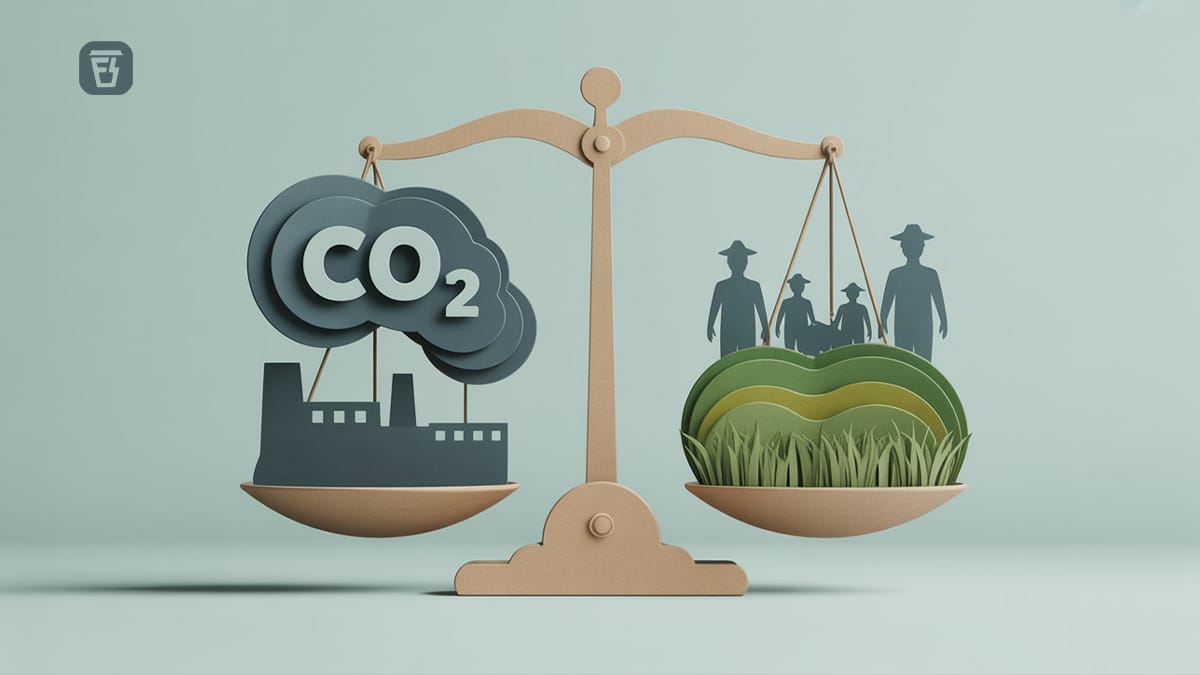
In today’s Finshots, we look at whether India can build a reliable carbon credit market that actually reduces pollution.
But here’s a quick sidenote before we begin. This week, we’re hosting a free 2-day Insurance Masterclass where we’ll walk you through simple rules to pick the right insurance plan and the common mistakes you should avoid.
📅 Friday, 20th Feb ⏰at 6:30 PM: Life Insurance
How to protect your family, choose the right cover amount, and understand what truly matters during a term claim.
📅 Saturday, 21st Feb ⏰at 10:00 AM: Health Insurance
How hospitals process claims, common deductions, the mistakes buyers usually make, and how to choose a policy that won’t disappoint you when you need it most.
👉🏽 Click here to register while seats last.
Now, on to today’s story.
The Story
India is often portrayed as a relatively low polluter on a global and historical scale. And that is broadly true. Since the Industrial Revolution, the country has contributed less than 5% of cumulative global emissions. However, that statistic hides a more uncomfortable reality.
Step into parts of Delhi in winter or drive past industrial belts outside Mumbai, and you see a very different story. Pollution in these pockets is not abstract. It affects our lungs, hospital bills, school attendance, and even how productive we can be at work.
In fact, a few weeks ago, economist and former Deputy MD of the IMF (International Monetary Fund), Gita Gopinath, underscored this point by arguing that air pollution imposes high economic costs on India. In her view, the drag from pollution on productivity and public health can be more consequential for growth than trade tariffs or any other external barriers.
When people fall sick more often, healthcare spending rises, and cities become harder to live in. Eventually, this affects everything from social aspects to economic growth. So while India may not be the biggest historical emitter, pollution is very much a present economic problem.
This is the dichotomy India now faces. And as we push to expand our manufacturing base and become a larger global production hub, carbon management is no longer a distant climate ideal, but a practical economic question.
And in the 2026 Union Budget, the government signalled that it recognises this. They announced a ₹20,000 crore investment in Carbon Credit Programmes over the next five years, with one of the primary goals being scaling up carbon capture, utilisation, and storage technology across high-emission sectors.
These are industries such as power, steel, cement, refineries, and chemicals that are difficult to decarbonise quickly. At the same time, they also form the backbone of infrastructure and manufacturing. So, if India wants to grow and clean up at the same time, these sectors have to be part of the solution.
This budgetary push is also part of a broader attempt to formalise and expand India’s emerging carbon market infrastructure under the Carbon Credit Trading Scheme (CCTS).
But what is carbon trading, in the first place?
Let’s understand it with an example. Imagine you’re part of a gym with a mandatory wellness challenge. The gym assigns a “maximum calorie budget” for the month. And anyone who exceeds this will be imposed with a massive cash penalty. But if you burn enough calories, you earn a “fit-coupon” that you can sell to anyone.
You hit the gym and burn significantly more than required, so the gym rewards you with 2 Fit-Coupons. Meanwhile, a friend at the snack bar eats too many burgers and exceeds their limit. To avoid this fine, your friend is interested in buying your coupon for a price lower than the fine. It sounds like a perfect incentive, right?
It’s a win-win situation, and in theory, it does two things:
- It puts an economic value on calorie burn, and
- It creates incentives for people to lose weight.
Continuing that analogy, companies that reduce emissions more efficiently can benefit. Those that pollute more have to pay or invest in cleaner technologies. That is the economic logic.
But our early experiments with carbon-related markets show that getting the design right is not really straightforward.
You see, in 2023, the Green Credit Programme under the Ministry of Environment aimed to allow corporations to earn credits for activities such as tree planting and ecosystem restoration.
On paper, this sounded simple. You plant trees, earn credits, and offset your environmental impact. But in practice, this ran into trouble. The law ministry flagged concerns about poor verification and raised questions about whether the credits being issued truly represented real and additional climate benefits.
And it made sense. If these activities were not properly monitored and verified, companies could claim environmental virtue without actually delivering a measurable impact. The risk here was that carbon credits would become an accounting tool rather than an environmental one.
Contrast that with another model that has a clearer economic link: farmers and sustainable farming.
Let’s go back to the earlier gym example. Now, instead of the gym, imagine a farmland, where a farmer can earn an incentive by practicing sustainable farming. Through this farming, for every 1 tonne of estimated carbon that is ‘captured’ from the air, the farmer gets a credit. They may then choose to sell it to industries that pollute the environment.
Under this approach, farmers adopt practices that increase soil carbon or enhance biomass, such as regenerative agriculture or agroforestry. These practices remove carbon dioxide from the atmosphere and store it in soil or plant matter. And once the credit is earned, it can then be verified and sold, usually to companies looking to offset emissions.
The appeal of this model is straightforward. It connects rural livelihoods with climate finance. Instead of only focusing on punitive measures for industries, it recognises that farms can act as carbon sinks. If designed well, this could mean an additional income stream for farmers, while industries get access to verified carbon removal credits.
Early pilot projects and private marketplaces have shown that there is interest on both sides. And the economic logic is also clear. Remove carbon. Measure it. Earn a credit. Sell it.
Sounds simple, right? But here too, scale is the challenge.
Generating verifiable carbon credits from farming depends on robust measurement, reporting, and verification (MRV) systems. Soil carbon has to be measured accurately. Farmers need training and support. And more importantly, marketplaces must be transparent so that buyers trust what they are purchasing.
India’s CCTS offset mechanism now provides a formal pathway for registering such projects. Yet integrating these credits into large-scale, liquid trading markets is still a work in progress.
Which brings us to the real task for policymakers. It is not about simply issuing more credits. It is about ensuring that every credit represents genuine carbon removal or a measurable reduction in emissions. The framework must be meaningful, credible, and backed by proper verification. Otherwise, markets will lose trust, and the entire exercise will prove to be futile.
The WEF suggests stabilising the carbon markets through a Price or Supply Adjustment Mechanism (PSAM) that acts as a shock absorber. This includes releasing credits gradually through controlled auctions to avoid oversupply or shortages, setting expiry rules so older credits cannot be hoarded indefinitely, and introducing price corridors with a minimum floor and maximum ceiling to prevent extreme volatility. Together, these tools aim to keep carbon prices credible, predictable, and economically workable while ensuring the market continues to drive real emissions reductions.
As India transitions into a larger and more industrialised economy, carbon management tools could become central to balancing growth with environmental stability. Heavy industries will only continue to expand, and energy demand will continue to rise.
However, apart from our own consumption, there is also an external dimension. The European Union’s Carbon Border Adjustment Mechanism (CBAM) was already implemented in January this year. This means that importers of certain high-emission products must purchase CBAM certificates reflecting the embedded carbon in those goods. This basically puts a sort of ‘tariff’ on any exports to the EU where there is excessive pollution above normal.
This will increasingly affect carbon-intensive Indian exports, especially steel. If exporters cannot demonstrate lower carbon intensity or credible offsets, they may face higher costs in European markets. A well-designed domestic carbon market could help Indian industries document and reduce emissions more systematically, improving their competitiveness abroad.
If the loopholes are addressed, India has a chance to build a domestic carbon market that industries can actually use. Not merely as a gesture, but as a functioning economic tool.
At the end of the day, getting carbon credits right should not be about planting the most trees or issuing the highest number of certificates. It should be about credibility. Because in carbon markets, trust is the currency. And without it, no amount of budget allocation can make the system work.
Until then…
If this story helped you understand how carbon credits can be traded, share it with your friends, family, or even curious strangers on WhatsApp, LinkedIn, or X.