
Can India become the pharmacy for weight-loss drugs?
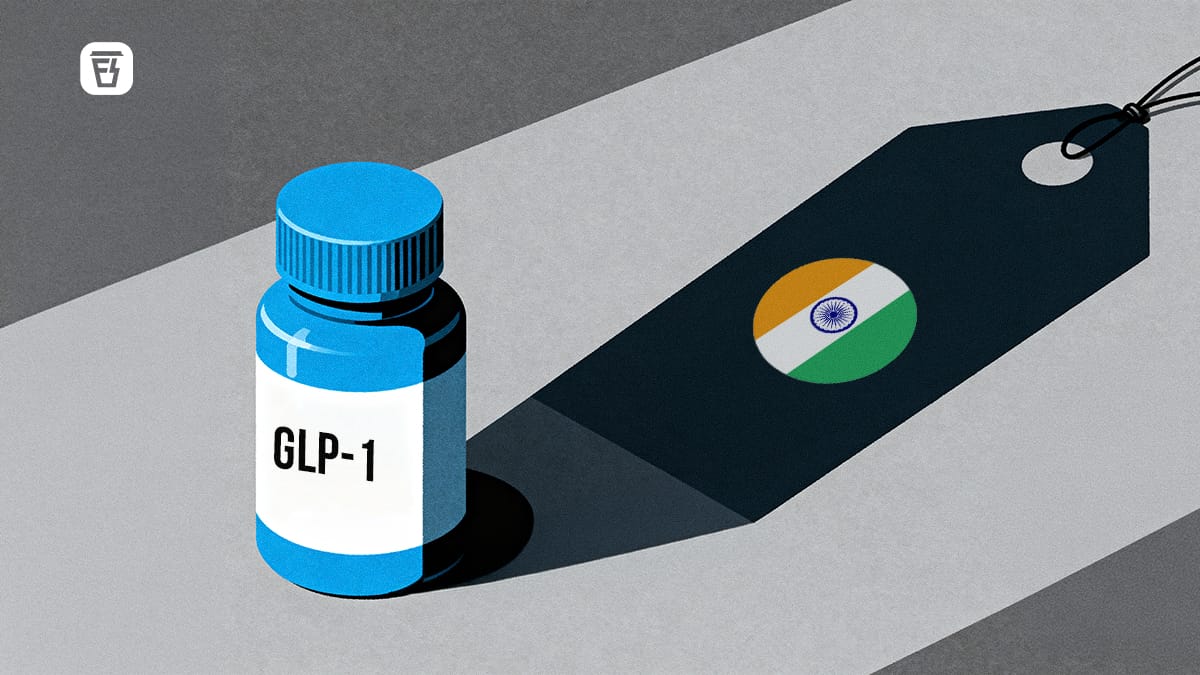
In today’s Finshots, we tell you whether India can truly become the world’s largest exporter of affordable GLP-1 medicines, better known as weight-loss drugs.
But here’s a quick disclaimer before we begin. This story is about affordable weight-loss drugs, and there’s a lot of excitement around them. But don’t let the online buzz influence you to take any medication on your own. Please consult a qualified doctor before doing so.
Also, if you’re someone who loves to keep tabs on what’s happening in the world of business and finance, then hit subscribe if you haven’t already. If you’re already a subscriber or you’re reading this on the app, you can just go ahead and read the story.
The Story
The last time we wrote about affordable diabetes and weight-loss drugs, about a year ago, we told you that a drug revolution would arrive in 2026. Turns out, it may have just begun.
Last weekend, a key patent on semaglutide, the molecule behind Danish drugmaker Novo Nordisk’s popular drugs Wegovy and Ozempic, expired in India. And almost immediately, a beeline of drugmakers lined up to launch generics (identical medicines sold at lower prices).
And that, as you may have already heard, could mean that cheaper versions of semaglutide are on their way, transforming access to diabetes and weight-loss treatment in India.
For context, Novo Nordisk’s semaglutide drugs can cost around ₹8,800–10,000 per month. Generics, on the contrary, could be priced up to 60% lower, making them far more affordable.
And that’s no small deal in a country like India, where nearly 10 crore people live with diabetes, and a significant share also struggle with obesity.
Now, before we go any further in this story, we ought to give you a quick background on how these medicines work.
When you eat carbohydrates like rice, roti, bread, etc., your digestive system breaks them down into glucose, a type of sugar that floods your bloodstream. As this happens, the cells in your gut release a natural hormone called GLP-1 (glucagon-like peptide-1). This smart signal does three jobs at once. First, it tells the pancreas to release insulin, a hormone that acts like a delivery truck, transporting glucose into muscle cells and other tissues for energy, but only when blood sugar is actually high, avoiding crashes. Second, it slows digestion, so sugar enters the blood gradually, so as not to spike it. Third, it travels to the brain, dialing down hunger and signalling, “You’re full.”
But in diabetic patients, particularly type-2 diabetes, this turns into something of a chaos. Cells start ignoring insulin’s signal (called insulin resistance), glucose piles up, and the pancreas works overtime until it can’t keep up. And that ends up pushing blood sugar levels higher, paving the way for other health issues over time.
To fix this, scientists tried to replicate the natural GLP-1 system in the lab, creating semaglutide, a type of GLP-1 receptor agonist. These drugs mimic the hormone’s effects, but better and for longer. But during trials, scientists also realised that it didn’t just control blood sugar. It led to significant weight loss as well. And that’s when semaglutide drugs began to be used not just for treating diabetes, but for tackling obesity too.
Which brings us back to India.
After the patent on this popular diabetes and weight-loss drug expired, pharma giants aren’t just targeting the domestic market. Their eyes are firmly on exports too, planning to scale up and ship these cheaper drugs to countries where Novo Nordisk’s semaglutide patents have also expired this year, like Canada, Turkey, and Brazil.
And you can see why. Together, these countries account for roughly 30% of the world’s population, and nearly the same share of adults living with obesity. That’s a massive opportunity. Especially for a country like India, often called “the world’s pharmacy”, with its well-developed generics industry supplying around 20% of global off-patent medicines.
But here’s the thing.
India may be the generic king when it comes to pills, tablets, and capsules. But the most visible face of Wegovy and Ozempic generics isn’t a pill. It’s an injectable pen.
This is essentially a glass cartridge filled with the drug solution, tucked inside a sleek, reusable plastic device — roughly the size of a TV remote. It comes with a hidden needle, as thin as one or two strands of human hair, and a dose dial. You simply press to inject, with dose windows even for the visually impaired.
Sure, pills exist. But the injectable pen has been the real workhorse. It delivers the drug efficiently, works at lower doses, lasts longer in the body, and is so easy to use that you barely feel a thing.
Vials with separate syringes are cheaper, no doubt. But they can be tricky to handle, especially for older patients. And that’s why both patients and doctors tend to prefer pens in obesity care.
Which means, if India is eyeing that big export opportunity, hoping to become the world’s largest supplier of affordable weight-loss drugs, the road ahead won’t be easy.
The main challenge being, making these drug delivery devices — the prefilled pens themselves. They need precision-engineered plastics, glass cartridges, ultra-fine needles, springs, and dose mechanisms that can reliably deliver small, variable doses every week.
Now, India does have experience with syringes and even some insulin pens. But when it comes to high-end components, especially pen systems for complex biologics, a significant share has historically been imported. Needles often come from Japan, glass from Germany, and pens from Switzerland.
And then there’s another problem that walks in. These drugs need to be assembled in clean environments, tested mechanically, and then shipped through a cold chain that must maintain 2–8°C all the way from factory to pharmacy. Sure, India’s cold chain has improved rapidly over the years. But it’s still patchy.
It’s probably good enough to support large-scale GLP-1 exports to many markets. But not yet strong or uniform enough to call it a fully ready, “dominant world exporter” infrastructure.
That said, things are changing. After COVID, investments in biologics, vaccines, and injectables have significantly expanded cold-chain capacity across the Asia-Pacific region, with India emerging as one of the fastest-growing markets through 2030. Production-linked incentives (PLIs) are driving new compliant warehouses and vial-handling hubs around pharma clusters like Hyderabad, Ahmedabad, and Pune, specifically to support biologics and injectable exports. On top of that, cold-chain logistics have seen upgrades like GPS-enabled reefer trucks and retrofitted warehouses with full backup power, all designed around pharma’s needs.
But you have to understand that, when it comes specifically to GLP-1 drugs, things get a bit more nuanced. Cold-chain storage is still limited across India, especially beyond major metro cities. And that could become a real bottleneck. Because as demand for these cheaper drugs rises, storing and distributing peptide injectables like semaglutide at scale won’t be easy.
To give you a sense of the scale, India’s GLP-1 market is expected to grow rapidly, with demand for diabetes and weight-management therapies potentially multiplying fivefold by 2030. And globally, the market is expected to expand at a similar pace.
But the problem is that the complexity of manufacturing GLP-1 drugs, and delivering them through devices like pens, is already starting to strain existing supply chains.
So whether India becomes the world’s pharmacy for cheap weight-loss drugs will depend on the choices it makes now. Like whether it treats GLP-1s as just another generic molecule or as a once-in-a-generation opportunity to build a full-stack industry that can handle molecules, devices, and cold chains together.
Because otherwise, it risks losing ground to China, where semaglutide patents have also expired last week. Besides, China also already has a crowded pipeline of late-stage semaglutide programmes, alongside strong capabilities in drug-delivery devices and vertically integrated factories that can take production from peptides all the way to pens for export.
And if that happens, India’s price advantage may not count for much in the weight-loss drug race after all.
Until then…
If this story helped you understand the challenges India must overcome to truly become the world’s pharmacy for affordable weight-loss drugs, share it with your friends, family, or even strangers on WhatsApp, LinkedIn, and X.
🚨Three insurers are revising their term premiums!
Three prominent insurers are set to revise their term insurance premiums. Policies issued after the revision will reflect the updated pricing. If you have already generated a quote, the premiums may change once the revision comes in.
Here’s why this matters: When you purchase a term life insurance policy, you pay a premium or a small fee each year to protect against financial risks. In the unfortunate event of your passing, the insurance company pays out a substantial sum to your family or loved ones.
If you've been considering a term plan, now is the perfect time to act. To assist you in the process, our advisory team at Ditto is here to help. Click on the link here to book a FREE call with our IRDAI-certified advisors.