
A vegan cricket ball that lasts 50 overs?
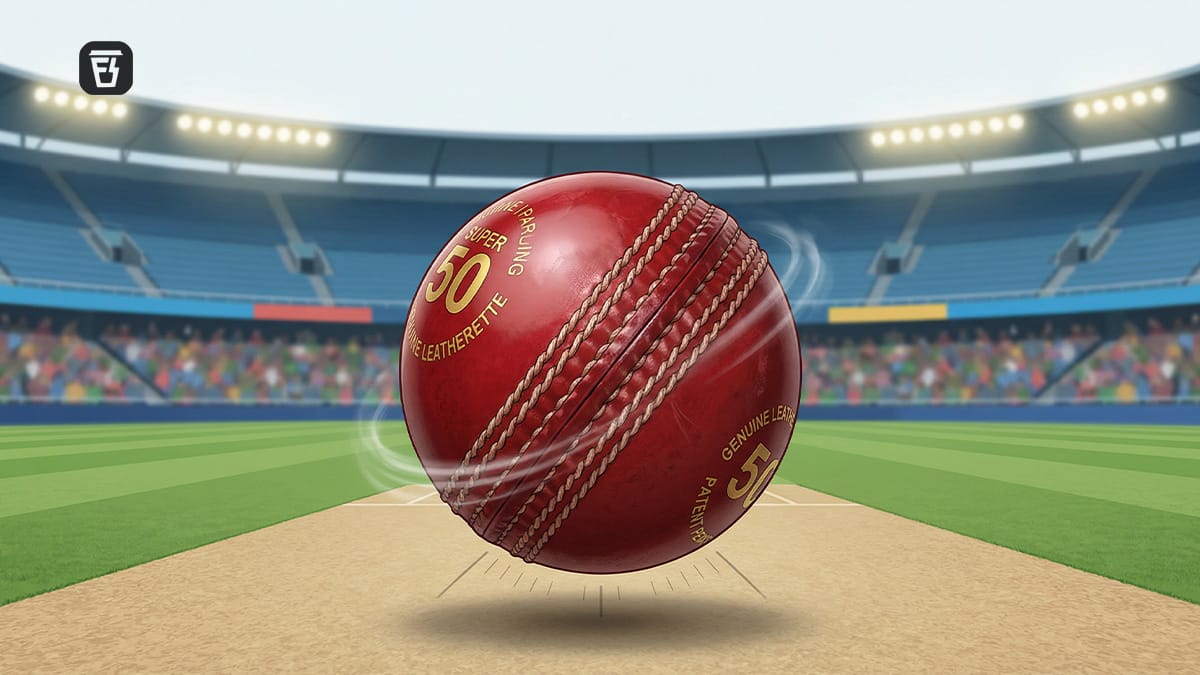
In today’s Finshots, we give you a glimpse of India’s cricket ball manufacturing industry and how the Super 50, a non-leather, synthetic cricket ball could change the game.
But before we begin, if you’re someone who loves to keep tabs on what’s happening in the world of business and finance, then hit subscribe if you haven’t already. If you’re already a subscriber or you’re reading this on the app, you can just go ahead and read the story.
The Story
Making a cricket ball is a proper, old school craft.
It has four layers, which starts with a solid core made entirely of cork. That’s the innermost bit. Around this sit two leather cups. To make those, dyed leather (red for Test matches, white for One Day Internationals, and pink for day-night Tests) is hand-cut into semi-sphere shapes. These pieces are stitched together and pressed into moulds until they form perfect half-cups that can snugly cover the ball.
The cork core is then placed between these two leather halves and stitched together using a special thread. That creates the first, inner seam. After that come more stitches on the outside. By the end, you get the six neat rows of stitching that run across the ball’s surface. One last press in a mould keeps it perfectly round. Then it’s polished and stamped with the brand name. Only then is it ready.
And while we’ve walked through that pretty quickly, making a real cricket ball is anything but fast. One ball can take up to 90 minutes. Every part is weighed so the final product falls within a very tight range of between 155.9 and 163 grams for men’s cricket, and 140 to 151 grams for women’s cricket.
In India, most of this work is still done by hand. That means incredible focus and attention to detail, because even a small change in a stitch or polish can affect how the ball swings or moves. And sometimes, that’s enough to change the course of a match.
But here’s what you should know. Cricket didn’t always have standardised balls. It took years of trial and error, in fact centuries, to settle on the right materials, weights, sizes, stitch counts, and seam structures. But through all of that, one thing barely changed. From the early days of cricket in the 17th century — whether the core was cork or wool, the ball was always wrapped in leather.
And there’s a good reason for that. Leather is what helps bowlers make the ball move in the air and off the pitch. The way the core, string winding, and leather covering interact, determines a ball’s bounce and swing. Bowlers and fielders rely on the grip that leather provides. And leather-covered balls simply last longer.
Which is why what happened a few days ago is pretty interesting.
People for the Ethical Treatment of Animals (PETA) India gave Sanspareils Greenlands — better known as SG, their Innovation in Business Award for developing a professional-level cricket ball that doesn’t use leather at all.
It’s called the Super 50. It’s made from vegan leather, patented by SG, and the company claims that it can retain its shape through an entire match and last at least 50 overs.
Now, SG is one of India’s biggest cricket equipment manufacturers. Its balls are used in Test matches played in India and in the Ranji Trophy. But this new vegan ball isn’t meant for that level. At least not yet.
Instead, it’s aimed squarely at professional cricket academies that train young, aspiring cricketers. And it’s being pitched as something that could quietly disrupt the game in the years to come.
That’s because this ball meets all the technical specifications required to play professional cricket. Same weight, similar feel, and same performance benchmarks, all without the traditional leather. Which means no dependence on large-scale cow slaughter just to make the outer casing. On top of that, leather tanning itself is an environmental nightmare. Tanneries release toxic chemicals into nearby water bodies and expose workers to substances linked to cancer, respiratory diseases, and other serious illnesses. That’s exactly why authorities have cracked down on tanneries in cities like Meerut and Vellore (Tamil Nadu), forcing many of them to shut down.
This also created an unintended consequence. A massive shortage of leather.
Cricket ball manufacturers suddenly found it harder to source raw material. But demand didn’t slow down. In fact, it kept rising. To put things in perspective, cricket academies in India consume roughly 40 lakh leather balls every year. And that number is growing at about 6–7% annually.
So SG’s push towards synthetic material was sort of a practical response to a supply crunch. When leather became scarce, but the need for cricket balls kept climbing, rethinking the material itself started to make a lot of sense.
But before we get carried away with the idea that vegan cricket balls will change everything, there are a few uncomfortable realities about how the cricket ball manufacturing industry actually works in India.
For starters, India is the world’s largest producer and exporter of cricket balls. And most of that production is centred in Meerut. Not in giant factories and assembly lines. But in home based cottage industries spread across 10,000 people in roughly 30 villages. Each unit is usually a small family setup, maybe with a few extra hands, quietly stitching balls day after day.
Now, cricket balls aren’t stitched by hand because there’s no alternative, but because hand stitching works best for leather balls. It gives manufacturers far better control over seam height, stitch tightness, and durability. It’s simply a craft refined over generations.
In fact, even SG comes from this exact tradition. Though now a well-known brand with over 850 dealerships in India and abroad, its roots are deeply local. The Anand brothers — Dwarkanath and Kedarnath Anand, moved from Sialkot (now in Pakistan) to Meerut after Partition in 1950. And what began as a family leather business in 1931 eventually grew into India’s primary supplier of Test match balls to the BCCI (Board of Control for Cricket in India), a position SG has held since 1994.
But the thing is that vegan balls don’t need the same kind of hand stitching. Much of that work can be mechanised. And that shifts manufacturing away from traditional, manual leather craftsmanship, potentially reducing the need for the very skills that thousands of families have depended on for decades.
Then there’s the demand side. Like we mentioned earlier, India’s cricket academies alone need around 40 lakh professional balls every year. But leather balls have a known weakness: moisture. Dew can quickly affect how they behave. Vegan balls solve that problem. If they get wet, you wipe them dry and keep going. So even if a ball like the Super 50 costs nearly double that of a basic leather ball, which starts at around ₹250, academies might still prefer it because it lasts longer.
But as demand shifts towards vegan balls, production will likely move towards machine stitching. And over time, that could slowly squeeze out the cottage-industry jobs that have been the backbone of India’s cricket ball ecosystem.
And finally, there’s the copy-cat risk.
India’s advantage so far has been manual efficiency. Countries like England and Australia already have brands such as Dukes and Kookaburra. They do use some machine stitching, not fully manual methods as it’s simply not economical for them. Indian manufacturers, especially in Meerut, pay workers per piece, which works out to roughly ₹16–20 per ball. So you can imagine the profit margins that cricket ball manufacturers make when you consider that leather balls can sell for ₹4,000 or more, even after accounting for materials and other overheads.
Foreign manufacturers simply haven’t been able to match this cost structure because they can’t pay such low wages for such intricate handwork. But synthetic balls change that math. Once mechanisation becomes viable with synthetic cricket balls, countries outside India could start experimenting, investing more in machines, and producing academy-grade balls at scale.
And if that happens, India’s long-standing edge in cricket ball manufacturing may no longer be as secure as it once was.
So yeah, while the Super 50, and more balls like it, could reshape professional cricket, there’s a flip side we can’t ignore. It risks hurting small workers who already earn very little for highly skilled craftsmanship. For many of them, this work is the only thing that puts food on the table. But as manufacturing slowly moves away from hand-stitched leather, that livelihood could quietly slip away.
Until next time…
If this story helped you explore a side of cricket you’ve probably never paid much attention to, despite being a fan, why not share it with fellow fans, friends, and family on WhatsApp, LinkedIn, and X?
How Strong Is Your Financial Plan?
You’ve likely ticked off mutual funds, savings, and maybe even a side hustle. But if Life Insurance isn’t a part of it, your financial pyramid isn’t as secure as you think.
Life insurance is the crucial base that holds all your wealth together. It ensures that your family stays financially protected when something unpredictable happens.
If you’re unsure where to begin, Ditto’s IRDAI-Certified insurance advisors can help. Book a FREE 30-minute consultation and get honest, unbiased advice. No spam, no pressure.