
A slightly different explainer on the LPG conundrum
In today’s Finshots, we talk about how India’s LPG programme is inadvertently fuelling a parallel black market.
The Story
One could argue that the current LPG shortage for households is due to the US/Israel-Iran war. And that’s true to some extent. After all, India is the world’s second-largest consumer of LPG, and we import 60% of our requirement primarily from Qatar and other Middle East countries.
However, India was not always this dependent on LPG. We can largely attribute India’s LPG consumption to the Ujjwala gas scheme (PMUY) started in 2016. This scheme provided LPG connections to women and persons below the poverty line without any security deposits.
And over time, we have had over 32 crore LPG connections in 2024, up from around 15 crore when the scheme started. India is one of the biggest clean-energy success stories in the world. The length of our operational Natural Gas Pipelines also increased from around 15,000 km in 2014 to 25,000 km in 2024.
The broader objective was clear: move millions of households away from fuels such as firewood and kerosene and into a cleaner, formal energy system.
In many ways, that objective has been achieved. Rural households that once had smoky kitchens now have access to cleaner LPG cylinders. In a way, we can also say that this fortunately trickled down to better public health and lower indoor air pollution, and the programme became a flagship example of how subsidy-led energy transitions can scale (Unlike solar ☹️).
And naturally, as demand surged, the government has increasingly tried to prioritise domestic supply. In periods of tight availability, policymakers have nudged distributors to prioritise households receiving cylinders. In some regions, this has meant restricting or slowing the supply of commercial LPG cylinders, especially as household refill waiting periods begin to rise. So businesses that depend on them, mainly restaurants, have either shut shop or are scrambling to find whatever LPG cylinders they can. And that’s exactly where the problem begins.
You see, domestic cylinders are cheaper than commercial cylinders, and when commercial supply becomes tighter, the price difference creates an opportunity for arbitrage.
Recent police raids across several cities have uncovered LPG diversion rackets operating within this gap. Investigations in places such as Nagpur and Noida revealed networks in which subsidised domestic LPG cylinders were siphoned off and sold in the black market.
However, enforcement agencies suggest that the issue goes beyond isolated criminal activity. The Comptroller and Auditor General (CAG) has pointed to structural weaknesses in how the LPG subsidy programme itself has been implemented.
One concern relates to beneficiary identification. According to the audit, about 42% of LPG connections were issued solely based on Aadhaar verification, without additional cross-checks against other household databases. In several cases, connections were issued despite incomplete household records or mismatched identities. The audit also identified more than 12.5 lakh instances where beneficiary names in the LPG database did not match official census records, raising the possibility that some connections may have gone to unintended recipients.
Furthermore, the system failed to enforce eligibility criteria, resulting in 1.9 lakh connections being wrongfully released to men instead of the intended women from Below Poverty Line (BPL) households.
There was also an unusually high consumption level among certain beneficiaries. Some households recorded more than 12 refills per year, far above the typical household's consumption level. In at least one instance, distributors issued multiple refills to the same beneficiary on the same day. In fact, nearly 14 lakh beneficiaries used between 3 and 41 cylinders in a single month.
Such patterns strongly suggest that cylinders were being diverted from domestic kitchens into black-market supply chains.
And even when irregularities are detected, enforcement is not straightforward. India’s LPG distribution network is vast, involving thousands of distributors and delivery routes spanning rural and urban regions. Once a cylinder leaves a warehouse and enters the last-mile delivery network, tracking its final destination becomes difficult. Monitoring every transaction across such a large system requires far more granular data and oversight than currently exists.
And that makes it easy to divert cylinders from their intended use.
Consider the price structure. A domestic LPG cylinder may cost around ₹800-₹900 without subsidies, while a commercial cylinder can cost ₹1,900 (currently over ₹3,200 in the black market). That difference creates a powerful incentive. If a distributor diverts even a small fraction of domestic cylinders into the commercial market, the margin can be substantial. A few hundred diverted cylinders each month can generate lakhs in profits.
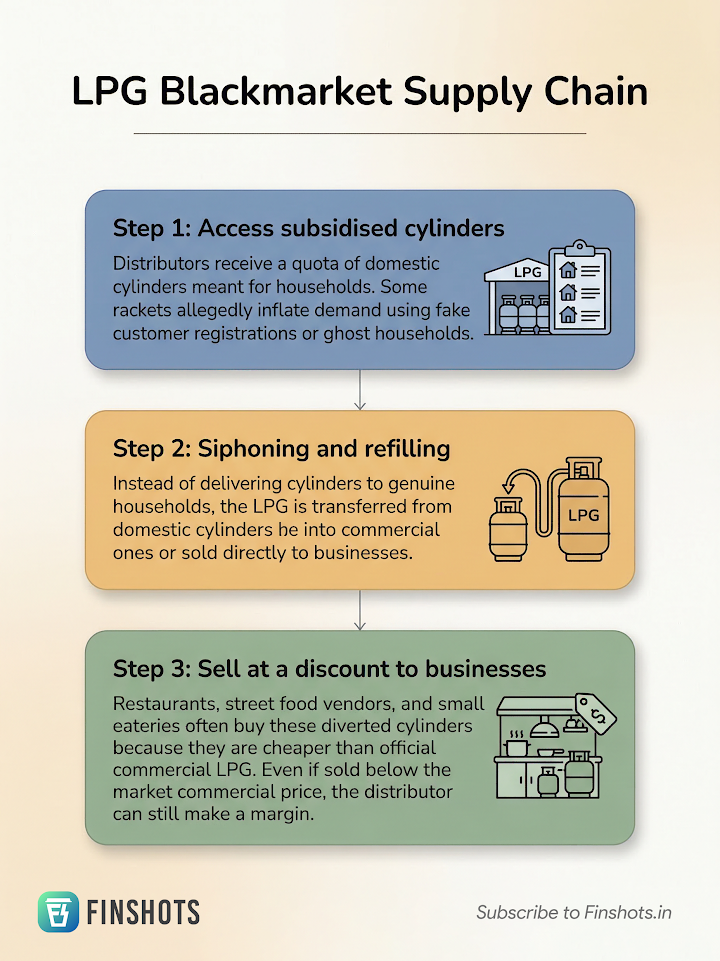
Police investigations suggest that the diversion chain follows a predictable pattern.
First, access to subsidised cylinders is secured. Distributors receive quotas intended for household delivery, but rackets may inflate demand by using ghost households or fake registrations to increase their allocations.
Second, the gas is siphoned. LPG from domestic cylinders may be transferred into commercial cylinders or sold directly to businesses in smaller containers.
Third, the diverted cylinders are sold at a discount to commercial users. Restaurants, street vendors, and small eateries often prefer these unofficial cylinders because they are cheaper than officially priced commercial LPG. Even when sold below the official commercial rate, the distributor can still earn a margin.
The system persists because each participant benefits in the short run. The distributor earns the price difference. Businesses generally receive cheaper fuel. And enforcement remains difficult because the distribution network is so extensive.
The unintended consequence is that genuine households may face longer waiting periods for refills. In some cases, households that cannot obtain official refills quickly enough are pushed toward the same informal market that created the shortage.
And this, folks, reveals a paradox.
India’s LPG programme succeeded in expanding access to clean cooking fuel. But the same subsidy programme that supports households has also created a price distortion large enough to sustain a parallel market.
Direct benefit transfers were originally designed to reduce leakages by transferring subsidies directly to beneficiaries rather than intermediaries. Yet as long as domestic cylinders remain significantly cheaper than commercial ones, the incentive for diversion remains embedded in the system.
The more durable fix lies in redesigning how the subsidy works. If domestic and commercial cylinders are priced closer to market levels and subsidies are directly transferred to verified domestic customers’ bank accounts, the incentive to siphon cylinders would largely disappear. Technology could further strengthen this through improved refill tracking, stronger identity verification, and real-time monitoring of distributor behaviour.
Until that happens, the LPG programme will continue to live with an uncomfortable paradox. A policy designed to deliver clean fuel to household kitchens will continue to create opportunities for diversion, where those same cylinders find their way into restaurants and street stalls instead.
Ultimately, the LPG diversion problem is not simply about shortages. It reflects how such programmes can unintentionally reshape market incentives and pose consequences.
If this story helped you understand the paradox behind India’s LPG programme, feel free to share it with your friends, family or even strangers on WhatsApp, LinkedIn or X.
🚨Term Life Insurance Prices are About to INCREASE!
A prominent insurer is set to raise their term insurance rates in the next few weeks. This means if you don’t secure a term plan now, your premiums could significantly go up!
Here’s why this matters: When you purchase a term life insurance policy, you pay a premium or a small fee each year to protect against financial risks. In the unfortunate event of your passing, the insurance company pays out a substantial sum to your family or loved ones.
The best part? By buying early, you can lock in your premiums, ensuring they're not affected by any future rate hikes.
If you've been considering a term plan, now is the perfect time to act. To assist you in the process, our advisory team at Ditto is here to help. Click on the link here to book a FREE call with our IRDAI-certified advisors.